
Results
-
 £157.50
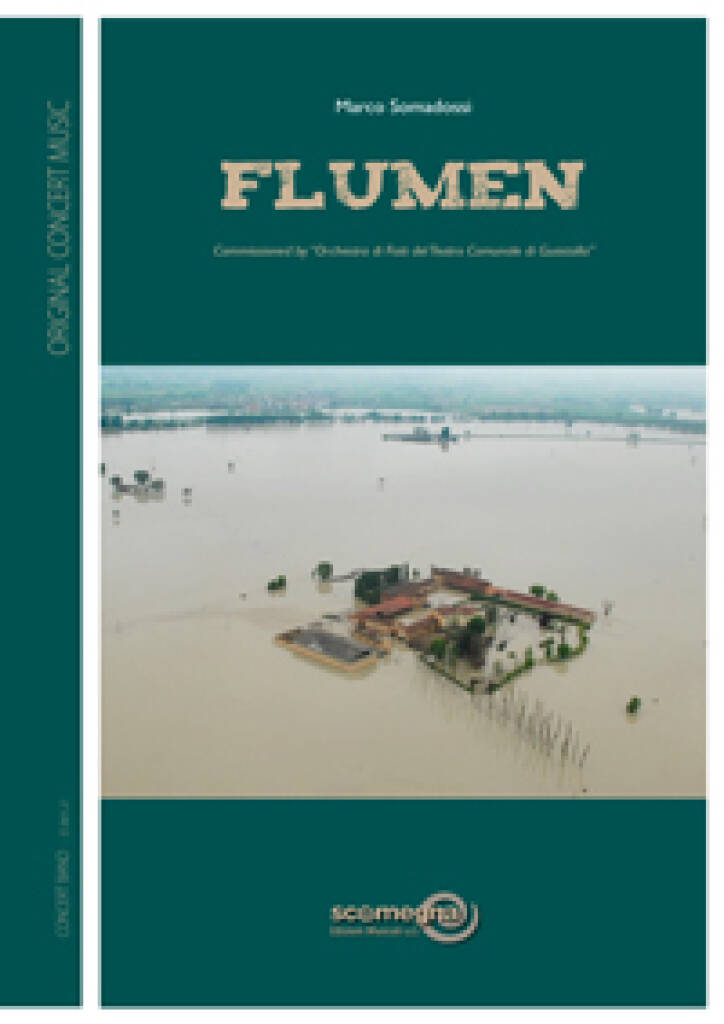
Flumen - Marco Somadossi
In October 2000, the River Po produced its highest flood waters in the last hundred years, provoking a natural disaster of dramatic dimensions. To the thousands of valiant men and women committed to defending their villages against the threat of the flood is dedicated the symphonic poem entitled "Flumen" (river, in Latin), inspired by the thematic material in the Gregorian sequence, "Victimae paschali laudes". The main melody is elaborated and its essence is transfigured in an alchemy of modern sounds from which, at times, archaic echoes emerge. The composition is structured in two parts: the first ("The River") is sullen and menacing, with sounds that portray the turbulent water and the inexorable and frightening rise of the flood;this contrasts with a second section ("The People"), with its primitive rhythms and vaguely multiethnic character (expressed through modal harmonies). Here the work evokes man's ancestral struggle against the forces of nature: the strenuous defence of the Po riverside communities to against the threat of flooding. In the finale, the two themes interweave and overlap, re-establishing a symbolic and primordial equilibrium where man and nature are again in harmony with each other.
Estimated dispatch 7-14 working days
-
 £54.99
Campfire Song - Porter Eidam
Just about everyone who has been to summer music camp has come home with a bucketload of fun stories about the many activities. Campfire Song has its origin in such a story and even includes the sound effects of a crackling campfire. The melody started as an inside joke in the form of a catchy, impromptu song that had its first and last performance at a camps season-end campfire. This setting is meant to be a fun selection - dont be surprised if audience members are humming the tune as they leave the auditorium!
Estimated dispatch 7-14 working days
-
 £159.99
Solemnitas - Franco Cesarini
Each year on the last Monday in June, the German city of Burgdorf celebrates the holiday of youth, the so called 'Solennitat'. It is the most important event occurring in the city and consists of three processions walking through the centre of town to celebrate, at the city's expense, the good results achieved in school. This new work by Franco Cesarini takes it's inspiration from this event and leads us through contrasting variations of a Swiss folk tune.
Estimated dispatch 7-14 working days
-
 £144.99
Jungle - Thomas Doss
In this fascinating piece we experience an exciting adventure in the jungle. The entrance into the "green hell" turns out to be very dangerous with wild monkeys and the roaring of elephants accompanying our way through the dark forest. There seems to be something lurking behind every tree and all of a sudden, a horde of savage cannibals appears. A wild hunt sets off and we escape at the last second by jumping from a cliff into the savage water below. Exotic birds welcome us in a new landscape and from somewhere in the distance we can hear a bamboo flute playing. This is a journey of no return.... The effects (elephants, wild monkeys, exotic birds and rain) should be producedwith much creativity - individual ideas are always desirable and welcome.
Estimated dispatch 7-14 working days
-
 £102.99
All the Best - Otto M. Schwarz
All the Best is a happy, upbeat piece by Otto M. Schwarz. He has already composed several pieces in this genre, including Fire & Ice, Last Call, and Funky Brass, and is constantly looking for ways to adapt new and interesting sounds and rhythms for concert band. All the Best will be a huge success with musicians and audiences alike, whether as a congratulatory piece, a concert-opener or as a rousing encore at the end of your concert.
Estimated dispatch 7-14 working days
-
 £154.99
About Reynard the Fox - Kevin Houben
We find ourselves initially at the court of King Nobel, where all the animals have arrived for a court hearing. Reynard the Fox has plenty to answer for but he seems determined to avoid his punishment... Kevin Houben chose this fable as the theme forhis programmatic work, in which the musical setting of the fox forms the main theme. But King Nobel, Braun the bear, Murner the cat and Grimbart the badger also take a musical turn. About Reynard the Fox promises excitement and adventure rightto the last note!
Estimated dispatch 7-14 working days
-
£159.99
Fantasia Per La Vita E La Morte - Bert Appermont
The mystique surrounding life and death formed the starting point of this composition. I wanted to write a work without a story, mixed up in a kind of musical quest for a new world of sound, original rhythm sequences, melodies filled with suspenseand distinct orchestral tones.The indirect cause was the birth of my first child which took place during this time, followed by the death of a close family member. At such a moment you experience just how close life and death are to each other, anddespite one being the antithesis of the other, they are incredibly similar. Both radical events are passages into new worlds and have great emotional impact. Moreover, the work was commissioned by "New Life", an orchestra that lost one of itsmusician in a plane crash, which also led me to believe that this approach would be appropriate.I would prefer not to comment on which passages in the composition concern life (birth) and which refer to death. It seems to me that it is moreinteresting to question traditional conceptions and leave it open for the listener. If you think that a passage is about birth, and this idea then shifts, it is this that raises fascinating questions, on both a musical and metaphysical level.Music isin an indirect but incredibly persuasive way in which to express the endless striving and seeking of mankind. Music can even touch eternity, as it were, and give us the feeling that we can transcend death. This endless search (and also longing) canbe heard throughout the work; as much in the sound fields and accent shifts in the first part as in the enormous tension curves and compelling themes of the second part. The semi-tone functions in this way as a guide or something to hold on to,running through the whole work and upon which much of the musical material is based. Traces of profound love resound with quiet simplicity in the slow section's melodious solos, after which the work contemplates life and death one last time, musesupon joy and sadness, on the possibilities and limitations of people and on the why of all things.I would like to dedicate this work to my dearest daughter Paulientje, to Meterke and to Johan de Jong of the "New Life" orchestra. May it fare themwell, here or in another dimension...
Estimated dispatch 7-14 working days
-
£264.99
Diferencias on an Old Spanish Song - Yasuhide Ito
I am immensely happy that my Gloriosa, symphonic poem for band (1990), has been performed by so many bands in the last thirty years.During this period, the growth of the internet has made it much easier to access information.When I composed Gloriosa, I only had limited information about the period when Christianity and Western music was first introduced to Japan, and had to rely a lot on my imagination.However, nowadays, it is easy to obtain various source materials and to read interesting studies on the music of the past.In recent years, the music of Luis de Narvez (born ca.1500 - died between 1555-1560), Spanish composer and vihuela player, has become increasingly known, and several CDs of his music are now available.Narvez composed the earliest-known set of diferencias, a forerunner of the variation form. One of his works is Seys diferencias sobre el himno "O gloriosa domina" [Six diferencias on the hymn "O gloriosa domina"] (1538), based on the Spanish Marian hymn, and it was this melody I used in the first movement of my Gloriosa.Western music has been my musical roots since childhood, and throughout my career as a composer, it has continued to fascinate me. One could say that this has provided the inspiration for Diferencias on an Old Spanish Song, my own take on the diferencias form.Actually, such music from the early sixteenth century could sound fresh to our modern ears. So I decided to quote the melody from Narvez's Sey diferencias at the beginning and end of the piece, in order that people can get the feel for the period.The main section (bars 42-390) is formed of 13 diferencias, similar to the first movement of the Gloriosa.In the middle section, which begins after the eighth diferencia(from bar 187), one should be totally absorbed in the tranquility and the beauty of the music. Although it's in the style of a sarabande, it should be taken slower and played as pianissimo as possible.This is followed by folk-style dance music. (As only standard percussion instruments are used, try to be creative with tonal colours and sense of rhythm).The structure of the work is simple, but be aware of the connection between the sections when constructing the whole.Also, think about the tonality. Overall, the work is in F minor. The main section is basically in D minor, but from bar 102, it modulates to A flat minor and G minor, and then in the middle section it suddenly switches to A flat major (which is the furthest key from D minor, and the relative major of F minor). From bar 219, it modulates to F minor and then to C minor, then back to F minor by way of A minor.N.B. The Oboe II part can be substituted by the English Horn (as indicated in the parts). One can choose according to the player's skills or preference.Recent new compositions for wind band are often full of rhythm, dynamism, and tonal colour, and compositional techniques and orchestration have also evolved greatly. Yet on the other hand, they tend to feature fewer melodic or expressive elements. Since this work is the test piece for WMC Kerkrade 2022, I had to think about what "tests" or "challenges" to set, and I decided to compose something that doesn't involve a lot of technical display, but requires beautiful sounds and harmonies, and above all, musical expressivity. I didn't put many expression markings in the score, because I wanted the performers to think about how best to express this music. If it is played merely as notated, it's not going to sound very interesting.Christianity was introduced to Japan in the mid-16th century, but it was subsequently banned and Japan entered a period of national isolation, which meant that there was hardly any international exchange for two hundred years. As a result, the Christian hymns that were introduced prior to the isolation became almost unrecognizable over the centuries. This was the theme I explored in my Gloriosa thirty years ago.Now, in 2021, the whole world has been forced to "isolate" due to the Covid-19 pandemic. In such times, it seems pertinent that I've written a work using this melody again. I sincerely hope that people will be able to gather in Kerkrade in 2022.(English Translation:Nahoko Gotoh)
Estimated dispatch 7-14 working days
-
 £239.99
The Three Musketeers, Op. 8 - Maxime Aulio
Les Trois Mousquetaires (The Three Musketeers) was commissioned by the Miraphone company for the Miraphone Tuba Quartett and the Musique des Gardiens de la Paix (Paris, France). It was premired in Guebwiller (France), on 28 June 2003 by its dedicatees.Even if you have never read a line of the mythical novel The Three Musketeers (1844) by Alexandre Dumas, father, you will at least have heard of the "four invincibles"; four extraordinary names - D'Artagnan, Athos, Porthos, and Aramis - and one unique motto "All for one, and one for all." The musical texture of Les Trois Mousquetaires is focused on specific elements of a character's personality rather thanon its influence on the book's plot. Maxime Aulio has largely turned his attention on D'Artagnan, the sensitive, romantic and perfect gentleman who is easily charmed by women such as the gentle Constance Bonacieux and the perfidious Milady de Winter whose beguiling beauty seduced him. The first movement - D'Artagnan - is true to the character of the young provincial noble of the Gascony region: heroic and enthusiastic in all circumstances. The second movement entitled Constance Bonacieux, is romantic, delicate and passionate. The third and last movement is as duplicitous as the bewitching femme fatale its reveals: Milady de Winter.
Estimated dispatch 7-14 working days
-
 £76.99
Allein Gott in der Hh' sei Ehr
Jacob de Haan begins his arrangement of the well-known hymn Allein Gott in der Hh' sei Ehr (All Glory Be to God on High) with a quotation from his own Missa Katharina, a mass for choir, soprano, and band. To this melody he sets the Latin text from the last part of the Gloria. The chorale is then heard after an interlude and can, at the director's discretion, be accompanied by the choir singing in either German or English. A perfect work for church concerts.
Estimated dispatch 7-14 working days
 View Music