
Results
-
 £204.99
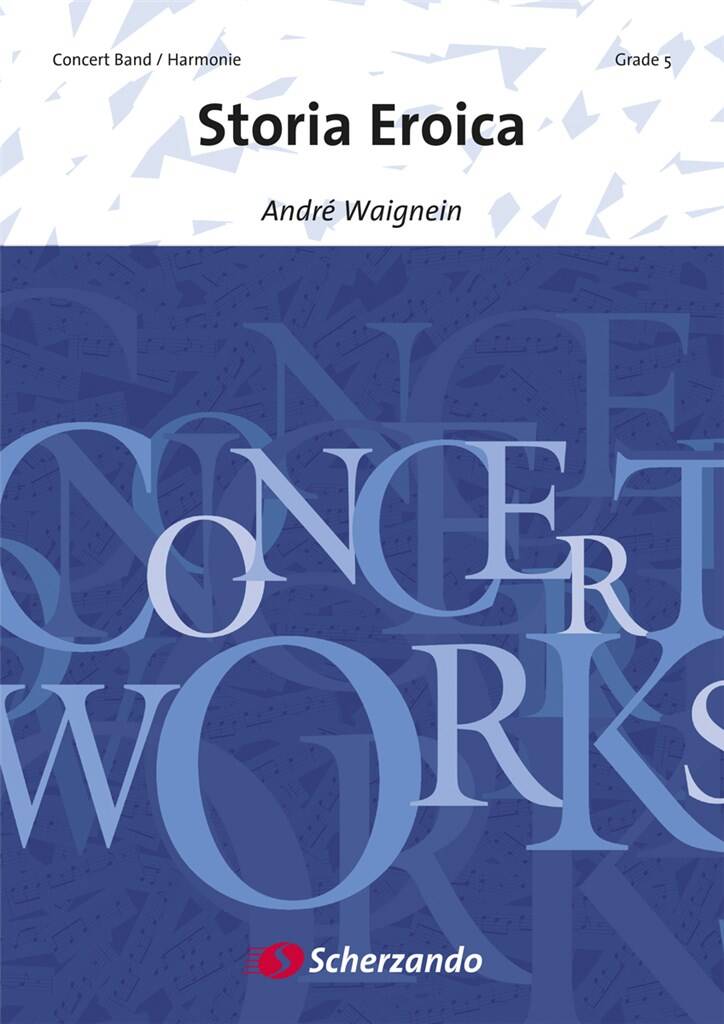
Storia Eroica - André Waignein
Andr Waignein received order of this composition of the "Municipal Brass Band of Luxembourg-Bonnevoie". It is in the presence of the Grand-Duke Heir Henri that took place first interpretation on January 24, 1998 with this orchestra, and with the composer as director.This work is a musical evocation describing this magnificent Luxembourgian region and her inhabitants.The overture evokes the serenity met in this region. An orchestrale development, as rhythmic as sound, propels the orchestra in a "military" atmosphere putting in evidence all the registers of the orchestra. This tension is maintained until the general explosion of the whole. One cantilena appears in all theinnocence. Gradually, the orchestration suppresses, until the exhaustion. The passage which follows represents the tempestuous events which took place through ages. A spectacular cadence, by the clarinet or by the soprano saxophone, terminates this desorder.An ample and lyric theme reflects the generosity which always played an important role. Then, having found some of initial themes, work ends in an atmosphere of enjoyment, developed in rich and eclectic one variety which proves the sphere of influence of the sound colour at Andr Waignein.
Estimated dispatch 7-14 working days
-
£159.99
Fantasia Per La Vita E La Morte - Bert Appermont
The mystique surrounding life and death formed the starting point of this composition. I wanted to write a work without a story, mixed up in a kind of musical quest for a new world of sound, original rhythm sequences, melodies filled with suspenseand distinct orchestral tones.The indirect cause was the birth of my first child which took place during this time, followed by the death of a close family member. At such a moment you experience just how close life and death are to each other, anddespite one being the antithesis of the other, they are incredibly similar. Both radical events are passages into new worlds and have great emotional impact. Moreover, the work was commissioned by "New Life", an orchestra that lost one of itsmusician in a plane crash, which also led me to believe that this approach would be appropriate.I would prefer not to comment on which passages in the composition concern life (birth) and which refer to death. It seems to me that it is moreinteresting to question traditional conceptions and leave it open for the listener. If you think that a passage is about birth, and this idea then shifts, it is this that raises fascinating questions, on both a musical and metaphysical level.Music isin an indirect but incredibly persuasive way in which to express the endless striving and seeking of mankind. Music can even touch eternity, as it were, and give us the feeling that we can transcend death. This endless search (and also longing) canbe heard throughout the work; as much in the sound fields and accent shifts in the first part as in the enormous tension curves and compelling themes of the second part. The semi-tone functions in this way as a guide or something to hold on to,running through the whole work and upon which much of the musical material is based. Traces of profound love resound with quiet simplicity in the slow section's melodious solos, after which the work contemplates life and death one last time, musesupon joy and sadness, on the possibilities and limitations of people and on the why of all things.I would like to dedicate this work to my dearest daughter Paulientje, to Meterke and to Johan de Jong of the "New Life" orchestra. May it fare themwell, here or in another dimension...
Estimated dispatch 7-14 working days
-
£264.99
Diferencias on an Old Spanish Song - Yasuhide Ito
I am immensely happy that my Gloriosa, symphonic poem for band (1990), has been performed by so many bands in the last thirty years.During this period, the growth of the internet has made it much easier to access information.When I composed Gloriosa, I only had limited information about the period when Christianity and Western music was first introduced to Japan, and had to rely a lot on my imagination.However, nowadays, it is easy to obtain various source materials and to read interesting studies on the music of the past.In recent years, the music of Luis de Narvez (born ca.1500 - died between 1555-1560), Spanish composer and vihuela player, has become increasingly known, and several CDs of his music are now available.Narvez composed the earliest-known set of diferencias, a forerunner of the variation form. One of his works is Seys diferencias sobre el himno "O gloriosa domina" [Six diferencias on the hymn "O gloriosa domina"] (1538), based on the Spanish Marian hymn, and it was this melody I used in the first movement of my Gloriosa.Western music has been my musical roots since childhood, and throughout my career as a composer, it has continued to fascinate me. One could say that this has provided the inspiration for Diferencias on an Old Spanish Song, my own take on the diferencias form.Actually, such music from the early sixteenth century could sound fresh to our modern ears. So I decided to quote the melody from Narvez's Sey diferencias at the beginning and end of the piece, in order that people can get the feel for the period.The main section (bars 42-390) is formed of 13 diferencias, similar to the first movement of the Gloriosa.In the middle section, which begins after the eighth diferencia(from bar 187), one should be totally absorbed in the tranquility and the beauty of the music. Although it's in the style of a sarabande, it should be taken slower and played as pianissimo as possible.This is followed by folk-style dance music. (As only standard percussion instruments are used, try to be creative with tonal colours and sense of rhythm).The structure of the work is simple, but be aware of the connection between the sections when constructing the whole.Also, think about the tonality. Overall, the work is in F minor. The main section is basically in D minor, but from bar 102, it modulates to A flat minor and G minor, and then in the middle section it suddenly switches to A flat major (which is the furthest key from D minor, and the relative major of F minor). From bar 219, it modulates to F minor and then to C minor, then back to F minor by way of A minor.N.B. The Oboe II part can be substituted by the English Horn (as indicated in the parts). One can choose according to the player's skills or preference.Recent new compositions for wind band are often full of rhythm, dynamism, and tonal colour, and compositional techniques and orchestration have also evolved greatly. Yet on the other hand, they tend to feature fewer melodic or expressive elements. Since this work is the test piece for WMC Kerkrade 2022, I had to think about what "tests" or "challenges" to set, and I decided to compose something that doesn't involve a lot of technical display, but requires beautiful sounds and harmonies, and above all, musical expressivity. I didn't put many expression markings in the score, because I wanted the performers to think about how best to express this music. If it is played merely as notated, it's not going to sound very interesting.Christianity was introduced to Japan in the mid-16th century, but it was subsequently banned and Japan entered a period of national isolation, which meant that there was hardly any international exchange for two hundred years. As a result, the Christian hymns that were introduced prior to the isolation became almost unrecognizable over the centuries. This was the theme I explored in my Gloriosa thirty years ago.Now, in 2021, the whole world has been forced to "isolate" due to the Covid-19 pandemic. In such times, it seems pertinent that I've written a work using this melody again. I sincerely hope that people will be able to gather in Kerkrade in 2022.(English Translation:Nahoko Gotoh)
Estimated dispatch 7-14 working days
-
 £174.99
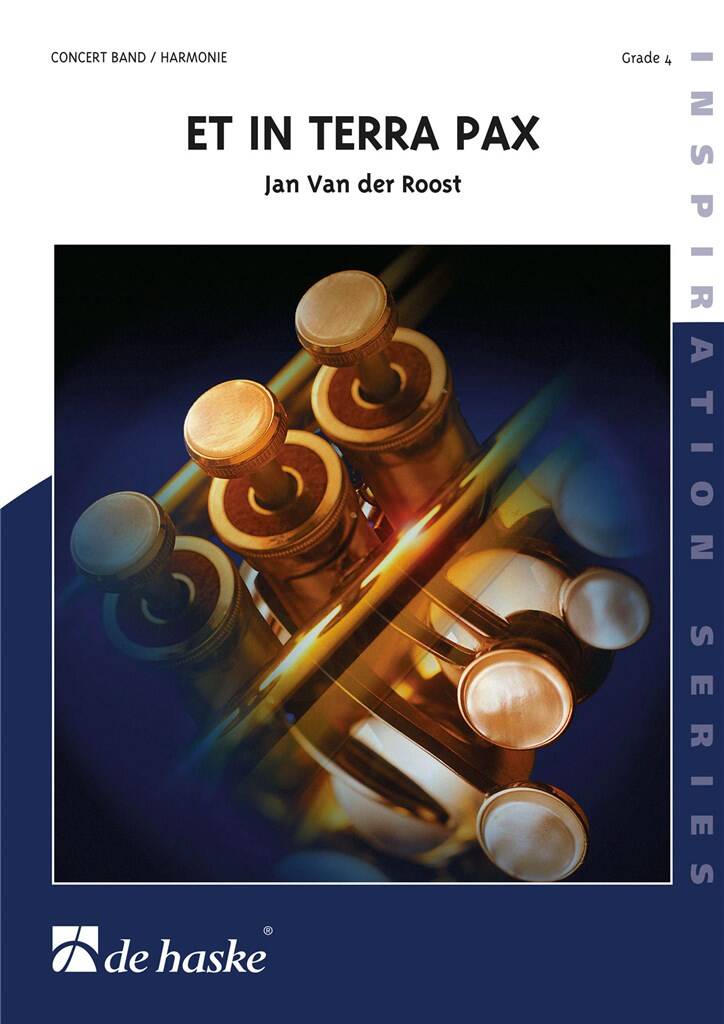
Et in terra Pax - Jan Van der Roost
This piece was commissioned by the 'Concert Band Vlamertinge' and is a plea for peace: the title translates as 'Peace on Earth'. This is expressed by means of the vocal contribution expected from the performers. In various places of the piece you can recognize, the words 'Et In Terra Pax' - an appeal for peace - at first jumbled together but later more rhythmically structured, developing into synchronized massed voices.The work starts with a pentatonic theme based on the notes D, E, G, A and C (taken from 'ConCErtbAnD VlAmErtinGE' and the name of the conductor, NiCk VAnDEnDriessChe). A somewhat sad melody is developed during an orchestral climax which leads to the firstexplosion of sound (measure 62 onwards). Suddenly the opening measures are recaptured, albeit with a differently colored sound: the words 'Et In Terra Pax' bring the first movement to a close. A restless Allegro follows which abruptly stops and is replaced by a calming cho-rale-like passage. A narrator reads aloud the poem 'Sonnet' by the young poet Charles Hamilton Sorley, who was killed during World War I. This poem fittingly puts into words the cruelty and senselessness of war. After the expanded recapitulation of the allegro, the broad, almost infinite atmosphere of the beginning returns. Clarinet and English horn play the pentatonic opening theme once more, this time broadly, while the words 'Et In Terra... Pax' are repeated again and again by the rest of the orchestra.The composer has purposely avoided all forms of aggression and bombastic sounds regularly used in works about war. Fear of violence and destruction can be heard and felt during the allegro passages. The charged opening makes way in the end for hope: May peacefulness replace cruelty in everyday life, too.
Estimated dispatch 7-14 working days
-
 £104.99
Do Not Go Gentle Into That Good Night - Elliot Del Borgo
The Dylan Thomas poem Do Not Go Gentle into That Good Night was the motivation for this musical composition. While not a programmatic depiction of the poem, the work attempts to recreate the essence of the poem in sound. Theopening motive, representative of the life force, permeates much of the work. The use of sound layers - in the form of polytonal hymns - calls to mind the struggles and persistence of the human spirit and its refusal to go gentle.A substantial and dramatic work for mature ensembles. Dur: 11:15 (Grade 5)
Estimated dispatch 7-14 working days
-
 £98.50
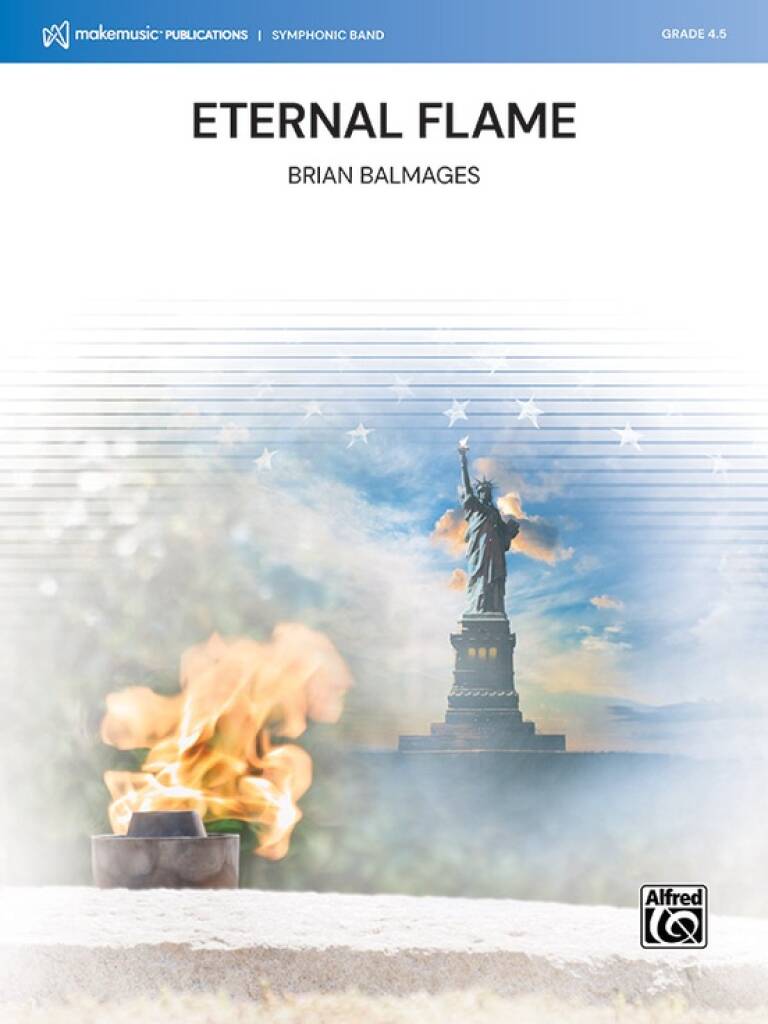
Eternal Flame - Brian Balmages
This thrilling and majestic overture by Brian Balmages pays homage to the only eternal flame memorial in the United States dedicated to Medal of Honor recipients. Subtle nods to "America" remind the listener of the incredible sacrifices made by these brave individuals. While the piece is not overtly patriotic, the olympic-style fanfares and stately themes make it more than suitable for such an occasion! (5:40)Recorded sound courtesy of the U. S . Marine Band. Use of the recorded sound does not constitute or imply endorsement by the Department of Defense, U.S . Marine Corps, or U. S. Marine Band.The terms U.S . Marine Band and "The President's Own" are trademarks of the U.S . Marine Corps, used with permission.
Estimated dispatch 7-14 working days
-
 £109.99
Catedrales - Bert Appermont
Cathedrals have always appealed to the imagination. Hundreds of years of manpower have been invested in their building and it is not for nothing that today they represent imposing symbols of architecture and history. The cathedral is also a great source of inspiration for compositions, drawing on a full palette of acoustic echo effects, Gregorian melodies and organ based choral themes.The work "Catedrals" opens with a five tone motif using double tonguing which resonates through space. Then comes a Gregorian antiphonal theme "Salve Regina" which is heard in the euphonium and later combines with the opening motif. The quicker passage that follows is basedentirely on the intervals in the motif which by now has added rhythmic variations and develops in different forms, including a fugue. The work then builds towards its first climax, from which unusual muted sounds emerge creating an atmosphere shrouded in mystery.Gradually, more melodious fragments are added to the Gregorian antiphonal theme which develops into an expansive choral, emulating the organ and which rises above the sound mass. The work grows more powerful and brilliant in sound until it culminates in a short and explosive finale wherein elements from the whole work come together.
Estimated dispatch 7-14 working days
-
 £115.60
Hard to Say I'm Sorry - Peter Cetera
"Hard to Say I'm Sorry" is one of the greatest hits by US rock band Chicago. It was the first single record from the "Chicago 16"-album (1982). The song went to no. 1 on the Billboard charts and stayed there for two weeks. Produced by David Foster, the song was given a typical early 80's sound with synthesizers and heavy guitars dominating the sound. The album-version of the song included a part two of the song, "Get Away", a up-tempo song featuring the famous horn-section of the band.
Estimated dispatch 7-14 working days
-
 £84.99
Trumpet Fiesta - André Waignein
Trumpet Fiesta spotlights four trumpet soloists. From the opening bars the music expresses a feeling of happiness. This swift and lively piece begins with a series of dynamic staccato passages from the soloists. The central section, in the minor key, contrasts with the beginning of the work and during this transition period there are only two solo trumpet parts. The first theme then quickly reappears before moving on to a peaceful and more melodic trio in which long and flowing melody lines allow the soloists to let the beautiful sound of the trumpet fully reveal itself. The sound pyramid then formed by the whole band leads this spectacular piece to a powerful finale.
Estimated dispatch 7-14 working days
-
 £134.99
Absolute Crossover - Otto M. Schwarz
This composition is made up of three themes, which feature all thefacets of the instrumentation of a concert band as well as that ofa big band. The symphonic passages, reminiscent of film music,enable the full tone and colour of the concert band to be heard,whilst the big band sound is represented in the rock segments andslow swing sections. The musical journey travels along practicallyall styles, ending with an impressive tutti, in which the shufflerhythm of the big band melts together with the grand, classic filmmusic sound of the concert band.
Estimated dispatch 7-14 working days
 View Music