
Results
-
 £72.99
Dixieland on Parade (Concert Band - Score and Parts) - Brown & Henderson
The late Luther Henderson was a master arranger with a long list of credentials, including behind-the-scenes collaborator for many years with Duke Ellington. In addition, he served as a primary arranger for the Canadian Brass, creating over 130 arrangements for this storied brass ensemble. Here is a marvellous medley of Luther's arrangements adapted for concert band by Michael Brown.Includes:Sugar BluesRoyal Garden BluesThat's a Plenty
Estimated dispatch 7-14 working days
-
 £164.95
Chivalry (Concert Band - Score and Parts) - Ellerby, Martin
This 'Symphonic Tone Poem for Brass and Percussion' was commissioned by Philip Biggs and Richard Franklin for the 2003 All England Masters Brass Band Championship. The work transfers well to the concert band and is already being featured around the world. It is based on two principle themes of love and war which compete against each other in what can be broadly described as a cinematic structure.Performance time 14'05"Recorded on QPRM 150D CHIVALRY, Royal Northern College of Music Wind Orchestra
Estimated dispatch 7-14 working days
-
 £37.95
Chivalry (Concert Band - Score only) - Ellerby, Martin
This 'Symphonic Tone Poem for Brass, Wind and Percussion' was commissioned by Philip Biggs and Richard Franklin for the 2003 All England Masters Brass Band Championship. The work transfers well to the concert band and is already being featured around the world. It is based on two principle themes of love and war which compete against each other in what can be broadly described as a cinematic structure.Performance time 14'05"Recorded on QPRM 150D CHIVALRY, Royal Northern College of Music Wind Orchestra
Estimated dispatch 7-14 working days
-
 £58.50
Delmar Festival Overture (Concert Band - Score and Parts) - O'Reilly, John
Delmar Festival Overture is a powerful concert overture utilizing many of the contemporary compositional techniques that distinguish John O'Reilly's work. From the opening brass fanfare to the exciting conclusion, syncopated rhythms and numerous, interesting shifts of meter abound. Biting polychords establish the predominant harmonic structure for the opening "Allegro," but the majestic theme that follows in the horns and saxes takes on a decidedly British band style. The lyrical middle section begins with a fully scored chorale, which serves as the subject for a lovely melodic development featuring woodwinds and French horn. A brilliant brass fanfare ushers in a return to the opening section, which is now reorganized and further developed to bring this exciting overture to its dramatic conclusion. A great concert opener that will show off the talents of your musicians! Duration: 4.45
Estimated dispatch 7-14 working days
-
 £66.95
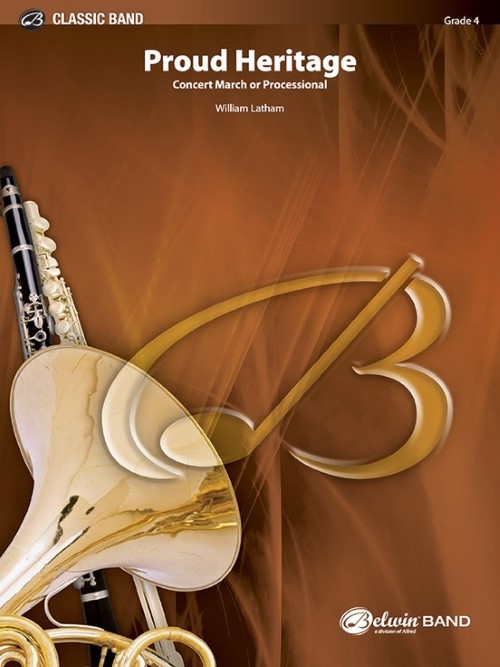
Proud Heritage (Concert Band - Score and Parts) - Latham, William
This timeless march succeeds equally well as a processional or as a concert march. Development of the legato reeds and low brass is punctuated by powerful and brilliant brass tonalities. The combination of these attributes with an array of tone colours assures perpetual recognition as an exceptional march. Duration: 3.00
Estimated dispatch 7-14 working days
-
 £58.50
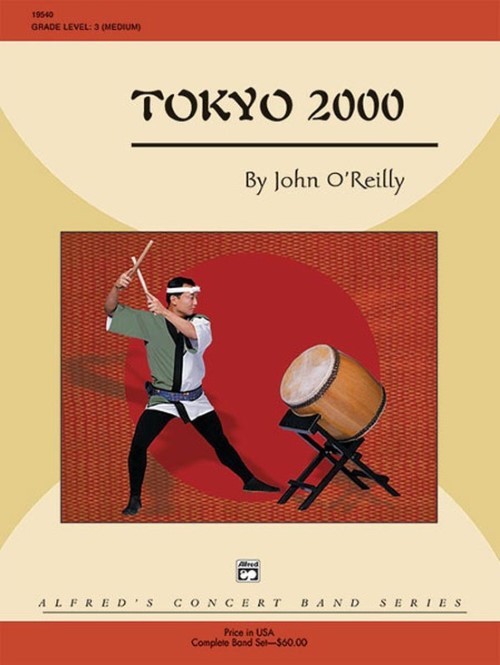
Tokyo 2000 (Concert Band - Score and Parts) - O'Reilly, John
Tokyo 2000 begins with a haunting pentatonic flute passage, which is immediately answered by tom-toms and timpani that evoke the sounds of the classic drums of Kyoto. Stark brass pyramids and fluid woodwind passages set the stage for the exciting "Allegro," combining pentatonic melodies with contemporary polychords and interesting syncopated rhythms. A chorale-style middle section showcases the brass, only to lead back to the main theme and a rousing coda to bring the work to a magnificent finish. Let John O'Reilly take you and your band to Tokyo on your next concert! Duration: 5.45
Estimated dispatch 7-14 working days
-
 £164.95
Music for a Festival (Concert Band - Score and Parts) - Sparke, Philip
Music for a Festival was originally composed for brass band and used as a test piece in the National Brass Band Championships of Great Britain. The wind band transcription was commissioned by Chris Hooker for the Hounslow Youth Wind Orchestra and first performed by them in May 1989 with the composer conducting. This work falls into three movements which are played without a break. The outer two movements are full of energy and surround a tender central section with delicate quartet writing and a broad climax for the whole band.Duration: 12.30Recorded on QPRM115D GREAT BRITISH MUSIC FOR WIND BAND, Western Band of the Royal Air Force
Estimated dispatch 7-14 working days
-
 £19.95
CAMBRIAN SUITE (Prestige Concert Band Extra Score) - Ball, Michael
Extra Score. This suite - originally a brass band work - was commissioned jointly by the Black Dyke Band and the Brass Band Heritage Trust. The composer later made this version for concert band. The work is intended to be played without a break but divides naturally into three sections. Each section is based upon a traditional Welsh melody treated in free variation manner, respectively Gwyr Harlech (Men of Harlech), Suo-Gan (Cradle Song) and Codiad Yr Hedydd (The Rising of the Lark). There is a momentary reference to Yr Deryn Pur (The White Bird) at the end of the second section. (Grade 4) Performance time: 12:00 Recorded on Polyphonic QPRM152D MOSAIC: Great British Music Vol. 13
Estimated dispatch 7-14 working days
-
£99.95
CAMBRIAN SUITE (Prestige Concert Band Set) - Ball, Michael
Score and Parts. This suite - originally a brass band work - was commissioned jointly by the Black Dyke Band and the Brass Band Heritage Trust. The composer later made this version for concert band. The work is intended to be played without a break but divides naturally into three sections. Each section is based upon a traditional Welsh melody treated in free variation manner, respectively Gwyr Harlech (Men of Harlech), Suo-Gan (Cradle Song) and Codiad Yr Hedydd (The Rising of the Lark). There is a momentary reference to Yr Deryn Pur (The White Bird) at the end of the second section. (Grade 4) Performance time: 12:00 Recorded on Polyphonic QPRM152D MOSAIC: Great British Music Vol. 13
Estimated dispatch 7-14 working days
-
 £77.22
Carolina's Majesty
Carolina's Majesty captures the grace and beauty and of the Blue Ridge Mountains. Opening with a dialogue between brass section fanfares and lyrical woodwind statements the piece quickly develops into a soaring melody first heard in the woodwinds and then passed through the brass section. The slower middle section weaves the flowing melodic material between all choirs of instruments and a unique fugue inspired by the opening melodies leads us to a majestic and energetic conclusion. With emphasis on melodic development throughout the composition, this powerful composition is an excellent choice for any concert or contest setting.
Estimated dispatch 7-14 working days
 View Music