
Results
-
 £59.40
Who Will But Let Himself Be Guided - Bach, Johann Sebastian
The 13th in this now classic series of transcriptions and adaptations of the music of Bach for winds by one of the masters of this highly sensitive art. Featuring the woodwind and saxophone choirs throughout this noble setting of an earlier Bach chorale tune achieves a beautiful sonority and will delight both player and audience.
Estimated dispatch 7-14 working days
-
 £115.60
Jyn Erso Theme - Michael Giacchino
After seven soundtracks written by John Williams for the Star Wars. the music for Rogue One A Star Wars Story is composed by Michael Giacchino. Giacchino is one of the leading composers of film music today with soundtracks for "The Incredibles", "Star Trek", Zootropolis", "Inside Out", and TV-series "Lost" as his greatest achievements. With his music to "Rogue One", Giacchino puts his own mark on the new Star Wars movie but with natural influences by "the master" himself John Williams.. Jyn Erso Theme portraits one of the new characters of the "Rogue One" movie. British actress Felicity Jones plays the role of Jyn Erso in "Rogue One"
Estimated dispatch 7-14 working days
-
 £211.80
Karneval i Paris - Johan S. Svendsen
Johan Svendsen (1840-1911) composed "Carnival in Paris" in 1872, inspired by the energy and vibrancy of the Parisian carnival celebrations. The piece showcases a variety of moods and orchestral colours, ranging from jubilant and playful sections to more lyrical and elegant passages. It is a lively and colourful work that reflects Svendsen's skill in orchestration and his ability to capture vivid, festive atmospheres in music. In "Carnival in Paris", his Nordic musical roots meet the cosmopolitan influences he encountered while living and working in major European cities. The work has become one of Svendsen's most popular and is frequently performed in concert halls and festivals. About My Transcriptions for Wind Bands Ever since I started playing the clarinet at 8 or 9 years old in the school band "Blveisene" in my hometown of Gjvik, playing transcriptions of orchestral music has been a natural part of the repertoire. In regional bands, Norway's National Youth Band, and during my 10 years in a Military band, I played many such transcriptions. These transcriptions often included handwritten parts, masterfully crafted by colleagues in a time when music notation software didn't exist. Similarly, the scores were often incomplete, typically featuring just a solo clarinet part and condensed score in Bb. The transcriptions also contained parts for instruments like the Eb cornet and multiple tenor horns, but no saxophones, which made them less suitable for modern wind bands. The rise of many skilled Concert Bands and the increasing demands for scores and accessibility made me realize that someone needed to preserve this tradition. The reason I've transcribed these works is to ensure that you can play or conduct a repertoire that I believe has a rightful place in Norwegian Wind Band tradition. These transcriptions are my contribution to preserving some of the unique works in Norwegian music literature. Creating a transcription is a complex task, and I believe the score of "Carnival in Paris" is one of the most intricate I've undertaken. The first part of the process involves entering the entire orchestral score into music notation software. This is time-consuming and requires meticulous work. The next step is to check several editions to see if there are any discrepancies. Mistakes are often found in orchestral material, which can lead to further errors in the transcription. After that, I listen to many different recordings while following along with the score, paying attention to how different conductors emphasize balance and timbre. Gradually, I begin to note down passages I believe will work well for wind bands. One particular challenge in this piece is that the woodwinds and strings operate in the same register. In the original, the tonal difference between the strings and winds helps to clarify the individual musical lines. In the transcription, I've tried to address this by separating the lines, for example through octave adjustments, and highlighting them without compromising other aspects. I've also used some mallet percussion to broaden the tonal palette. There are countless decisions to be made to create a product that will hopefully allow future generations of wind band musicians to play this repertoire. - Stig Nordhagen -
Estimated dispatch 7-14 working days
-
 £149.40
The Battle of the Hats - Øystein Sjøvaag Heimdal
The word svimesltt, which is the title of this piece in Norwegian, has two meanings. One meaning is "knocked out", whilst the other, "sltt", means a folk melody/dance.Svimesltt is one of several folk dances, all of them with humorous titles, originally written by ystein Olsen Vadsten. Norwegian culture is the basis for these dances, both rhythmically and melodically. The accompaniment has brought this funpiece into the 21st Century.When it comes to Svimesltt, it is the traditional dance "halling" that is the inspiration. Halling is a rather wild dance, where the man tries to win the heart of a lady by attempting to kick a hat off a stick,held up in the air. This iswhere "The Battle of the Hats" gets its distinctive name A truly Norwegian tradition.The composer wanted to write a "crazy" melody, which highlights how "knocked out" a man can be by love, as he tries to win the chosen ones heart.
Estimated dispatch 7-14 working days
-
 £193.20
CASTRVM - Lionel Beltrán-Cecilia
CASTRVM is a symphonic episode inspired by four of the main civilizations that have coexisted over time in Ulldecona's Castle. With its melodies and sound effects, the composer tries to transport the listener through a trip to four uninterrupted movements, from the beginnings of this small settlement, creating a natural atmosphere recreated by the voice and the singing of birds to take us into the history with the first inhabitants, the Iberians, giving strength to the introduction of the composition, to move on to the time of the Andalusians, which with a melody in the form of a dance marked by percussion will transport us to take a walk in the surroundings of its circular tower. Next, and with strength, we arrive at the medieval and Christian period, marked in the score by the brass instruments, in this fragment we find moments that take us into the church of "Santa Mara de los ngeles", with melodies that evoke resonance and pomposity, continuing until we find the immense square tower, symbol of the fortress and homage, finally used as a prison and arsenal of those times. Then, there is a small slow march that will move us to some measures of strong stridency to finish with the whole section of low brass having its great moment of prominence, down to we reach the last part, Qna, a name that is recited during the musical piece and one of the names given in the past to the area that could be seen from the castle, where the change of location of the new town is recreated leaving the castle site, but always looking at it with respect and admiration as at the beginning of what is now the current Ulldecona, in this part, the composer plays a bit with a very well-known and significant melody for the inhabitants of Ulldecona, the "Jota Vieja", first making a reflex effect of all its melody and then only with the first six notes of this one, which builds a bridge until reaching the march and, later, the grand finale of this symphonic episode. The work was commissioned by Ulldecona Town Council and the Ulldecona Music Band, led by its conductor Joan Nadal i Girona, to commemorate the 800th anniversary of the donation of the Town Charter of Ulldecona "the old" (1222-2022), as part of the PATRIMONIUM 20.22 programme, "La Banda (Sonora) del Castell" (The soundtrack of the Castle).CASTRVM consists of: I.Iberians: stone and ironII.AndalusiansIII.The square tower: fortress and homageIV.Qna
Estimated dispatch 7-14 working days
-
 £435.40
Goldberg 2012 - Svein H. Giske
The first time I heard Bach's Goldberg Variations was in the movie Silence of the lambs, in the early 1990s. I noticed the beautiful background music in one of the scenes, but at that time I didn't know what it was. A few years later, when I was studiying at the Grieg Academy, I got to know the entire piece. For me, this is a piece of music which I can listen to countless times. I think it sounds as fresh today as it did more than 15 years ago and it never ceases to inspire me. Both Bach's composition and Glenn Gould's famous 1955 recording (which was the first one I heard) still makes a great impression on me. Before Gould recorded it at age 22, it wasn't a highly ranked piece amongst pianists and Bach was by many viewed as a bit old-fashioned. The young Canadian turned all this around. He managed to portray Bach in a reformed way, producing fine nuances in phrasing and making the many layers in Bach's music more transparent than anyone before him. Thus he plunged both himself and Bach (back) onto the international music scene. When The Norwegian Band Federation (NMF) asked me to write the test piece for NM in 2012, it was only natural for me to use the Goldberg Variations as a starting point and inspiration for my work. Since I was a teenager at NMF's summer courses in the mid eighties I've always listened to many different styles of music. Growing up in Sunnmre with the Brazz Brothers as teachers and mentors, jazz-, pop/rock- and folk music were early on a natural part of my musical background. I also have my classical education from the Grieg Academy on trumpet. As the title of my piece implies, I've wanted to bring Bach to the present and put his music into various modern musical landscapes. I think you can bring about a special kind of energy when music from different genres are mixed and I've tried to do this by mixing Bach with artists and musical styles from the present. In Goldberg 2012, the music is often constructed by several layers, which in a way are living parallel musical lives. They are seemingly moving or floating freely, almost unaware of each other, but bound together by the same basic pulse. The rythms, however, are often notated on a different rythmic subdivision level than the usual 8th- or 16th note levels. By doing this, I hope to achieve transparent sounds that rythmically are perceived as more free and detached from each other. In large sections of the piece, pop/jazz is fusioned with elements from Bach. I guess you could have this little scene as a synopsis for the piece: picture a group of musicians meeting: some are classical performers, some are jazz. They start to improvise together, each in their own voice or musical dialect and I'm sort of in the middle, trying to write down what they are playing. This is what I feel much of Goldberg 2012 is about. The foundation of the piece, in addition to Bach and references from pop/jazz music, lies also in my own material. This material, basically two chords, is heard in it's purest form in the 1st movement. I use these chords to create scales, new chords and different motifs which contribute to blend together the different moods of the piece. It has not been my intention to copy Bach's form (theme and 30 variations), but rather to use the bits and pieces that I like the most as an inspiration for my own variations. The 1st movement, Aria 2, is for my 3rd son, Olav, who was born on the 21st of April 2011, and the 5th movement, From long ago, is dedicated to the memory of my father, Svein J. Giske, who passed away on the 6th of June 2011. -Svein H. Giske, January 2012-
Estimated dispatch 7-14 working days
-
 £244.00
Anemoia - Gauthier Dupertuis
Gauthier Dupertuis wrote Anemoia as part of his master's thesis at the Lausanne University of Music. It is dedicated to the most significant figure in his musical life: his teacher Jean-Claude Kolly.Anemoia is the name given to the feeling of nostalgia that one feels for a time that has never known. This emotion often translates into the uneasy sensation of having lost something important or of not living at the right place or time. Fascinated by this concept, Gauthier Dupertuis tried to translate it into music oscillating between exaltation, anguish and nostalgia.The piece is formed by two movements: (Un)desired sorrow and Behind the glass of time. The first movement initially evokes the feeling of unease one feels when suddenly struck by anemoia. It then evolves into majestic atmospheres, marking our admiration for times gone by. The second movement treats anemoia in a more melancholic way.The premiere took place on 6th December 2024, during Jean-Claude Kolly's last concert as a conductor of the Concordia de Fribourg, marking thirty years spent conducting this wind orchestra.
Estimated dispatch 7-14 working days
-
 £138.00
The Saints And the Royal - Eric Swiggers
The Saints and the Royal was composed on behalf of Royal brass band St. Willibrord Heeswijk on the occasion of its 200th anniversary in 2023.When the marching band was founded in 1823, it was given the name "Harmonie Sint Cecilia," referring to Saint Cecilia, the patron saint of music. Around 1904, the name was changed to 'Kerkelijke fanfare Willibrord', strongly emphasizing the connection with the church in Heeswijk, of which Saint Willibrord is the patron saint. In 1973, at its 150th anniversary, the band received the predicate 'royal'. From that time on one speaks of the Royal brass band Saint Willibrord.The composition musically depicts both Saints Saint Cecilia and Saint Willibrord and the jubilee royal brass band. Although one of the oldest musical societies in the Netherlands, this fanfare is alive and kicking and will celebrate its 200th anniversary in 2023. The composition therefore opens festively and energetically. The alto saxophone plays a recitative, the Gregorian "Cantantibus organis Caecilia virgo in corde suo soli domino decantabat" from the vespers of the feast day of Saint Caecilia, the patron saint of music. This is taken over by the full wood and soft brass group. After a brief, playful interlude, this chant is played by the full orchestra, like an organ, larded with circumambulations.St. Willibord was born in England but made the crossing to the Netherlands in 690 to preach the gospel as a missionary. This was far from harmless and he faced frequent uprisings. After his death he was buried in Echternach in Luxembourg. In this place he is commemorated to this day with the annual "Spring Procession" or "Dance Procession". This procession of Echternach went as follows until 1947: 3 steps forward, 2 steps backward. Hence we hear this procession back in a 5/8 measure: 3 + 2.After this procession, the Gregorian vesper of Sint Caecilia sounds one more time, leading the composition to a reprise of the opening: The jubilee Royal Fanfare Sint Willibord Heeswijk.
Estimated dispatch 7-14 working days
-
 £134.99
Cleopatra - Thierry Deleruyelle
Queen Cleopatra ruled Egypt for over 20 years. She is one of antiquity's best-known women, in particular because of her relationships with Julius Caesar and, above all, Mark-Anthony, but also because the cause of her death remains a mystery. The work is split into three parts and performed without breaks. The first section begins with a bright introduction representing Mark-Anthony. Dynamic in nature and reminiscent of military music, this characterises the Roman general. But soon after, another theme emerges, softer and more melodic, symbolising Cleopatra's femininity. The two characters then combine on a faster tempo. The middle section of the work depicts the love that Mark-Anthony and Cleopatra feel for each other. This passionate relationship lasted ten years and produced three children. This is expressed by a warm and intense theme, just like the beauty of the Egyptian queen. The third and last section opens in a determined and military mood. Mark-Anthony and Cleopatra were often apart, the Roman general was often away on a campaign. They met up in Alexandria to celebrate their triumph. But, as the targets of the jealousy and ambition of Octavius, Julius Caesar's son, the lovers are trapped and await the inevitable conquest of Egypt by the Romans. When Mark-Anthony heard the false news that Cleopatra had committed suicide, he ended his own life. The Queen of Egypt, for her part, was imprisoned shortly afterwards. The two lovers remain one of History's most famous couples. This piece was commissioned by the Wind Orchestra of the town of Antony, near Paris, directed by Philippe Rossignol, to mark its 90th anniversary.
Estimated dispatch 7-14 working days
-
 £100.00
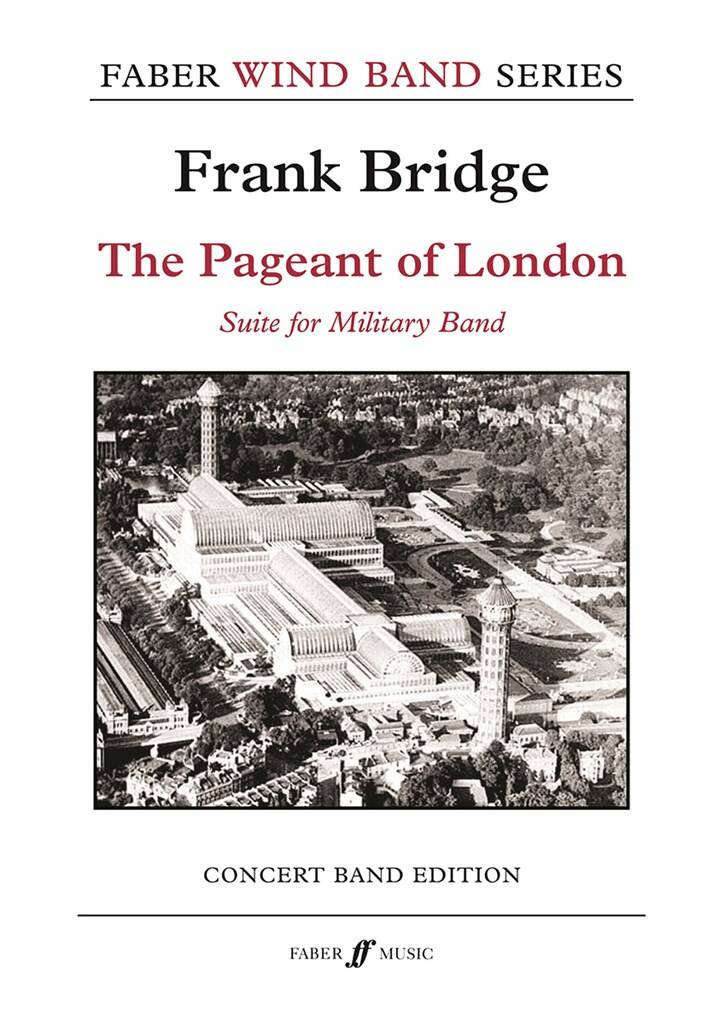
The Pageant of London - Frank Bridge
Frank Bridge was one of the finest English composers of the first half of the 20th century. The Pageant of London is his only work for wind band, comprising of two marches, one scored from Bridge's best known organ piece and including the chimes ofBig Ben, plus three short renaissance pastiche items, one arranged from Playford (later used by Peter Warlock in Capriol Suite). The music is tuneful, approachable and, in the words of wind band 'legend' Timothy Reynish makes a fine alternative toHolst's two suites, which were composed around the same time. Reynish has introduced this work to concert bands right across the world. It has been performed in USA and the Far East, recorded by the celebrated Kosei Wind Orchestra of Japan and alsoby the BBC National Orchestra of Wales in the Chandos edition of Bridge Orchestral Music.
Estimated dispatch 7-14 working days
 View Music