
Results
-
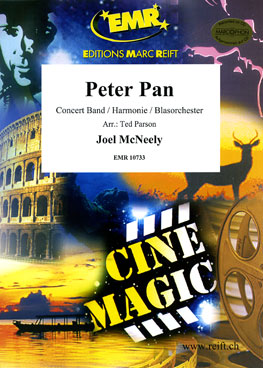 £176.00
PETER PAN (Advanced Concert Band) - McNeely, Joel - Parson, Ted
Includes: Main Title; Jane is Kidnapped; Hook and the Lost Boys; Jane Can Fly; Flight Through Neverland. Duration: 7:50
Estimated dispatch 7-14 working days
-
2nd Epitaph - Across the Water - Peter Meechan
This piece, as the title suggests, is the second Epitaph I have written, the first being Epitaph (for Hillsborough). '2nd Epitaph - Across the Water' was written for the Fountain City Brass Band, who are from the USA, to perform on D-Day landing beaches in Normandy, France.The title has a double reference point - the water between the UK and France, across which many troops (from the UK and the USA amongst others) travelled in the Normandy invasions, and also the water between the UK (the home of the composer) and the USA (the home of the band).
Estimated dispatch 5-14 working days
-
Apex - Peter Meechan
Apex is a solo which can be played on any instrument (the recording on this page is with the Chinese Er-hu). It was originally commissioned by Mark Bousie and David Armitage (President of Sellers International Ltd.) for the Sellers International Youth Band to perform at the Action Research Entertainment Contest in Blackpool, 2007.The accompaniments parts are simple, and they feature singing, as well plenty of percussion!Apex takes its title from the literal meaning of the word - the highest point.First performance:Sellers International Youth BandMark Bousie - ConductorJoe Murray - CornetPerformance notes:The singing parts are written in transposed pitch, and should be sung to an "ah" soundThe percussionists should feel free to add instruments (Such as bongos) and treat section C to the end as a guide, which they can change and build onFrom section C until the end, percussion parts 1 and 2 may be played by one percussionist on a drum set
Estimated dispatch 5-14 working days
-
Apophenia - Peter Meechan
"Apophenia is the experience of seeing patterns or connections in random or meaningless data."Apophenia is a trumpet concerto in three movements written for American trumpet virtuoso Rex Richardson. Each of the three movements features a different instrument; Movement 1 is for the Bb trumpet, the second is for flugel horn and trumpet, and the third is for trumpet and piccolo trumpet.Each of the three movements of Apophenia relate to the phenomenon of viewing Dark Side of the Rainbow - a name used to refer to the act of listening to the 1973 Pink Floyd album The Dark Side of the Moon whilst watching the 1939 film The Wizard of Oz, where moments where the film and the album appear to correspond with each other.Movement 1 is a fast a furious movement. Solo and ensemble interact at high tempo, swapping and creating new ideas, leading each other in new directions. Aside from the trumpet soloist, the kit player also acts as a quasi soloist.The second movement takes its musical inspiration from the Pink Floyd song Us and Them. It is during this segment of the film that some of the most amazing moments of connection happen.The final movement is a dance - and a tour de force for the soloist who begins on the Bb trumpet, before switching to the piccolo trumpet (or Eb trumpet) for the fast and furious finale. Many of the coincidences from Dark Side of the Rainbow relate to dancing, however, as long as a piece of music is the same tempo as the original, and the time signature is a regular one, this could be the case across most films. So the composer chose to write a dance that wouldn't synchronise to too many existing dance scenes!The soloist is free to improvise their own cadenza.Apophenia is dedicated to Rex Richardson.
Estimated dispatch 5-14 working days
-
Burn - Peter Meechan
Written for British clarinetist Linda Merrick, Burn was premiered by Linda in March, accompanied by Sheffield University Wind Orchestra (SUWO) conducted by Tony Houghton. The initial unaccompanied passage that opens the work was written during 2011's "Arab Spring", which dominated news reports of the time.The haunting soundtrack to these newscasts (which were a strange cocktail of devastating, uplifting, angry, mournful, rallying and peaceful) was the calls to prayer.There was no attempt whilst writing Burn (a title inspired by region's climate) to directly imitate these calls to prayer, but certainly they had an impact on the opening passage of the work, and therefore the whole piece.
Estimated dispatch 5-14 working days
-
Devil's Duel - Peter Meechan
Devil's Duel takes its inspiration from the story of the infamous Niccolo Paganini whose virtuosity was astounding. He began playing the violin at age seven, and by the age of 13 had the reputation of being the leading Italian violinist of his time. People began to speculate about Paganini's great talent, and began to wonder about his gift. He became known as a "Hexensohn" or witch's brat.Paganini's demonic reputation became so widespread that his talent was often attributed to the belief that he had help from the devil. Later in life, Paganini would tour Europe, though rumours of supernatural guidance never ceased. He would give concerts, and often "duel" with other virtuosi - "winning" by improvising during the contest (or concert!) by adding octaves, thirds, and sixths, and often playing more notes in a second than thought humanly possible.Devils Duel uses the famous music of Paganini's Caprice no.24 as its musical material, and sees the euphonium soloist duelling with various instruments in the band with displays of virtuosity in the fast music, and cunning in the slow.Devil's Duel was commissioned by David Thornton, to whom this is dedicated. The premiere was given by David Thornton, Nicholas Childs, and the Black Dyke Band at Leeds Town Hall, 26 May 2006.
Estimated dispatch 5-14 working days
-
Dreams Unseen - Peter Meechan
A number of traumatic global events over the past year have tested humanity. The global pandemic, racism, human rights issues, the discovery of thousands of unmarked Canadian Indigenous children's graves and climate change are testing humans' willingness to listen, hope and seek change. This three-movement work is a journey through silence, resistance and hope.Dreams Unseen begs the question, "Are we listening?"As people around the world endure and cope with significant loss, isolation, uncertainty and fear, Dreams Unseen contemplates the journey through uncertain times and is fraught with the complexities of today. As we continue to endure loss and uncertainty, we must have faith in resilience, goodwill and hope for a brighter future.Jacquie Dawson, August 2021Note from the composerWhen composing Dreams Unseen I was faced with a variety of decisions and complexities. Initially commissioned with the idea of conveying joy and hope as we emerged, or hoped to emerge, from a pandemic, too much happened around us in the world - locally, globally, and personally - that made the initial goal of the piece something that didn't represent so much that I saw.This made the selection of texts particularly difficult.As time passed, the texts originally selected became less and less appropriate to what I wanted to say, and, as the unmarked graves of murdered Indigenous children were uncovered throughout Canada on a daily basis, I felt compelled to move away from joy and the promise of hope to instead write about listening, to put hope in a more fragile, truthful context, to be grateful for those who never gave up, those who stood up in the face of all that was happening - the scientists, the leaders, people we've never met, people we know. It felt that the only way I could say all that I wanted to say as a composer was to write my own words.The first movement, In Silence, I ask us not to just hear, but to listen. It is only once we understand the truth that we can truly begin the process of reconciliation. The second movement, In Resistance, is my amazement at those who stood up in these times of adversity - specifically the scientists who saved our lives and those who continue to fight for what it right in the face of a seemingly impossible situation. I continue to believe that, because of those people, love will win, and lyrically I wanted to pay homage to that; The Beatles "In My Life" and Dr. King's "I Have A Dream" speech are both referenced.The final movement, In Hope, also takes existing words as an inspiration. The Rodgers and Hammerstein song "You'll Never Walk Alone" has been a song so close to my heart throughout my life, in the good times and difficult times alike. None of these times have been more difficult than losing a friend during the pandemic. His fight with cancer was driven by hope. A wonderful musician and human, he would also turn to "You'll Never Walk Alone" - so I chose this final movement to pay homage to the song, to my dearly missed friend, and to the idea that hope - for a better future, for a win against an almost unstoppable disease, for those whose voice is so often not heard to be listened to, and that Dr. King's words will come true - is everything.Pete Meechan, August 2021With funds from:Desautels Faculty of Music at the University of Manitoba - Jacquie Dawson, Director of BandsUniversity of Kansas - Paul Popiel, Director of BandsAnd the following commissioning partners:Arizona State University - Jason Caslor, Director of BandsGeorgia State University - Robert Ambrose, Director of BandsMarietta College - Nils Landsberg, Director of BandsNew Mexico State University - Michael Mapp, Director of BandsOregon State University - Erik Leung, Director of BandsThe Desert Winds - Charles Maguire, Artistic DirectorUniversity of Colorado Boulder - Donald McKinney, Director of BandsUniversity of Missouri - Brian Silvey, Director of Bands, and Amy Knopps, Associate Director of BandsUniversity of North Florida - Erin Bodnar, Director of BandsUniversity of Texas - Jerry Junkin, Director of BandsUniversity of Toronto - Gillian Mackay, Director of Winds ConductingValdosta State University - Ben Harper, Director of BandsWright State University - Shelley Jagow, Director of Bands
Estimated dispatch 5-14 working days
-
Elegie - Peter Meechan
The opening unaccompanied passage of this work was originally written as a short memorial piece for saxophone, but was later adapted as the basis of this more developed work for solo euphonium or trombone.The work uses a variation structure, with both the soloist and the accompaniment changing throughout the piece; the harmony, rhythm and melodic lines leading somewhere new and different each time they are heard - similar to the way our memories of a person often wander in different directions, but are still always focused on that person.
Estimated dispatch 5-14 working days
-
Episodes and Echoes - Peter Meechan
Episodes and Echoes is a concerto in three movements for tuba. The title of the work relates directly to the way the composer approached writing the piece."Although the work is scored with piano and wind band accompaniments, Episodes and Echoes was originally written for tuba and brass band. I had several problems to overcome - the brass band contains 4 tubas, and 2 euphoniums, all of which could obscure the solo line, so I decided to write for the soloist in a manner that meant they were either playing alone, in episodes, or repeating/echoing phrases."In addition to this, the composer combined the characteristics of the tuba with other instruments: in the second movement the tuba is similar to a singer performing an aria and a recitative, and third movement a bass guitar.Episodes and Echoes was commissioned by, and dedicated to, Les Neish who premiered the work in 2005, accompanied by the Beaumaris Brass Band, conducted by Gwyn Evans.The concerto has received many performances throughout the UK, as well as the rest of Europe.
Estimated dispatch 5-14 working days
-
Epitaph (for Hillsborough) - Peter Meechan
Epitaph (for Hillsborough) was written on the 20th anniversary of the Hillsborough stadium disaster, April 15 1989, in memory of the 96 victims. All of the victims were fans of Liverpool Football Club, the club I have supported since I was a young child.The disaster unfolded in front of the BBC television cameras, and due to the importance of the match (FA Cup semi final), millions, including myself, witnessed it first hand, leaving a lasting impression in the public psyche.Several features of the piece were determined by the tragedy. The length of the piece, 6 and a half minutes, represents the minutes of the game that were played that day (The match was abandoned after 6 minutes), and the final thirty seconds of the work, where the band gently applaud, is a reference to the first match played after the tragedy, a European Cup semi final between AC Milan and Real Madrid.After 6 minutes, the referee blew his whistle and all the players stood still where they were, both sets of fans applauded in memory of the perished, and the fans of AC Milan began singing You'll Never Walk Alone, the anthem of Liverpool Football Club.The work also features 96 strikes of the tubular bells, in memory of each person who lost their life.Epitaph is dedicated to the 96 people who died that day, and to their families whose fight for justice is an inspiration to all.
Estimated dispatch 5-14 working days
 View Music