
Results
-
 £82.50
Bravura - Robert E. Foster Jr.
This famous circus march has been a favorite of bands and audiences for years, and this well-crafted arrangement puts it easily within the reach of less experienced musicians. It will sound great with young players and provide a thrilling march addition to concert or contest programs. The solid and well-doubled scoring will sound impressive on any program and will provide the same feeling of excitement as the original.
Estimated dispatch 7-14 working days
-
 £121.00
Metro Dances - Travis J. Weller
Driving in Pittsburgh involves a fair amount of vehicular "dancing" in that theres rarely a direct route to get where you want to go. Metro Dances is a work in five sections about this driving experience. Hit the Gas! starts with a full cup of coffee and just a little less time than normal to reach our destination. Traffic "Jam" abruptly comes out of nowhere in true Pittsburgh fashion. Big Trucks appear, appropriately represented with important material for the lower winds. Next is Rush Hour, which features an optional open section with suggested solos for trumpet and alto sax. Finally, Breaking Free culminates with a brisk finish as traffic opens up and there's smooth sailing on a free and open highway.
Estimated dispatch 7-14 working days
-
 £92.00
The Supreme Diana Ross - Pi Scheffer
The American singer and actress Diana Ross was soloist with the popular female group 'The Supremes' from 1964 to 1969. With the song 'You keep me hanging on' the group was number one in the hitparade for twelve consecutive weeks. In 1970 Ross started a solo career both as singer and actress (Lady sings the Blues 1972). Many of her songs, such as Touch me in the Morning (1972), Love Hangover (1976) and Endless Love (1982) became extremely popular. The famous Dutch bandleader, composer and arranger Pi Scheffer made this splendid arrangement combining some of Ross's successful songs. The hits in this arrangements are: Do You Know, Reach out and Touch, Stop in the name of love
Estimated dispatch 7-14 working days
-
 £131.30
Hymns And Dances II - J. Slothouwer
In 1990 Jochem Slothouwer composed Hymns and Cances II. This work for symphonic band and harp (ad libitum) is based on Hymns and Dances I for piano, mixed choir and percussion. The compostition is based on the contrast between hymnlike melodies and dance music episodes. The work, in five connected parts, seems to look for a reconciliation of both melodic and rythmical elements. The initial theme with the horns and the answer of the band form the base of the first part.The second part, charcterized by a vitorous dance rhythm, is dominated by the percussionn and syncopated motifs with the brass. A melody with the euphoniums almost imperceptibly slips into the ensemble and gradually gets to the foreground. The dance and the hymn reach a real climax interrupted by a short and dark intermezzo (part three). The clear sonority of part four, a fiery tarantella with many small byt virtuoso solos, is a new contras. The final adagio reuses the previously developed ideas of part one and ends in sheer ecstasy.
Estimated dispatch 7-14 working days
-
 £61.00
Toccatino and Fugetta - Uri Hodorov
The American conductor and composer Uri Hodorov, actually working in Israel, has been inspired by the great Johann Sebastian Bach to write this original, light and rather easy 'toccata and fugue' for symphonic band. The title clearly indicates that, despite the references to the master's model, this composition is contemporary and rather short, in order to be within reach of the average wind band. A nice tribute to old father Back avoiding the ambush of the pastiche.
Estimated dispatch 7-14 working days
-
 £274.99
Pilgrim Concerto - Thomas Doss
The Pilgrim Concerto, written for the 2012 World Music Contest Kerkrade, is a highly demanding yet rewarding work for alto saxophone and wind band. It is one of a series of spiritual works by the composer which also includes Symphony inGreen. Sometimes minimalistic and at other times romantic, it describes a pilgrim who is at times calmy meditative, but also full of anxious impatience to reach his goal.
Estimated dispatch 7-14 working days
-
 £53.95
Floating - Todd Stalter
With dream-like harmonies and arcing melodies,Floating, by Todd Stalter, is a musical journey of relaxation and mindfulness. Perhaps riding in a hot air balloon, lying on an inflatable in a pool, being on a boat in a river, or simply relaxing and daydreaming come to mind as the music evokes peaceful feelings and emotions via interesting textures. All technical demands are well within the reach of young performers, providing opportunities for the development of musical expression and nuance.
Estimated dispatch 7-14 working days
-
 £71.50
Follow The River - James Swearingen
This haunting and distinctive work is based on a novel by celebrated author/historian James Alexander Thom. Melodies in both minor and major tell the 1755 true account of a young woman who, after having escaped from the Shawnee Indians, tries to find her way home. With the Ohio River as her guide, Mary Ingles begins a one thousand mile journey through the wilderness in her valiant attempt to reach that goal. The addition of intriguing percussion parts and optional piano/synthesizer makes this remarkable story set to music a must for every library. Very effective!
Estimated dispatch 7-14 working days
-
 £78.99
The Flight of the Bumble Bee - Nikolai Rimsky-Korsakov
This famous orchestral work from the Russian master Rimsky-Korsakov is now available in this ingenious arrangement for concert band. While previous band transcriptions of this work have long been the nemesis of clarinet sections, this arrangement cleverly dovetails moving lines between clarinets, flutes, and alto saxophones, making the technical aspects of this piece accessible to better high school bands. Not simplified, but through clever scoring this work comes within reach of maturing bands. Well worth the effort!
Estimated dispatch 7-14 working days
-
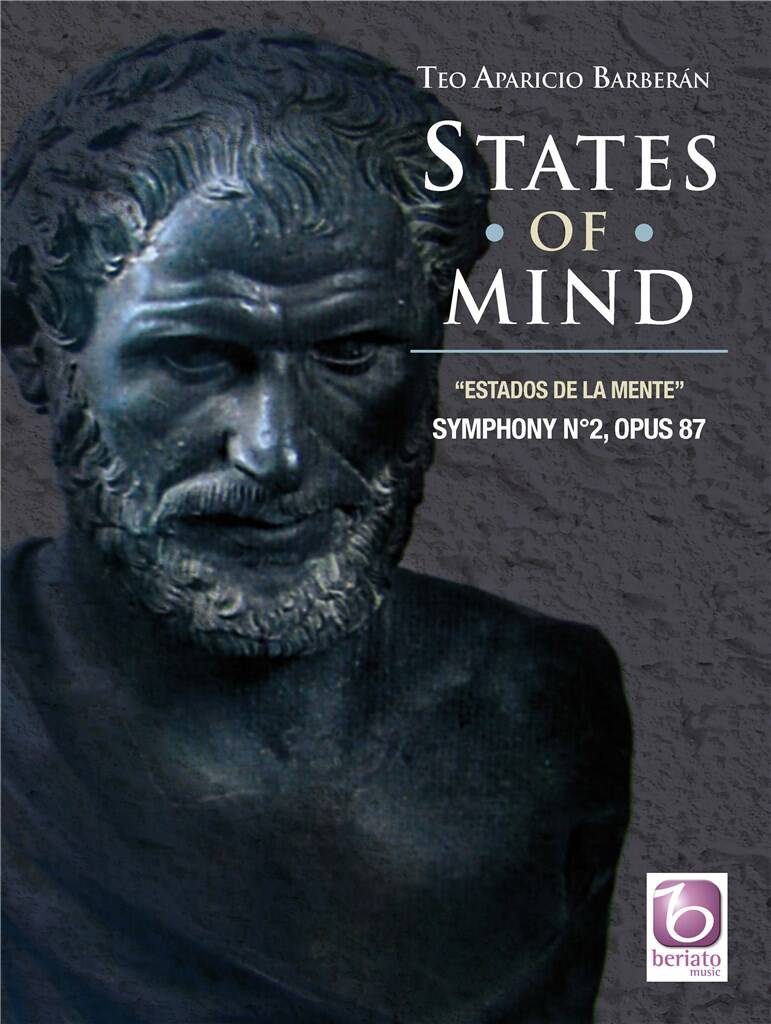 £274.99
Symphony No. 2: States Of Mind, Opus 87 - Teo Aparicio-Barberán
I- Logos (reason)II- Pathos (emotion)III- Ethos (credibility)The ancient Greeks believed that music shaped the character of man. In Egyptian temples, music was an essential part of the magical rites to alter the course of nature or to treat illness.And today we know that sound can actually alter matter. The secret of music lies in harmony and mathematics, as many great musicians and experts have always known.One of the most important qualities of music is that it enables the listener to focushis attention inwards instead of on what is around him. It is indisputable that music can inspire emotion. Music leads us into a universe of emotions that are difficult to put into words. In short, music reaches into corners of our soul and thoughtsthat words cannot reach and makes it possible to more clearly describe these different States of mind.The composer of this symphony also believes that each "musical argument" must be constructed so that it will induce the desired reaction in thelistener.Music: more than wordsIn recent times, most orchestral symphonies have been based on a story, a text or something similar so that their composition must be structured accordingly.The intention of this work by Teo Aparicio-Barbern is quitedifferent. The composer describes the three elements of the argument as the only formal structure of the work. Since certain philosophers in world history were able to subdivide grammatical argument, why shouldnt that also be possible for the musicalargument?Since ancient times the power of the spoken word has captivated mankind. How can an argument move people and mobilise the masses? Where does the power of words come from today? The answer lays not so much in what people say but in how theysay it.Rhetoric is one of the oldest humanist disciplines in Western civilisation. Aristotle, in the 4th century BC, called it the art of persuasion. Indeed, the terms rhetoric and persuasion are mutually interchangeable.More than 2000 years agoAristotle structured his rhetoric according to the following three elements: the logos, the pathos and the ethos.Logos (words, reason) is the reasoning that gives freedom to the structure of the text by expressing what one wishes to say usingspecialist terms. With logos we create arguments to receive public approval and to defend our ideas.Pathos, the second element, refers to the effective use of public psychology. Pathos can be considered as the capacity to induce the desired emotionalresponse in the public, by creating an emotional connection with the public so that they accept our message.The third element, ethos (credibility), refers to the character of the speaker and is perhaps the most important of the three elements.Aristotle based his concept of ethos upon his belief that truth and justice will always have the upper hand over anger. He believed that what was true and good was easier to prove and was more persuasive.This second orchestral symphony from thecomposer from Enguera follows these three parameters of the argument according to Aristotle. Each movement tries to summon a different state of mind in the listener so that the message itself can be better understood and appreciated. Apart from thesethree general concepts the music is only structured, as Claude Debussy would say, in a "formative way".The first movement, logos, is based on a scherzo melody that undergoes various changes in rhythm and harmony. The arguments are presented by meansof conventional techniques of composition. The second movement, pathos, is characterised by suggestions of sound. It is subdivided into two large parts. The first part is based on a five seven sequence with five sounds that are repeated in differentenvironments, structures and dynamics. The second part, which is largely tonal, brings out more directly the emotional overtones that each argument must have. The third movement, ethos, is a faithful rendition of the composers personality. In thislast part, clear rhythmic sequences stand out, there are large dynamic contrasts and lots of tone variation. In addition, and this is quite in keeping with the composers earlier work, the harmony in States of Mind is handled in a manner that is bothoriginal and efficient, as a result of which Aparicio-Barberns message is well understood by the listener.This second symphony by Teo Aparicio-Barbern is devoted to "my dear Henrie Adams, a guiding light in this eternally dark musical world. Thankyou for everything."
Estimated dispatch 7-14 working days
 View Music