
Results
-
 £87.99
Alice in Wonderland (Concert Band - Score and Parts) - Fain, Sammy - Suzuki, Eiji
During the 1930's, 40's and 50's American film and musical composer Sammy Fain (1902-1989) wrote many award-winning soundtracks. He also composed songs for Walt Disney Cartoons including Alice in Wonderland. The enchanting title song of this 1951 film is now available in a concert band arrangement by Eiji Suzuki. Duration: 3.45
Estimated dispatch 7-14 working days
-
 £164.95
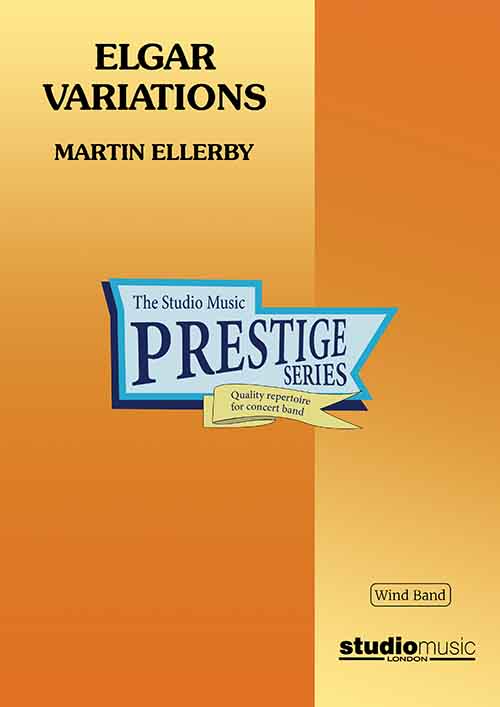
Elgar Variations (Concert Band - Score and Parts) - Ellerby, Martin
The year 2007 marked the 150th anniversary of the birth of the British composer Sir Edward Elgar (1857-1934) and as such I thought it an appropriate moment to write something in tribute to this event. There are quite a few enigmas about this piece and they are all intentional! First and foremost is that the variations are not constructed on any of Elgar's actual themes. Rather I have written a sequence of contrasting sections (all played without a break) on the essence and character of his musical style. I have also written this work with bands, the soloists within, conductors and, not least, their audience firmly in mind. The language is essentially tonal and the test musical rather than overtly technical. There are no tempo indications other than suggested metronome marks. I have deliberately kept things to a minimum as the true test here is to find the style and interpret that aspect over the whole structure. Whereas the faster sections are more or less self explanatory the slower parts require deliberate rubato and much feeling. This is for the conductors to discover and I encourage them to do so. Adjudicators should be fully aware that I sanction this aspect but it requires an insight and understanding to successfully execute so 'any old thing' will not suffice! The 'variation' commencing at rehearsal letter P is the emotional core of the piece and requires a passionate but not saccharine approach to pacing and sensuality. The cadenza type material is built into the process rather than being a separate sequence of entities. There are many allusions to the music of Elgar here without recourse to blatant pastiche - if it is thought of as a series of songs and dances this may help. The final comment is the dedication, after one of Elgar's own but subtly adjusted: to my friend pictured within - never to be revealed - now there's an enigma!- Martin EllerbyDuration: 14.00Recorded on Polyphonic QPRM155D Scenes from Childhood (Great British Music for Wind Band Vol.15), Royal Northern College of Music Wind Orchestra
Estimated dispatch 7-14 working days
-
 £32.95
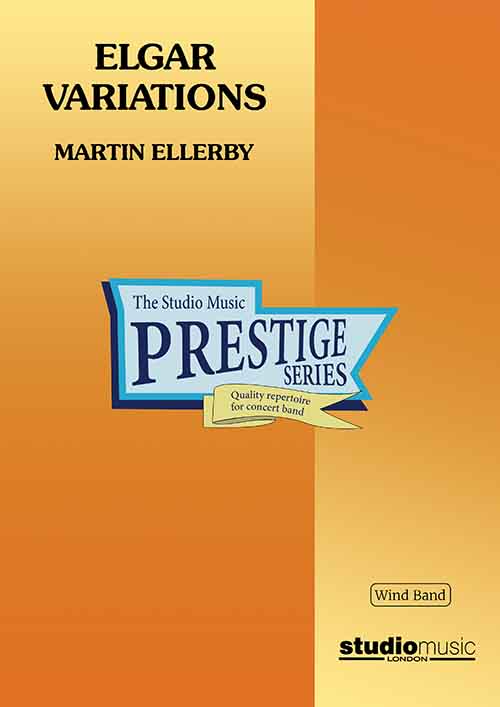
Elgar Variations (Concert Band - Score only) - Ellerby, Martin
The year 2007 marked the 150th anniversary of the birth of the British composer Sir Edward Elgar (1857-1934) and as such I thought it an appropriate moment to write something in tribute to this event. There are quite a few enigmas about this piece and they are all intentional! First and foremost is that the variations are not constructed on any of Elgar's actual themes. Rather I have written a sequence of contrasting sections (all played without a break) on the essence and character of his musical style. I have also written this work with bands, the soloists within, conductors and, not least, their audience firmly in mind. The language is essentially tonal and the test musical rather than overtly technical. There are no tempo indications other than suggested metronome marks. I have deliberately kept things to a minimum as the true test here is to find the style and interpret that aspect over the whole structure. Whereas the faster sections are more or less self explanatory the slower parts require deliberate rubato and much feeling. This is for the conductors to discover and I encourage them to do so. Adjudicators should be fully aware that I sanction this aspect but it requires an insight and understanding to successfully execute so 'any old thing' will not suffice! The 'variation' commencing at rehearsal letter P is the emotional core of the piece and requires a passionate but not saccharine approach to pacing and sensuality. The cadenza type material is built into the process rather than being a separate sequence of entities. There are many allusions to the music of Elgar here without recourse to blatant pastiche - if it is thought of as a series of songs and dances this may help. The final comment is the dedication, after one of Elgar's own but subtly adjusted: to my friend pictured within - never to be revealed - now there's an enigma!- Martin EllerbyDuration: 14.00Recorded on Polyphonic QPRM155D Scenes from Childhood (Great British Music for Wind Band Vol.15), Royal Northern College of Music Wind Orchestra
Estimated dispatch 7-14 working days
-
 £69.99
Another World's Hell (Concert Band - Score and Parts) - Dobson, Simon
Another World's Hell is inspired by a passage in Aldous Huxley's classic 1932 science-fiction novel Brave New World, which describes in unusually close detail the music that is being played at a dance. This is Dobson's interpretation of the imagined 'future music' that Huxley dreamed of. Duration: 13.00
Estimated dispatch 7-14 working days
-
 £160.00
DANCE SUITE (Concert Band) - Muldowney, Dominic
Includes:1. Hey2. Pavane/Waltz3. Polka4. Waltz/Galliard5. Tangos6. Break-DanceDance Suite displays a variety of historical dance forms from a twentieth century viewpoint. The six dances move forward historically from the ancient Hey, through Waltz and Polka, to the sophisticated Tango and the jazz tradition. The rhythm that typifies each dance is constantly under attack, sometimes from a different dance style altogether. These intrusive elements are most obvious in the final dance and prompts the double meaning of the title.I. HEYHey is constructed like a mediaeval motet, where the main blocks of material are rhythmically unconnected to one another. The percussion is the most disconnected of all and seems to have arrived from a Chinese carnival. The scoring alludes to the eight, four and two foot pipes of a baroque organ.I. PAVANE/WALTZAfter a nod in the direction of Dowland's Lachrimae Pavan, the piece seems to wander to and fro between the 16th century and the 19th century world of the Lehr waltz.I. POLKAThe Polka is derived from a four bar fragment found in Stravinsky's sketchbook for The Rite of Spring above which is written: "Dieppe Polka".I. WALTZ/GALLIARDThis is a reversal of the date-shift process in the second movement, in that the wandering goes backwards rather than forwards, particularly to the William Byrd of the Fitzwilliam Virginal Book.I. TANGOSA slow sentimental tango is sandwiched between an abstract deconstructed one, both of which are developed in Dominic Muldowney's opera The Voluptuous Tango.I. BREAK-DANCEBreak-Dance is the fastest, hardest and strangest movement. Its exuberance fractures the texture, which slowly crumbles midway through the movement, only to be resurrected mirror fashion. The piece is a species of palindrome with no true centre, hence: "Break-Dance".Conductors are free to make a selection from these dances for festival or competition programmes, when limited performance time is available.
Estimated dispatch 7-14 working days
-
 £55.00
Ides March (Concert Band - Score and Parts) - Bermel, Derek
Ides March was commissioned by William Brine in 1990, Bermel's first commission. Brine requested that the work be a march suitable for performance at both a wedding and a funeral. Although originally titled Brine's March, when the composer learned that the march was to receive its premiere on 15 March, he changed the title to Ides March in a umorous nod to the Shakespearean admonition 'Beware the Ides of March'; in his youthful view a sentiment appropriate for either a wedding or a funeral. However, a line from Cole Porter was the inspiration behind the major key to minor key interplay of the work: 'What could be any finer? But how strange the change from major to minor, every time we say goodbye', a line that captured the composer's attempt to write a march that did justice to both the melancholy and triumphant. Duration: 5.00
Estimated dispatch 7-14 working days
-
 £206.99
Omaggio - Philip Sparke
Omaggio was commissioned by Steven Mead in celebration of his 60th birthday and in memory of his father, Rex. He gave the premiere of the brass band version in Rome in March 2022, accompanied by the Italian Brass Band conducted by Filippo Cangiamilla. The concert band premiere took place on 6th July that year as part of the 2022 Spanish International Tuba Euphonium Conference, accompanied by the Banda municipal de msica de Mlaga. The concerto is set in 3 continuous movements, which are united by a recurring syncopated interval of a fifth. The first movement, FANTASIA, opens with this motive accompanying an extended monologue for the soloist. This is followed by a lengthy bridge passage by the band (piano), which is eventually joined by the soloist, who guides the music back to the opening soliloquy, leading to an energetic central section. This develops until the opening material again returns to introduce the second movement, BALLAD, which revolves around an expressive melody for the soloist, interspersed by accompanied cadenzas. The third movement, THE KING TRIUMPHANT, pays homage to Steven's late father, Rex, and its title alludes both to Rex's name ('Rex' being Latin for 'king') as well as his love of Eric Ball's Salvationist masterpiece, The Kingdom Triumphant. The finale is an energetic tour-de-force featuring an acrobatic 6/8 melody, which is interrupted twice by the magnificent hymn tune, Helmsley, which Ball uses so effectively in The Kingdom Triumphant. A galloping coda brings the work to a close.
Estimated dispatch 7-14 working days
-
 £183.20
Danser fra "Kosakkene" - Catharius Elling
The Opera "The Cossacs" by Catharinus Elling is based on the Nikolai Gogol novel about Taras Bulba."The Cossacs" was premiered in 1897 at Eldorado in Kristiania (the old name on Norway's capitol Oslo). Despite positive response in the papers of that time, the opera was newer performed again in it's entirely. The Norwegian Broadcasting Corporation have an abbreviated recording in it's archives, but no complete performance is known to date.The Norwegian National Opera Orchestra recorded both the overture and the dances in 2021, conducted by Ingar Bergby. Thet are both a part of the CD "Norwegian Opera Overtures".This arrangement is not commissioned by anyone, but rather written to better the availability of quality Norwegian orchestral music arranged for Concert Band.This edition is a good opportunity to be more familiar with Norwegian heritage of orchestral music.
Estimated dispatch 7-14 working days
-
 £127.30
Ballade fra Fantasistykker for Piano op. 36 - Agathe Backer-Grøndahl
Agathe Backer Grndahl's 'Ballade' can best be described as a Romantic character piece. Such one-movement piano pieces with titles that loosely indicate a mood/idea made out a central genre in the 19th century. In Backer Grndahl's production, several of these are grouped under the term 'fantasy pieces'. There are six collections with a total of 48 fantasy pieces on her opus list and 'Ballade' is from the first of these (Op. 36), published in 1895. 'Ballade' is a broader work than the other fantasy pieces. It is built around a dramatic theme that keeps returning after episodes with strongly contrasting thematic material.The arrangement is close to Backer Grndahl's original composition. It is transposed a semitone down: from E flat minor to D minor. The arrangement contains some challenging passages and is well-suited for amateur bands of a certain level. The instrumentation makes no special demands beyond normal concert band instrumentation and will sound just as good in small as in large bands.
Estimated dispatch 7-14 working days
-
 £67.50
Wedding March - Felix Mendelssohn Bartholdy
Felix Mendelssohn Bartholdy (1809 - 1847) composed the music for William Shakespeare's play A Midsummer Night's Dream at two different times. In 1826, at the age of 16, he wrote a concert overture (Op. 21). Sixteen years later, in 1842, he composed the incidental music (opus 61) for King Frederick William IV of Prussia, in which he incorporated the existing overture. The overture premiered in Stettin (then in Prussia, now Szczecin, Poland) on February 20, 1827, conducted by Carl Loewe. Mendelssohn had to travel 80 miles through a raging snowstorm to get to the concert, which became his first public appearance. The interlude between the 4th and 5th acts of the incidental music is the famous Wedding March, Mendelssohn's most popular and most performed work.
Estimated dispatch 7-14 working days
 View Music