
Results
-
 £49.95
A Life Well Lived (Concert Band - Score and Parts) - Wiffin, Rob
A Life well lived was commissioned by the Morrish family in 2023 on the death of Ian Morrish. It is dedicated to them with the inscription in loving memory of Ian.I knew Ian from early days at Southall Citadel Salvation Army Corps and then our paths crossed again briefly when I joined the Central Band of the Royal Air Force. Ian had been a euphonium player in the band for many years and was about to leave to take up a teaching post in Surrey. He was always very involved in choral music, conducting choirs throughout his life. I therefore wanted to keep this piece song-like and actually started with the song which appears from letter D to the end, which can always be performed on its own. From there I used the rising octaves that introduce the song to form the beginning of the work, with the feeling in the back of my head of a river starting to flow. There is nothing referential in the more dramatic sections towards the beginning, but every life has its dramas and I wanted something to give some balance to the tranquil nature of much of the piece. In the middle of the work I use a little motif taken from a song I remember Ian singing in his floating tenor voice. I develop the motif a little as an accompaniment to a new line which has, for me, a sense of purpose and directness and has an oblique reference to the RAF March Past. This builds to the aforementioned song and from there the music flows with its highs and lows to its peaceful conclusion.- Rob WiffinDuration: 3.30
Estimated dispatch 7-14 working days
-
 £32.95
Trombone Concerto (Trombone Solo with Concert Band - Score only) - Wiffin, Rob
The composer writes:My Trombone Concerto was commissioned by Brett Baker following an earlier piece I had written for him called Shout. The concerto was composed in Spain the summer of 2010. Once I started writing I realised this concerto was, inevitably, going to draw on my own experiences as a trombone player.The first movement was really a matter of getting the right thematic ideas and balancing the tutti and solo passages so, for formal structure, I studied the Gordon Jacob Trombone Concerto. There is a lyrical section preceding the first Allegro that owes much in spirit (but not the actual music) to The Eternal Quest, Ray Steadman-Allen's Salvation Army solo.The slow movement seemed determined to come out in the vein of a Richard Strauss song. I wanted to write ineluctably cantabile as we trombone players rarely get a chance to play the melody! There is a brief allusion to that wonderful moment when the trombone gets to sing above the orchestra in Sibelius' seventh symphony. Arthur Wilson (my teacher at college) died in the summer of 2010 so it seemed appropriate to dedicate this movement to him.The last movement is the lightest of the three in style and is slightly jazz-inflected, hopefully providing some fun for the soloist.While wanting to test the instrument, I did not set out with the intention of making the concerto difficult but there are undoubtedly challenges of technique, range and style to be met by the soloist.Recorded on Polyphonic CD QPRM161D Roman TrilogyDuration: 19:30
Estimated dispatch 7-14 working days
-
£164.95
Trombone Concerto (Trombone Solo with Concert Band - Score and Parts) - Wiffin, Rob
The composer writes:My Trombone Concerto was commissioned by Brett Baker following an earlier piece I had written for him called Shout. The concerto was composed in Spain the summer of 2010. Once I started writing I realised this concerto was, inevitably, going to draw on my own experiences as a trombone player.The first movement was really a matter of getting the right thematic ideas and balancing the tutti and solo passages so, for formal structure, I studied the Gordon Jacob Trombone Concerto. There is a lyrical section preceding the first Allegro that owes much in spirit (but not the actual music) to The Eternal Quest, Ray Steadman-Allen's Salvation Army solo.The slow movement seemed determined to come out in the vein of a Richard Strauss song. I wanted to write ineluctably cantabile as we trombone players rarely get a chance to play the melody! There is a brief allusion to that wonderful moment when the trombone gets to sing above the orchestra in Sibelius' seventh symphony. Arthur Wilson (my teacher at college) died in the summer of 2010 so it seemed appropriate to dedicate this movement to him.The last movement is the lightest of the three in style and is slightly jazz-inflected, hopefully providing some fun for the soloist.While wanting to test the instrument, I did not set out with the intention of making the concerto difficult but there are undoubtedly challenges of technique, range and style to be met by the soloist.Recorded on Polyphonic CD QPRM161D Roman TrilogyDuration: 19:30
Estimated dispatch 7-14 working days
-
 £154.99
Swaying in the West Wind (Concert Band - Score and Parts) - Yagisawa, Satoshi
This piece was commissioned by Japan Ground Self Defense Force Western Army Band. In the programme note for the premiere the composer wrote: "I am always impressed by the expansive earth and sparkling ocean scenery when I come to Kyushu. I have met many local people here and they are all expressive and energetic. I wrote this dramatic piece to convey to the whole of Japan the memory of my experience here, swaying in the west wind. I wrote this, hoping that the Self Defense Force will forge closer ties with the community through this piece." Eastern drama felt in the west wind!Duration: 8:00
Estimated dispatch 7-14 working days
-
 £93.10
Impressions from a Journey (Concert Band - Score and Parts) - Stahli, Urs
I'm in the mountains... in Switzerland - in the Valais - on the Riederalp. I'm enjoying the view of the surrounding mountain peaks on this late summer afternoon.A alphorn plays a melody. The echo comes back once, twice, no, three times from the mountain slopes! It's getting dark. The melody of the evening blessing from Humperdinck's Hansel and Gretel comes to mind. It is night.A new day begins! I make my way to Riederfurka, to Villa Cassel. There I am greeted by the sound of the orchestra. I enjoyed the music and my lunch. In the afternoon, the musicians invited me to a dance. As waltzing is not really my thing, I walk on to the Riederhorn. There I enjoy the wonderful view! I am happy!- Urs SthliDuration: 8.00
Estimated dispatch 7-14 working days
-
 £54.95
Spider Legs (Concert Band - Score and Parts) - Wiffin, Rob
Spider Legs is a vibrant Latin dance number. Although I have used Latin rhythms in pieces in recent years this is the first time I have returned wholeheartedly to one of my favourite types of music since I wrote Tiptoe Tune in 2001. Typically I wrote it when I should have been writing something else but I really enjoyed going back to these rhythms. Stylistically Spider Legs can best be described I suppose as 'Merengue House' but perhaps it is better without any description! It was composed in 2014, shortly after the birth of my granddaughter Emma Louisa who was nicknamed 'Spider Legs' at the time and the name seemed to fit the music so well that I could not resist it.
Estimated dispatch 7-14 working days
-
£10.95
Spider Legs (Concert Band - Score Only) - Wiffin, Rob
Spider Legs is a vibrant Latin dance number. Although I have used Latin rhythms in pieces in recent years this is the first time I have returned wholeheartedly to one of my favourite types of music since I wrote Tiptoe Tune in 2001. Typically I wrote it when I should have been writing something else but I really enjoyed going back to these rhythms. Stylistically Spider Legs can best be described I suppose as 'Merengue House' but perhaps it is better without any description! It was composed in 2014, shortly after the birth of my granddaughter Emma Louisa who was nicknamed 'Spider Legs' at the time and the name seemed to fit the music so well that I could not resist it.
Estimated dispatch 7-14 working days
-
 £160.00
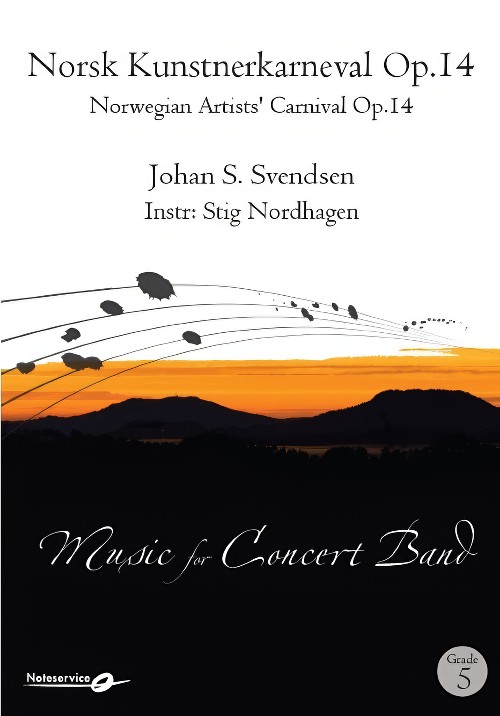
Norsk Kunstnerkarneval Op.14 (Norwegian Artists' Carnival Op.14) (Concert Band - Score and Parts) - Svendsen, Johan S. - Nordhagen, Stig
This well-known work was composed in Christiania in 1874 for a burlesque Carnival in Kunstnerforeningen.An early title for the work was Bryllup paa Dovre. The manuscript score and parts at The National Library in Oslo of the early version with this title have much more music than the version printed by C.F. Peters, Leipzig in 1881. The form in this first version was ABA with an additional trio part that later were discarded. In the trio Svendsen used the melody Saeterreisen (Os har gjort kva gjeras skulle) from Lindeman's collection of Norwegian Folk Tunes. (Vol. I/115). In the A-part a wedding tune (Bruraslaatten) from Sogn is used (Lindeman Vol. I/476). The Carnival's literary theme was the connection between the cold north and the warm south. Musically the south is represented in Svendsen's music by Raffaele Sacoo's melody from 1835, Te voglio bene assai.I believe that if Norwegian quality music from this period is going to be performed, it must at least be available. There must be editions for modern instrumentations with full scores. I do this as my contribution to expand and enrich the repertoire for Concert Bands.- Stig Nordhagen
Estimated dispatch 7-14 working days
-
 £91.99
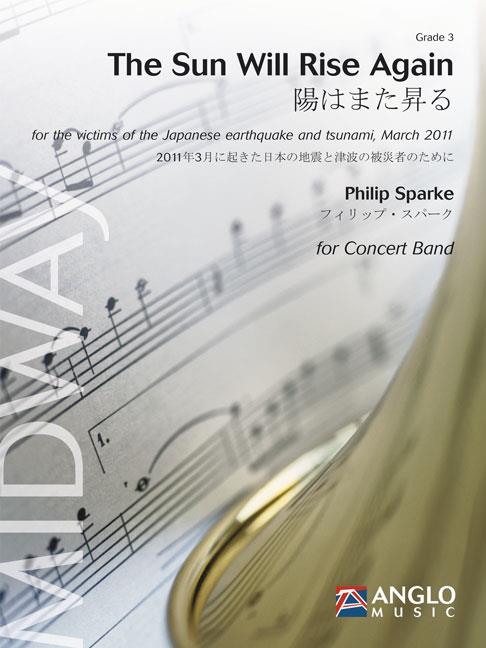
The Sun Will Rise Again (Concert Band - Score & Parts) - Sparke, Philip
The composer writes:On March 11th 2011 a massive 9.0- magnitude earthquake occurred off the coast of north-eastern Japan. I'm writing these programme notes barely a week later and the death toll caused by the quake and resulting tsunami already exceeds 6000, with thousands of people still unaccounted for. I have many friends associated with many bands throughout Japan and one of these, Yutaka Nishida, suggested I write a piece to raise money to help those affected by the disaster. I was immediately attracted by the idea and have arranged Cantilena (a brass band piece recently commissioned by the Grenland International Brass Festival, Norway) for wind band, giving it a new title to honour my friends in the Land of the Rising Sun. I will be donating royalties from this piece to the Japanese Red Cross Society Emergency Relief Fund and am delighted to say that my distributors, De Haske, who will generously also donate all net profits from sales of this piece, have pledged a substantial advance payment to the Red Cross so that what little help this project generates can be immediate. It is my sincere wish that this 'Band Aid' project will allow wind bands around the world support the people of Japan, where bands are a way of life for many, in this difficult time.- Philip SparkeDuration: 4:30
Estimated dispatch 7-14 working days
-
 £124.95
SWORD AND THE CROWN, The (Prestige Concert Band - Score and Parts) - Gregson, Edward
In 1988 I was commissioned by the Royal Shakespeare Company to write the music for The Plantagenets trilogy, directed by Adrian Noble in Stratford-upon-Avon. These plays take us from the death of Henry V to the death of Richard III. Later, in 1991, I wrote the music for Henry IV parts 1 and 2, again in Stratford. All of these plays are concerned with the struggle for power (the crown) through the use of force (the sword) and they portray one of the most turbulent periods in the history of the British monarchy.This work quickly became established in the mainstream repertoire and has received performances worldwide as well as five commercial recordings and many broadcasts. In 2002 I was approached by the Parc and Dare Band regarding their summer festival and commissioned to do a version for brass band. This was given its first performance in Treorchy Hall by the combined bands of Black Dyke and Parc and Dare conducted by Nicholas Childs.When the Royal Air Force Music Services commissioned me to write a work especially for their British tour in 1991 I immediately thought of turning to this music and transforming some of it into a three-movement suite for symphonic band.The first movement opens with a brief fanfare for two antiphonal trumpets (off-stage), but this only acts as a preface to a Requiem aeternam (the death of Henry V) before changing mood to the English army on the march to France; this subsides into a French victory march, but the English army music returns in counterpoint. Finally, a brief reminder of the Requiem music leads to the triumphal music for Richard Plantagenet, Duke of York, father of Edward IV and Richard III (the opening fanfare transformed).The second movement takes music from the Welsh Court in Henry IV (part 1) which is tranquil in mood; distant fanfares foreboding battles to come are heard, but the folktune is heard three times in different variations and the movement ends as it began with alto flute and gentle percussion.The final movement starts with two sets of antiphonally placed timpani, drums and tam-tam, portraying the 'war machine' and savagery of battle. Trumpet fanfares and horn calls herald an heroic battle theme which, by the end of the movement, transforms itself into a triumphant hymn for Henry IV's defeat of the rebellious forces.- Edward GregsonPerformance time 13'54"Recorded on QPRM117D FESTIVAL OF MUSIC 1991, Massed Bands of the Royal Air ForceRecorded on QPRM120D THE SWORD AND THE CROWN, Central Band of the Royal Air Force'Finale' recorded on QPRM142D FESTIVAL OF MUSIC 2002, Massed Bands of the Royal Air Force)
Estimated dispatch 7-14 working days
 View Music