
Results
-
£87.00
Yorckscher March - Ludwig van Beethoven - Bertrand Moren
Yorkshire March / Marche de Yorckscher
Estimated dispatch 10-14 working days
-
£105.00
Zapfenstreichmarsch - Ludwig van Beethoven - John Glenesk Mortimer
Estimated dispatch 10-14 working days
-
£22.00
Duet Album Vol. 1
1. Mlodie de l'Eurovision (J. F. Michel) / 2. Old Folks At Home (Stephen Foster) / 3. O du Frhliche / 4. Weinachtslied / 5. Grand Dieu nous te bnissons / 6. Hymne la Joie (Ludwig van Beethoven) / 7. Happy Birthday / 8. Ce n'est qu'un au revoir / 9. Cou Cou / 10. Carnaval de Venise / 11. Muss i denn zum Stdtele hinaus! / 12. Frre Jacques / 13. Marche / 14. Santa Lucia / 15. Volkslied aus der Schweiz / 16. Amazing Grace / 17. Glory, Glory Alleluja / 18. Funiculi, Funicula / 19. American Traditional / 20. Le bon Roi Dagobert / 21. Chant des Toradors / 22. Traditionnel Ecossais / 23. O Tannenbaum / 24. Ah si pure (Friedrich von Flotow) / 25. Schweizer Volkslied / 26. La Cucaracha / 27. Jericho / 28. Deep River / 29. La Paloma / 30. Swing Low, Sweet Chariot
Estimated dispatch 10-14 working days
-
£18.00
-
 £11.80
Suzuki Violin School, Volume 2: Violin Book - Shinichi Suzuki
Teach violin with the popular . The Suzuki Method of Talent Education is based on Shinichi Suzuki's view that every child is born with ability, and that people are the product of their environment. According to Shinichi Suzuki, a world-renowned violinist and teacher, the greatest joy an adult can know comes from developing a child's potential so he/she can express all that is harmonious and best in human beings. Students are taught using the "mother-tongue" approach. Each series of books for a particular instrument in the Suzuki Method is considered a Suzuki music school, such as the Suzuki Violin School. Suzuki lessons are generally given in a private studio setting with additional group lessons. The student listens to the recordings and works with their Suzuki violin teacher to develop their potential as a musician and as a person. This Suzuki Book is integral for Suzuki violin lessons. This revised edition of the Suzuki Violin School, Volume 2 features: * Revised editing of pieces, including bowings and fingerings * 16 additional pages * Additional exercises, some from Shinichi Suzuki, plus additional insight and suggestions for teachers * Text in English, French, German, and Spanish * Musical notation guide * Fingerboard position. Titles: Study Points for Volume 2 * Chorus from (Handel) * Musette, Gavotte II or the Musette from , BWV 808 (Bach) * Hunters' Chorus from 3rd Act of the Opera (Weber) * Long, Long Ago (Bayly) * Waltz, Op. 39, No. 15 for Piano (Brahms) * Bourre from , HHA IV/18, No. 8 (Handel) * The Two Grenadiers, Die beiden Grenadier, Op. 49, No. 1 for Voice and Piano (Schumann) * Theme from (Paganini) * Gavotte from (Thomas) * Gavotte (Lully) * Minuet in G, Wo0 10, No. 2 (Beethoven) * Minuet from No. 11, Op. 11, No. 5 in E Major (Boccherini). For a complete list of the most recent printings by AMPV number, go to alfred.com/suzuki. This title is available in MakeMusic Cloud. The International editions include an updated title page that designates the book as the International Edition. A Federation Festivals 2020-2024 selection.
Estimated dispatch 3-5 working days
-
 £7.87
£7.87Music for Little Mozarts: Music Lesson Book 1: Piano Book - Christine H. Barden, Gayle Kowalchyk, and E. L. Lancaster
Lesson Book 1 is pre-reading. Concepts taught are: How to sit at the piano; Correct hand position; High and low; Loud and soft (forte and piano); Keyboard topography; Bar line and measure, Quarter, half, whole notes and rests; and Repeat signs. The first pieces in the book are played on the black keys. Later in the book, C D E for the RH and C B A for the LH (Middle C position) are taught with letter notes (the name of the note is written inside the note head).Characters introduced: Mozart Mouse, Beethoven Bear, and Elgar E. Elephant. The music from this book is available in the Piano Maestro app that's downloadable at http://app.appsflyer.com/id604699751?pid=web&c=alfred. Learn more About JoyTunes, the maker of Piano Maestro at http://teachers.joytunes.com/?jt&utm_source=alfred&utm_campaign=web.
Estimated dispatch 3-5 working days
-
 £11.80
Suzuki Cello School, Volume 3: Cello Book
Teach Cello with the popular . The Suzuki Method of Talent Education is based on Shinichi Suzuki's view that every child is born with ability, and that people are the product of their environment. According to Shinichi Suzuki, a world-renowned violinist and teacher, the greatest joy an adult can know comes from developing a child's potential so he/she can express all that is harmonious and best in human beings. Students are taught using the "mother-tongue" approach. Each series of books for a particular instrument in the Suzuki Method is considered a Suzuki music school, such as the Suzuki Cello School. Suzuki lessons are generally given in a private studio setting with additional group lessons. The student listens to the recordings and works with their Suzuki cello teacher to develop their potential as a musician and as a person. This Suzuki Book is integral for Suzuki cello lessons. Titles: Berceuse, Wiegenlied or Lullaby, Op. 98, No. 2 (F. Schubert) * Tonalization: The Moon over the Ruined Castle (Taki) * Gavotte (Lully) * Minuet from No. 11, Op. 11, No. 5 in E Major (Boccherini) * Tonalization: The Moon over the Ruined Castle (Taki) * Scherzo (Webster) * Minuet in G, Wo0 10, No. 7 for Piano (Beethoven) * Gavotte in C Minor, Gavotte en Rondeau from , BWV 822 (Bach) * Minuet No. 3, BWV Anh. II 114/Anh. III 183/Anh. II, 115 (Bach) * Humoresque, Op. 101, No. 7 for Piano (Dvork) * La Cinquantaine (Gabriel-Marie) * Allegro Moderato from (Bach). For a complete list of the most recent printings by AMPV number, go to alfred.com/suzuki. This title is available in MakeMusic Cloud. The International editions include an updated title page that designates the book as the International Edition. A Federation Festivals 2020-2024 selection.
Estimated dispatch 3-5 working days
-
 £60.99
J'EU'FUL Wind Band Set (Score & Parts)
Op 25 maart 1957 vond de ondertekening van het verdrag van Rome plaats. Dit betekende het begin van de Europese Unie (EU). De Europese 'familie' is in 50 jaar tijd gegroeid van 6 tot 27 landen, ieder met hun eigen cultuur, taal en tradities. Vrijheid, democratie, gelijkheid, de rechtsstaat en respect voor de mensenrechten zijn de gemeenschappelijke waarden die worden nagestreefd. Europese Hymne: In 1972 koos de Raad van Europa het thema van 'Ode aan de vreugde' van Ludwig van Beethoven (uit de Negende Symphonie) als het Europese Volkslied. De tekst van het lied, 'Ode aan de vreugde' (An die Freude. Ode to Joy) is van de hand van Friedrich Schiller. Net als Schiller vond Beethoven dat alle mensen gelijk waren (broeders). Ter gelegenheid van deze bijzondere verjaardag componeerde Dagmar Kildevann de vrolijke mars J'eu'ful. De titel is een woordspeling op de tekst van het Europese volkslied. Kildevann gebruikt als inleiding op het volkslied het bekende motief uit Beethoven's Vijfde Symphonie. 02:15
Estimated dispatch 7-14 working days
-
 £123.20
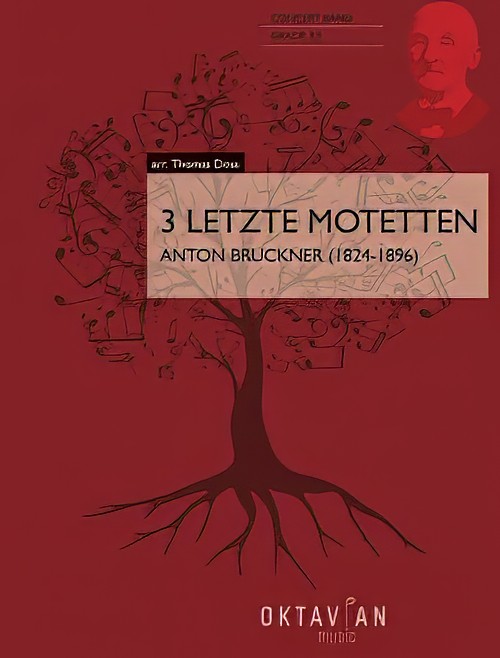
3 Letzte Motetten (Concert Band - Score and Parts) - Bruckner, Anton - Doss, Thomas
Anton Bruckner (b. 4.9.1824, Ansfelden, d. 11.10.1896, Vienna) didn't have it easy. Throughout his life, the Austrian composer was plagued by self-doubt. Anton Bruckner came from a simple, rural background. After the death of his father, he was accepted as a choirboy at the monastery of Sankt Florian in 1837. After several years as a school assistant and his own organ and piano studies, he first worked as organist in St. Florian, then from 1855 as cathedral organist in Linz. Introduced to music theory and instrumentation by Simon Sechter and Otto Kitzler, he discovered Richard Wagner as an artistic role model, whom he admired throughout his life and also visited several times in Bayreuth. In 1868 Anton Bruckner became professor of basso continuo, counterpoint and organ at the Vienna Conservatory; ten years later court organist; and in 1891 finally honorary doctor of the University of Vienna. He was considered an important organ virtuoso of his era, but had to wait a long time for recognition as a composer. It was not until Symphony No.7 in E major, composed between 1881 and 1883, with the famous Adagio written under the effects of Wagner's death, that he achieved the recognition he had hoped for, even if he was reluctant to accept it given his inclination towards scepticism and self-criticism. Anton Bruckner was a loner who did not want to follow a particular school or doctrine. He composed numerous sacred vocal works, such as his three masses, the Missa Solemnis in B flat minor (1854), the Te Deum (1881-84) and numerous motets. As a symphonic composer, he wrote a total of nine symphonies and many symphonic studies from 1863 onwards, tending to revise completed versions several times over. Bruckner's orchestral works were long considered unplayable, but in fact were merely exceptionally bold for the tonal language of their time, uniting traditions from Beethoven through Wagner to folk music, on the threshold between late Romanticism and Modernism. Anton Bruckner composed about 40 motets during his lifetime, the earliest a setting of Pange lingua around 1835, and the last, Vexilla regis, in 1892. Thomas Doss has compiled some of these motets in this volume for symphonic wind orchestra. These motets show many characteristics of personal expression, especially Bruckner's colourful harmony in the earlier works, which is in places aligned with Franz Schubert (changes between major and minor; and movements in thirds). Later works are characterised by many components which, in addition to the expanded stature of the movements, include above all a sense of the instrumentation as an outward phenomenon and the harmony as a compositional feature that works more internally. Some aspects of Bruckner's work are the result of his long period of study, which familiarised him not only with the tradition of his craft, but also gave him insights into the "modernity" of his time in such composers as Wagner, Liszt and Berlioz. From this developed his personal standpoint, which always pursues the connection between the old and the new.Duration: 14.00
Estimated dispatch 7-14 working days
-
 £95.99
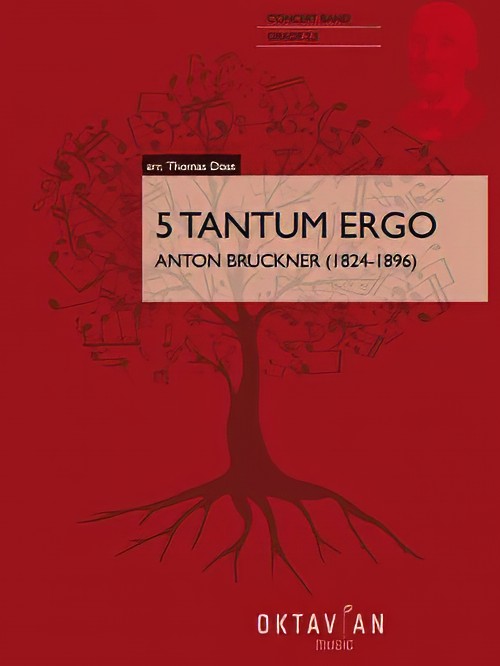
5 Tantum Ergo (Concert Band - Score and Parts) - Bruckner, Anton - Doss, Thomas
Anton Bruckner (b. 4.9.1824, Ansfelden, d. 11.10.1896, Vienna) didn't have it easy. Throughout his life, the Austrian composer was plagued by self-doubt. Anton Bruckner came from a simple, rural background. After the death of his father, he was accepted as a choirboy at the monastery of Sankt Florian in 1837. After several years as a school assistant and his own organ and piano studies, he first worked as organist in St. Florian, then from 1855 as cathedral organist in Linz. Introduced to music theory and instrumentation by Simon Sechter and Otto Kitzler, he discovered Richard Wagner as an artistic role model, whom he admired throughout his life and also visited several times in Bayreuth. In 1868 Anton Bruckner became professor of basso continuo, counterpoint and organ at the Vienna Conservatory; ten years later court organist; and in 1891 finally honorary doctor of the University of Vienna. He was considered an important organ virtuoso of his era, but had to wait a long time for recognition as a composer. It was not until Symphony No.7 in E major, composed between 1881 and 1883, with the famous Adagio written under the effects of Wagner's death, that he achieved the recognition he had hoped for, even if he was reluctant to accept it given his inclination towards scepticism and self-criticism. Anton Bruckner was a loner who did not want to follow a particular school or doctrine. He composed numerous sacred vocal works, such as his three masses, the Missa Solemnis in B flat minor (1854), the Te Deum (1881-84) and numerous motets. As a symphonic composer, he wrote a total of nine symphonies and many symphonic studies from 1863 onwards, tending to revise completed versions several times over. Bruckner's orchestral works were long considered unplayable, but in fact were merely exceptionally bold for the tonal language of their time, uniting traditions from Beethoven through Wagner to folk music, on the threshold between late Romanticism and Modernism. Hymns for four-part mixed choir a cappella (1846, St. Florian) No. 1 in E flat major (WAB 41/3): Quite Slow No. 2 in C major (WAB 41/4): Andante No. 3 in B flat major (WAB 41/1): Slow No. 4 in A flat major (WAB 41/2): Slow Hymn for five-part (SSATB) mixed choir and organ No. 5 in D major: Solemnly They are simple works, completely subordinate to their liturgical use, which nevertheless already show numerous characteristics of personal expression. These small pieces were able to stand up to the harsh scrutiny of the mature master: in 1888, Bruckner subjected them to a revision in which he made only minor corrections.Duration: 11.00
Estimated dispatch 7-14 working days
 View Music