
Results
-
£109.99
Symphonic Episode I - Satoshi Yagisawa
The title's meaning is two-fold: as a letter, I stands for the Japanese Iwata Band Association. As a number, I represents Satoshi Yagisawa's hope that this is only the first in a future series of works. Symphonic Episode Iprovides rich contrast between its various slow and fast sections, with the slow movement exemplifying Yagisawa's great ability to write warm and emotionally inspired music. Dur: 6:35
Estimated dispatch 7-14 working days
-
 £144.99
Like the Eagle, We Soar and Rise - Satoshi Yagisawa
Like the Eagle, We Soar and Rise was commissioned by Yuying Secondary School Concert Band and Yuying Alumni Association for the 2010 centenary of the school's foundation. The piece was named by a friend of the composer named Steven Phua, who originally suggested commissioning a new piece to Satoshi Yagisawa. The piece furthermore takes its name from the text of the Yuying Secondary School song.This composition is based on three different concepts: the first one demonstrates 'The founders' passion for education'; the second concept illustrates 'Hardship in war time'; the third one 'To the future' describes the inner strength people find to overcome struggles. Thispiece concludes with a fanfare, which is the sound of hope that leads to a brighter future in a positive direction.The world premiere of this piece was conducted by Faizal Bin Othman, who is one of the leading educators in Singapore, and was performed by the Yuying Secondary School Concert Band.
Estimated dispatch 7-14 working days
-
 £149.99
Colditz Castle - Rob Goorhuis
Written as a commission by the Stichting de Inrichting foundation of Wijk bij Duurstede (the Netherlands), Rob Goorhuis Requiem voor de mens (Requiem for Man) on lyrics by Andr van Zwieten was composed in the year 2001. This work for choir andwind-band greatly impressed the audience, whilst its composer remained obsessed by its war theme. When he subsequently heard that the Rundfunk Blasorchester from the German town of Leipzig -a place not far from Colditz - was to dedicate a CDto his work, Rob Goorhuis got the idea to process some of the themes from his Requiem for Man into an instrumental composition about the famous Colditz castle. a place still bearing the scars of war. From 1933 to 1934, the castle was aSchutzhaftlager. During the Second World War, it was used as a prison for senior officers. From this prison, many escapes were undertaken, which even resulted in the castle being nicknamed The Escape School. In the seventies, a television-seriesabout this period made the castle very well-known with the public at large.The despondent tone of the opening theme underscores the sadness caused by wars and violence. Nevertheless the works ending is hopeful and triumphant. Peace iscelebrated, but with the hope for a lasting peace sadly remaining a topical issue to the present moment.
Estimated dispatch 7-14 working days
-
 £61.00
Samba Crazy - Terry Kenny
This is based on the famous tango 'El Choclo' by Angel Villoldo. The tango is the national dance of Argentina, but Terry has turned it into a samba, which is the national dance of Brazil, thereby running the risk of antagonising half the population of South America. The arrangement is lively and up-beat, so we hope they will approve and enjoy it.
Estimated dispatch 7-14 working days
-
 £119.00
Ukrainian Bell Carol - Mykola Leontovich
Kurt Heinecke's new setting ofUkrainian Bell Carolis the perfect arrangement to inspire hope this holiday season and to acknowledge the spirit of the Ukrainian people. The piece opens with a small woodwind ensemble or solo piano stating a haunting four-note motif derived from a Ukrainian folk song. This ever-popular carol arrangement, featuring the small ensemble or piano throughout, develops and grows to a powerful climax. Appropriate for high school, university, and professional bands, it is the perfect show stopper for your holiday concert.
Estimated dispatch 7-14 working days
-
 £82.95
Horizons - Michael Olson
Bring a moment of beauty and reflection to your concert with Horizons, a breathtaking transcription for concert band. Originally the second movement of a string quartet, this evocative work paints a vivid picture of sunrise, symbolizing renewal and hope. With expressive sections that explore life's emotional highs and lows, it offers your students a powerful opportunity to connect deeply with the music and captivate audiences with its inspiring message of resilience.
Estimated dispatch 7-14 working days
-
 £71.50
The Aliens Return - John Prescott
An exciting piece that tells of ancient aliens that visited Earth long before there was any intelligent life. Now they have returned through a wormhole portal hidden in a cave deep in the Ozarks. They want to share many remarkable secrets but we cannot decipher their language - listen carefully as their message is reproduced here in the hope that someone out there will be able to figure out what it means.
Estimated dispatch 7-14 working days
-
 £159.99
Overture to a New Age - Jan de Haan
A new era dawns-heralded by solemn brass fanfares. What does the future hold? In his work Overture to a New Age, Jan de Haan expresses on the one hand anticipation, on the other also an awareness that things won't always be as rosy as theysometimes appear. Ultimately, however, confidence and hope win through, represented by Jan de Haan in a brilliant coda. The new age can begin!
Estimated dispatch 7-14 working days
-
 £169.99
subTERRA - Daniel Weinberger
subTERRA tells the story of a miner who miraculously survives the collapse of a mine shaft. The work consists of five movements:1. The Dream: A horrible nightmare plagues the miner. Dissonances and unusual sounds foreshadow the imminent disaster.2. The Work: The rhythmic second part describes the daily grind of a miner, from driving into the mine shaft to working deep underground.3. The Accident: Suddenly a piercing alarm is heard. Everyone tries to escape the mine amidst the ensuing chaos as the mine shaft collapses, trapping the unfortunate miner.4. Hope: Buried under rubble and debris, the miner regains consciousness. A prayer can be heard.5. The Rescue: A powerfulmaestoso symbolizes the successful rescue and survival of the trapped miner.
Estimated dispatch 7-14 working days
-
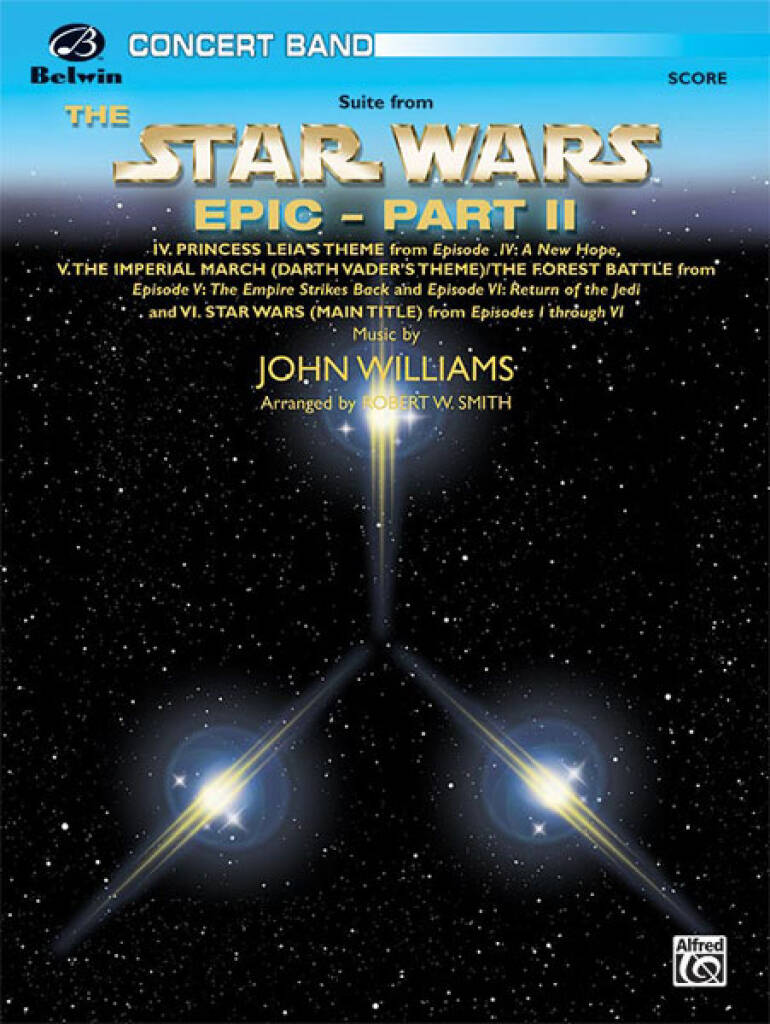 £80.95
Suite from The Star Wars Epic - Part II - John Williams
Playable alone or with Part 1 (24772), the Suite from Star Wars Epic -- Part II completes the journey. John Williams stellar film scores have received global acclaim for decades. Robert W. Smith has selected four cherished themes in threemovements. Included are Princess Leias Theme (from Episode IV: A New Hope), Imperial March/The Forest Battle (from Episode V: The Empire Strikes Back) and (Episode VI: Return of the Jedi) and Star Wars Main Title from all sixepisodes. May the force be with you performing this classic collection.
Estimated dispatch 7-14 working days
 View Music