Searching for Brass Band Music? Visit the Brass Band Music Shop
We've found 1000 matches for your search

Results

  • £154.99

    Piccola Suite Italiana (Concert Band - Score and Parts)

    With this new suite for concert band Franco Cesarini draws on the rich repertoire of folk songs from the Friuli Venezia Giulia region of northern Italy. Between the 16th and 17th Century this rural region developed the 'furlana', a brilliant dance in 6/8 time. This catchy dance soon spread throughout Europe and became more cultivated. Fran?ois Couperin (1668-1733), Georg Philipp Telemann (1681-1767) and Johann Sebastian Bach (1685-1750) all composer of the 18th century composed 'furlane' and in the 20th Century Maurice Ravel used a 'furlana' dance his Tombeau de Couperin. Franco Cesarini follows this great tradition by using the 'furlana' as the basis for this major new concert work. 08:49

    Estimated dispatch 7-14 working days

     PDF View Music

  • £139.99

    Singapura Suite Wind Band Set (Score & Parts)

    Singapura Suite was commissioned by Singapore's Ministry of Education Extracurricular Activities Branch to serve as a compulsory piece for the 1999 Singapore Youth Festival."Singapura" is the original name of Singapore in Malay, the native language there. Because Singapore is one of the most important harbors in the world, this two-piece work opens with a seaman's dance. An authentic melody, Chan Mali Chan, is woven into the middle of this first part, whose ABA form becomes clear through the recapitulation of the seaman's dance in a somewhat altered form.Singapore is also a dynamic city-state alive with excitement, thus the second part begins with a fitting dance, a fast bourr?e. As contrast there is a second authentic melody, Dayung Sampan, a more easygoing sailing song. This short but curious suite ends in high spirits with a recapitulation of the beginning. 0:08:20

    Estimated dispatch 7-14 working days

     PDF View Music

  • £159.00

    Greek Folk Song Suite No. 2 - Franco Cesarini

    After the great success of the Greek Folk Song Suite that has lasted for over twenty years, Franco Cesarini once again ventures into the long and rich tradition of Greek folk music. In his Greek Folk Song Suite No. 2, the three movements that form the piece are named after the three dances reworked by the composer.The first movement, Samiotissa is a kalamatianos, whose most distinctive feature is the irregular 7/8-time signature. It is a festive dance, today considered the Greek national dance, which has roots dating back to antiquity.The second movement, Kato sto jalo is a zeibekiko, a slow-paced dance performed by only one man at a time which was apparently originated among the warriors of Ancient Anatolia.The third and last movement, Chasaposerviko, is the fast part of the hasapiko dance and is characterized by its more extensive form.A new journey into the Greek folk tradition that will delight both performers and audience.

    Estimated dispatch 7-14 working days
  • £349.99

    Symphonic Dances - Yosuke Fukuda

    Symphonic Dances for Wind Ensemble was commission by the Central Band of the Japan Air Self Defense Force. The suite's five movements present "dances of the world". While the energetic quality and spirituality of each dance should be captured, the collection is still intended to entertain. Each movement is complete and can be performed accordingly.I. Renaissance DancesAn homage to European flavor and style from the time of Gervaise, Susato and Praetorius, after the introduction, the steps of courante, pavane, galliard, and branle appear. Please perform with vigor and contrast!II. TangoThis section is more an earthy and piquant Argentine romance than an elegant continental tango. Perform the alto saxophone theme and solis for each section very passionately!III. HoedownHere is the scene of the rodeo and a free-spirited western swing feel. The introductory clarinet solo can be done ad libitum. Maintain the mood by swinging slightly throughout. Present this movement playfully!IV. Spirituals (Bon-Odori-Uta)This is a requiem on the Bon-Okuri ceremony guiding ancestors back to the spiritual world. The initial piccolo motif repeats a chant in the rhythm of bon odori (a bon dance) and develops as a variation on Owara-bushi, a beautiful folk song from Toyama prefecture. The traditional bon odori have evolved into summer festival entertainment.V. Belly DanceThe belly dance is typically Arabic, its music performed by strings and drums.All should play with passion and flamboyance and a sense of bacchanalia and abandon. Employ a heavy sense of rhythm, also with a "Darbuka" (traditional Turkish goblet drum) if possible. Additionally, a "big-bang" coda is not only allowed, but encouraged!(Yosuke Fukuda)

    Estimated dispatch 7-14 working days
  • £115.00

    BOHEMIAN DANCES (Concert Band) - Woolfenden, Guy

    Includes:1. Shepherds and Shepherdesses2. Florizel and Perdita3. Dance of the SatyrsOne of my favourite Shakespeare plays is The Winter's Tale, and I have written music for three completely different productions during my time as Head of Music to the Royal Shakespeare Company. One, starring Judi Dench as both the mother, Hermione and her daughter, Perdita, had a big band Tribal Love-Rock score; another had a more classical, but timeless feel to it, and the last was an excellent small-scale touring production, for which I was allowed only a handful of instruments. It is from this source that the basic themes for Bohemian Dances, and an earlier version Three Dances for Clarinet Choir, have emerged. Act IV of the play is set in the kingdom of Bohemia - hence the title of the work.Shakespeare calls for "A Dance of Shepherds and Shepherdesses", which gives Florizel, the son of Polixenes, (King of Bohemia) a chance to become better acquainted with the beautiful Perdita, the lost daughter of Leontes, (King of Sicilia). This movement is written in seemingly tricky and ever-changing metres, but is rhythmically quite logical and melodically catchy.The slower second movement 'Florizel and Perdita' is the lovers' pas de deux: a gentle, slow waltz-like tune, initially presented by the principal oboe, is contrasted with a lndler-like double time melody, at the end of which a solo clarinet makes a link to the last movement.'Dance of the Satyrs' is a rip-roaring, foot-stamping dance performed in the play by 'three carters, three shepherds, three neat-herds, and three swine-herds', who enter in outrageous costumes representing the lecherous half-man, half-goat of Greek mythology. This dance is referred to as a "gallimaufry of gambols" - now where have I heard that word before?! - GW

    Estimated dispatch 7-14 working days
  • £113.30

    Rumanian Folk Dances - Béla Bartók

    Bla Bartk (1888 - 1945) showed from the beginning of his career an interest in popular music. He began studying music at the age of five and eventually focused on composition and piano. He collected a lot of popular songs, especially during his studies in Hungary, but also music from Romania and Slovakia. This had a lot of influence on his style. In his compositions, Bartk uses many Hungarian popular themes and rhythms, and even his own original works always refer to the same rhythmic and melodic folk character. At the beginning of the twentieth century, Bartk detached himself from romanticism and began to delineate his style on harmonic procedures based on diminished and augmented intervals, on bitonality, and on marked percussiveness, characteristics that are at the core of popular music.The Romanian Dances are a collection of seven folk dances, originally composed for piano (1915, the first six) and then transcribed for a small symphonic orchestra (1917). Of purely modal language, like almost all Bartk's music, each dance comes from a different area of Romania (Stick Dance, Sash Dance, In One Spot, Horn Dance, Romanian Polka, Fast Dance of Belnyes, and Fast Dance of Nygra).

    Estimated dispatch 7-14 working days
  • £66.95

    A Nutcracker Assortment

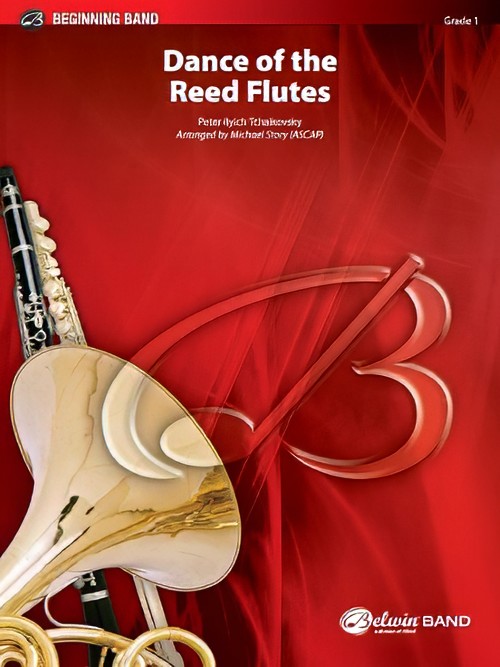
    A Nutcracker Assortment, arranged by Michael Story, contains six memorable themes from one of Tchaikovsky's greatest works. "The March," "Dance of the Sugar Plum Fairy," "Waltz of the Flowers," "Dance of the Reed Flutes," "Arabian Dance," and "Trepak" are all presented here in rapid succession. This piece will be an audience favorite at your holiday concert and serve your students as a great introduction to some of the most memorable melodies from a significant composer. (2:35) The PerformancePlus+ series is an innovative addition to the ever-expanding MakeMusic Cloud interactive library. These engaging selections are presented with educational resources designed to enrich the rehearsal process and create outstanding performances. Including:Assignment, recording, and assessment tools within MakeMusic CloudPiece-specific exercises focused on skills and techniquesPrintable sheet music (with a standard MakeMusic Cloud subscription)Educational tips and suggestions to support learningAvailable in print and digital formats.

    Estimated dispatch 7-14 working days
  • £79.99

    Simple Sarabande - Philip Sparke

    The sarabande originated in the early 17th century and is a stately dance in triple time. It was popular in France and Spain but as a dance it quickly spread throughout the courts of Europe and the style was soon adopted into instrumental music in dance suites for solo instruments as well as orchestra. Something of this style has influenced Simple Sarabande and although its harmonic language is perhaps more up-to-date it could be seen as a 'period piece'.

    Estimated dispatch 7-14 working days

     PDF View Music

  • £204.99

    Ceremonial - Ferrer Ferran

    Ceremonial was composed for the opening of the Auditorio Florida, the home base of the Banda Primitiva de Paiporta. The composition consists of three movements. I. Introduction - The introduction is presented in the form of a fanfare; it heralds the ceremony in a majestic way. II. March - The marching music leads to an expressive and delicate melody that contrasts with the other movements.III. Dance and finale - A dance concludes the ceremony. The dance, in combination with the melodic lines, radiates energy and grandeur, and finds its climax in a grandiose moment, which every ceremony deserves.

    Estimated dispatch 7-14 working days
  • £150.00

    The Perfect Fool, The Ballet from (Concert Band - Score and Parts) - Holst, Gustav - Noble, Paul

    The music for The Perfect Fool is taken from an opera by the same name, written by English composer Gustav Holst over the period of 1918 to 1922. The opera received its premiere at the Covent Garden Theatre, London on 14 May 1923. This arrangement consists of the three distinct dances: Dance of Spirits of Earth, Dance of Spirits of Water, and Dance of Spirits of Fire. They embody the power, intensity, mystery and sheer beauty that define this piece. This arrangement includes the original celesta and harp parts. However, the celesta may be substituted with piano at the octave, and the vibraphone covers the significant harp solos.

    Estimated dispatch 7-14 working days

     PDF View Music