
Results
-
£106.95
The Masks - Ronald Lo Presti
The Masks was composed in 1955 as a two movement orchestral suite that was part of the American Composers' Edition series produced by Eastman in conjunction with Carl Fischer music publishers. Lo Presti, a student of Howard Hanson is perhaps best known for his Elegy for a Young American written for concert band. Indeed, The Masks is reminiscent of the Elegy in its romantic style with rich contemporary harmonies. There is no programmatic significance to the title, according to Lo Presti, other than the fact that the two movements are in contrasting moods, much like the Greek masks of comedy and drama. Gregory Rudgers transcription is authentic to the orginal piece and gives bandseverywhere a new LoPresti piece of significance.
Estimated dispatch 7-14 working days
-
 £110.99
Second to None - Philip Sparke
Second to None is a perfectly suitable title for this work, though it actually refers to "Nulli Secundus", the motto of the British Corps of Army Music, who gave the commission to Philip Sparke. The piece opens with a fanfare, followed by two short quotes from two of the Corp's own marches and a festive Vivace. A more legato central section creates a nice contrast before the work closes with the opening fanfare. A perfect affair!
Estimated dispatch 7-14 working days
-
 £244.00
Anemoia - Gauthier Dupertuis
Gauthier Dupertuis wrote Anemoia as part of his master's thesis at the Lausanne University of Music. It is dedicated to the most significant figure in his musical life: his teacher Jean-Claude Kolly.Anemoia is the name given to the feeling of nostalgia that one feels for a time that has never known. This emotion often translates into the uneasy sensation of having lost something important or of not living at the right place or time. Fascinated by this concept, Gauthier Dupertuis tried to translate it into music oscillating between exaltation, anguish and nostalgia.The piece is formed by two movements: (Un)desired sorrow and Behind the glass of time. The first movement initially evokes the feeling of unease one feels when suddenly struck by anemoia. It then evolves into majestic atmospheres, marking our admiration for times gone by. The second movement treats anemoia in a more melancholic way.The premiere took place on 6th December 2024, during Jean-Claude Kolly's last concert as a conductor of the Concordia de Fribourg, marking thirty years spent conducting this wind orchestra.
Estimated dispatch 7-14 working days
-
 £112.99
Bite the Bullet - Jorge Machain
Bite the Bullet by Mexican-American composer Jorge Machain was named 2019-2020 winner of acclaimed "The American Prize" for music, in addition to being a finalist in the 2018 NBA Revelli competition. The work was inspired by a painting by Venetian artist, Carlo Marchiori, which depicts two 'Pulcinelli' (Venetian clowns) engaged in a gun battle. As the bullets meet in the middle of the scene, a colorful and vibrant cloudburst is created. Using a unique sonic color scheme, the brass and percussion portray the gunshots, while the woodwind flourishes emulate the painter's vibrant brush strokes.Commissined and recorded by the UNLV Wind Orchestra Thomas G. Leslie, conductor,featured on the Klavier recording "Quarternity" K11123.
Estimated dispatch 7-14 working days
-
 £225.99
Los Libros Olvidados - Johan de Meij
1. Barcelona 19452. Los Libros Olvidados - El Cementerio3. Las Ramblas - Els Quatre Gats4. Coubert - El Hombre sin Rostro5. Bea (Beatriz)6. El Inspector Fumero7. La Ciudad de las SombrasThis is a story wrapped within a story that unfolds in Barcelona 1945, following World War II. The protagonist, Daniel Sempere, is the teenage son of an antiquarian book dealer, who one day takes him to the Cemetery of Forgotten Books, a mysterious place with labyrinthine corridors where rare and banned books are stacked in massive dusty piles. His father tells Daniel to select a book, but it will be his responsibility to protect it. Daniel picks La Sombra del Viento (The Shadow of the Wind), a novel by a forgotten author Julin Carax. Daniel immediately starts reading the book, and the story unwinds itself into a compelling and complicated plot. As he reads, Daniel finds himself and his own life merging into the story's plot. It transpires that there is a mysterious man named Lan Coubert ('the man without a face') who is determined to destroy all copies of Carax's books. Daniel is threatened by Coubert and is determined to find out what happened to Carax, who fled to Paris and subsequently disappeared. Daniel finds that his own life has much in common with the author's. The book mixes magic realism, page-turning mystery, and Daniel's own real life. Daniel's once ordinary teenage existence is now filled with larger-than-life colorful and at times, terrifying characters. Among them are Fermn Romero de Torres, a beggar who Daniel and his father befriend and employ in the family bookstore; the evil police inspector Javier Fumero, who could be compared to Scarpia in Puccini's opera Tosca or Javert in Les Misrables. The corrupt Fumero uses the war as an excuse to practice his sadism and is widely feared in Barcelona. He is represented in the music by a fascist military march. The city of Barcelona becomes a character in the book and in the music. The Ramblas, the boulevard running through Barcelona's Gothic Quarter and the famous caf Els Quatre Gats (the four cats) come alive in the score through a Cobla, the traditional wind ensemble playing a sardana, typical Catalan folk music. Two parallel love stories turn up the heat: Julin Carax's passionate, forbidden love for Penlope, and Daniel's equally passionate and forbidden love for Beatriz (Bea). Bea's sultry love theme is based on the first three letters of her name, with the ascending intervals B-E-A. Johan de Meij New York, October 17th, 2023
Estimated dispatch 7-14 working days
-
 £79.99
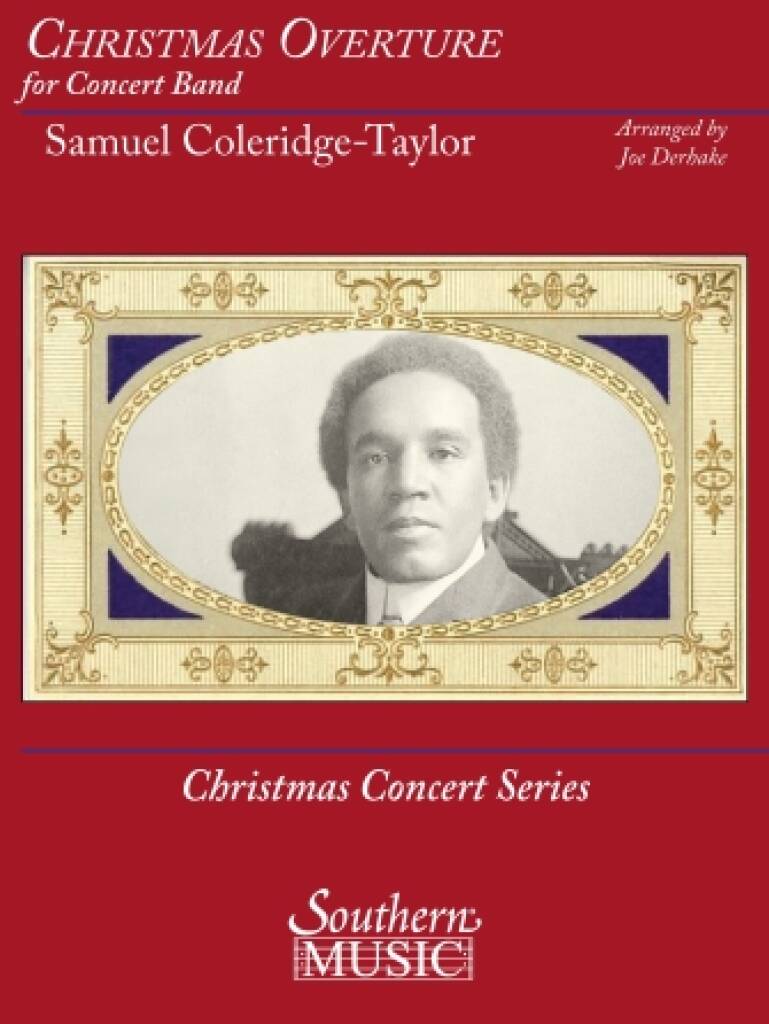
Christmas Overture - Samuel Coleridge-Taylor
Samuel Coleridge-Taylor's Christmas Overture appeared posthumously in 1925. Originally orchestrated by Sydney Baynes, it features God Rest Ye Merry Gentlemen and Hark the Herald Angels Sing. It is thought by some to have been put together from incidental music he wrote for a children's play called The Forest of Wild Thyme. This band arrangement, based on Baynes' orchestra score, omits the largely developmental middle section of the original, shortening the performance time by two minutes, while retaining all of the traditional carol material.
Estimated dispatch 7-14 working days
-
 £76.99
Drums of the Saamis - Samuel R. Hazo
Drums of the Saamis was commissioned by the Medicine Hat Concert Band Society of Medicine Hat, Alberta, Canada. The piece chronicles the merger of the First Nation (first natives) and modern Albertan cultures.The opening tribal drums followed by the haunting melody simulating the traditional wooden flute comprise two themes that are the foundation for the entire piece. Both elements are developed, varied and enhanced throughout as the listener senses the increasing influence of modern day Alberta through the use of modern sounding chords and rhythms.By the end, the marriage of the old and the new is complete. This powerful work closesas it began; a restatement of themes representing the musical and historical foundation of the region. Dur: 5:00
Estimated dispatch 7-14 working days
-
 £82.50
Chant and Celebration - David Gorham
Commissioned by the Oklahoma Secondary School Activities Association, this distinctive work for developing band is highlighted by two contrasting sections. A quiet opening is flavored with percussion sounds reminiscent of Native American music, while lyric woodwinds float above, weaving expressively hypnotic melodic lines. This spellbinding effect is then broken by a joyous and spirited celebration that unfolds in a delightfully uplifting manner, closing the work in a grand and joyous fashion.
Estimated dispatch 7-14 working days
-
£139.99
Algemiz - Ferrer Ferran
Algemesi is a town situated on the banks of the river Sucron, in the south of Valencia in Spain. Algemiz by Ferrer Ferran was inspired by two historical events connected with the town. When the Iberian peninsula was under the rule of the Romans a bloody battle took place between the armies of the generals Pompey and Sertorius known as The Battle of Sucron. Much later in the 13th century, Don Jaime 1, king of Aragon who had been defeated by the Maures d'Almenara, decided to lead an expedition to Sucron to evaluate the resistance of the Arab forces and conquer Alegmesi. This story of this expedition is told in The Dance of the Conquerors.
Estimated dispatch 7-14 working days
-
 £39.95
Music for Junior Wind Band - Vol. 6 - Adrian Taylor
The arrangements and compositions in these books were written by Adrian Taylor for various beginner or school bands that he has conducted over the years. Children joined these bands on the 2nd parts, usually having only been playing for a year and they then progressed to the 1st parts the following year.This volume of music was orchestrated a little differently to the other volumes but the easiest parts for each instrument continue to be written without key signatures in treble clef, in B flat major for bass clef trombone and euphonium and in E flat major for bass clef tuba. More advanced parts are written with the appropriate key signatures for each piece, reflecting the greater understanding and skills of the players on these parts. Most of the pieces can be played with only a few parts being covered, the addition of the other parts usually enhancing the arrangement rather than simply doubling existing musical lines. The essential parts are the Trumpet (and Clarinet or Cornet) parts, the two Trombone/Euphonium parts and in No. 4, the 1st Horn part. A piano part helps to fill out the harmonies where other parts are missing. The brass parts in the wind band versions are identical to those in the brass versions. This volume was created so that beginner players can play Calypso and When The Saints, which feature in Just Play... Book 1, accompanied by their school band.
Estimated dispatch 7-14 working days
 View Music