
Results
-
£137.99
Three Onegin Dances - Pyotr Ilyich Tchaikovsky
Tchaikovsky is best known for his purely instrumental compositions. However, we must not underestimate him as a composer of operas. Many of his operas such as Pique Dame and Eugene Onegin are still performed regularly throughout the world. Eugene Onegin (also called Jevgeny Onegin), composed in 1877-1878, was not called an opera by Tchaikovsky himself, but "lyric scenes". The work is entirely dominated by lyricism. However, there are two moments that contrast sharply with this lyricism: two ball scenes, for which Tchaikovsky wrote a waltz and a polonaise.After opening with a less well-known allegro dansant, this arrangement features the aforementioned waltz, which can beconsidered a beautiful Russian equivalent of the Faust Waltz by Charles Gounod. In the opera, this waltz is actually played by a military band. The arrangement concludes with the pompous polonaise (also mentioned above) which opens the last act: the ideal music to characterize high aristocracy in the salon of a palace in St. Petersburg.
Estimated dispatch 7-14 working days
-
 £116.40
Rapsodie sur des Themes Normands - Serge Lancen
The Paris born composer and pianist Serge Lancen (1922-2005) studied the piano with Marguerite Long and composition with Tony Aubin at the conservatory of his native town and was awarded a Prix de Rome. Lancen composed symphonic music, choral works, ballet music and several concertos.In 1960 he met his ancient study friend Dsir Dondeyne, conductor of the Paris Metropolitan Police Band, who incited him to write for symphonic band. Lancen wrote an impressive series of wind band works that earned him an international reputation. Among his most successful compositions are Manhattan Symphony (1962) an Cape Kennedy (1970), but we should not forget that Lancen also wrote several fine works for symphonic bands of average level. So he did in 1976 by writing two rhapsodies based respectively on Breton and Normandy themes. The Rhapsody on Themes from Normandy was recorded in 1977 on a long playing record by the French National Police Band conducted by Pierre Bigot alongside with Le Mont-Saint-Michel, Hymne la Musique and Rapsodie sur des Thmes Breton. Rhapsody on Themes from Normandy is a piece that is characterized by an original orchestration and fluent melodic lines, two main characters of Lancen's music.
Estimated dispatch 7-14 working days
-
£78.00
Interlude - Wilhem Stenhammar
Wilhelm Stenhammar (1871-1927) was a Swedish pianist, conductor and composer. His compositions include incidental music, operas, concerts, two symphonies and choral works. Initially influenced above all by Wagner and Bruckner, Stenhammar increasingly welcomed in his music a Nordic colour as well as melodic and rhythmic characters typical of Swedish folklore. Completed in 1921, the cantata Sngen (The Song) was Stenhammar's last major work, and its combination of harmonic richness and contrapuntal dexterity ensured it a warm reception.The Interlude connecting the two halves of the work is the only part frequently performed today. It begins by creating a serious and intimate atmosphere, then the music gradually unfolds in increasingly powerful sonorities. Towards the middle a noble brass chorale emerges, but neither this nor the following finely crafted climax manage to change the prevailing mood of subtle melancholy typical of late Romantic Scandinavian composers. This arrangement by Franco Cesarini will allow your audience to get to know this great composer unknown to most.
Estimated dispatch 7-14 working days
-
 £53.50
Four Pictures - Árpád Balázs
The teachers under whom rpd Balzs (b.1937) studied composition - Ferenc Farkas, Aram Khachaturian and Goffredo Petrassi - each independently formed the opinion that with his lyrical gift rpd Balzs's true creative field would be that of choral music and wind ensembles. Their early predictions are borne out by the roughly two hundred and fifty works for choir and almost twenty for wind orchestra that the composer has since produced. It is interesting that in the suite entitled Ngy kp (Four pictures) the stylistic features of these two related musical fields are united. In it the wind instruments sing! It was not by chance that the expansive second movement was given the title Cantilena, while the slightly livelier but just as lyrical third movement was entitled Arietta. The opening movement of the work is a stridently jolly, energetic Indul (March), but not one of the rigidly military kind: the 6/8 rhythm contributes to its light-hearted character. This music is avowedly akin to the ballet music of Prokofiev. This choice series of four character pieces is crowned by Jtk (Play) in which conveying the effect of the mixture of lines moving in parallel and then colliding with each other may be more technically demanding, but is well worth the effort! (Hungaroton HCD 31353)
Estimated dispatch 7-14 working days
-
 £233.99
First Symphony, Op. 35 - James Barnes
Composed during the summer and fall of 1974, Barnes' FIRST SYMPHONY, Op. 35 was his master's thesis at The University of Kansas. It was premiered in the spring semester of 1976 by their Symphonic Band, Robert E. Foster conducting. The following year, the symphony was awarded the American Bandmasters Ostwald Composition prize, which led to a second performance (of only the first two movements) by the Northwestern Wind Ensemble at the American Bandmasters convention with Col. Jack Cline (U.S Marine Band) conducting. Following this performance, Barnes submitted the work to several publishers, all of which declined on the basis it was too long and difficult to be marketable. For this reason, Barnes set the work aside and there it remained until 2022, when an offer came from the Osaka Shion Wind Orchestra to record all nine of Barnes'_x001A_symphonies to help celebrate their 100th anniversary. Barnes seized the opportunity, engraving all four movements, with revisions and corrections, an effort that took seven days a week for two months to complete. As a result, after almost fifty years, all nine of the Barnes symphonies are finally available for performance.
Estimated dispatch 7-14 working days
-
 £149.40
Grevling i taket - Øystein Dolmen og Gustav Lorentzen
This is an arrangement which has to be performed a bit humorous in the spirit of the original.It starts with a kazoo-like opening, played on the mouthpieces. At C, flutes and clarinets should stand up. Maybe the musicians can play it by heart?Two bars before D, the tempo increase. On E, the trumpet players should stand (and play by heart)?New, even higher tempo two bars before F. The trombonists should stand up in bar 103 to prepare for a terrific tempo. But G will be played like a laidback reggae-version. The saxophonists can stand up simultaneous with the glissando in bar 120.The tempo at H should be high and fresh and with several sections standing. In bar 158 should almost all players sit. At bar 160 everyone should stand up.In bar 162, all players should turn to the audience during the crescendo.
Estimated dispatch 7-14 working days
-
 £100.00
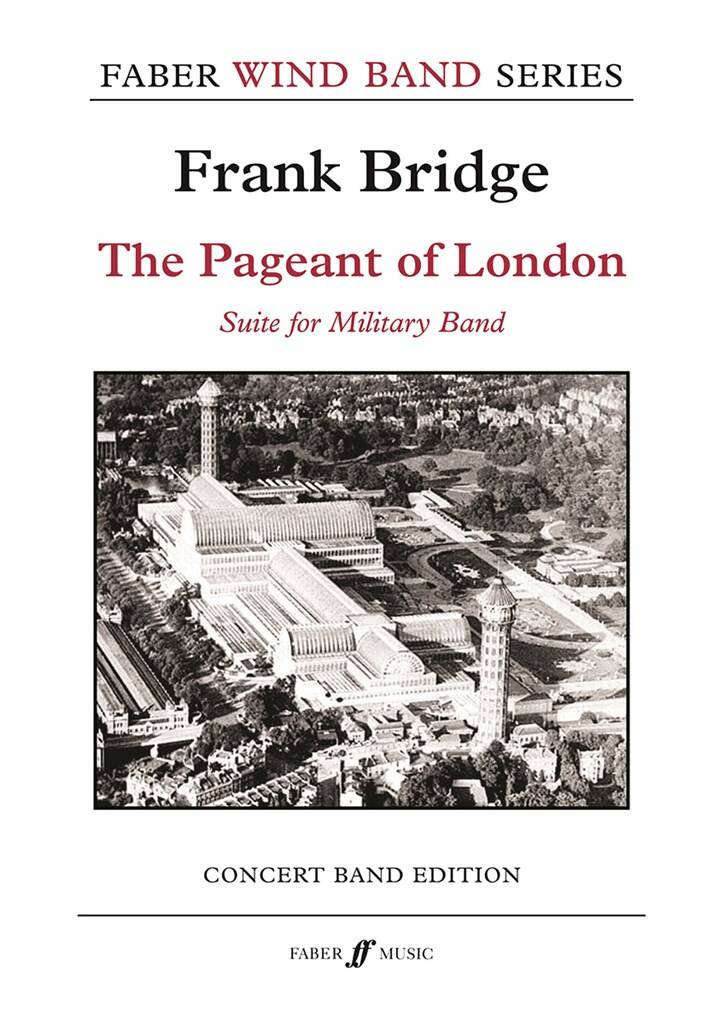
The Pageant of London - Frank Bridge
Frank Bridge was one of the finest English composers of the first half of the 20th century. The Pageant of London is his only work for wind band, comprising of two marches, one scored from Bridge's best known organ piece and including the chimes ofBig Ben, plus three short renaissance pastiche items, one arranged from Playford (later used by Peter Warlock in Capriol Suite). The music is tuneful, approachable and, in the words of wind band 'legend' Timothy Reynish makes a fine alternative toHolst's two suites, which were composed around the same time. Reynish has introduced this work to concert bands right across the world. It has been performed in USA and the Far East, recorded by the celebrated Kosei Wind Orchestra of Japan and alsoby the BBC National Orchestra of Wales in the Chandos edition of Bridge Orchestral Music.
Estimated dispatch 7-14 working days
-
 £50.50
Dueling Dragons - Robert W. Smith
Inspired by a rollercoaster ride as enjoyed by composer Robert W. Smith and his children, "Dueling Dragons" features two distinct groups of instruments. The brass and select percussion represent "Fire" with the woodwinds and metallic percussion representing "Ice." The duel between the two includes interacting melodic lines and intense effects leading to a very exciting conclusion. Exciting and educationally rich with teaching opportunities, "Dueling Dragons" will be one of those pieces that your students ask to play over and over. Let the fun begin!
Estimated dispatch 7-14 working days
-
£154.99
Symphonic Variations - Jacob de Haan
This composition is based on a passacaglia theme, in which artistic perfection, symphonic drama and oriental melody lines play a role. The passacaglia is originally a dance made up of a series of variations above a bass line constantly present as an ostinato. It is not in this sense that the "Symphonic Variations" are in the passacaglia form but in the sense of the open form of the variations. Jacob de Haan, himself originally an organist, took his inspiration for this piece from the famous passacaglia for organ in C-minor by J.S. Bach. Following the introduction of the passacaglia theme (in the bass) the entry by the trumpets and trombones forms the majestic start to amusical adventure, in which this theme (often fragmentary) returns in variations. Then there follow two faster movements with dramatic contrasts and virtuose passages. Particularly striking here is the use of two characteristic intervals from the beginning of the theme namely the minor second and the augmented fourth. An apause in the composition comes in the slow bridge where a syncopated bourdon (perfect fifth) is constantly repeated. The tension grows in dynamics and harmony, and the oriental-flavour becomes obvious in the melody. We arrive at a faster movement via an accelerando, in which a perpetuum mobile based on the passacaglia theme is central. Finally the whole flows into a martial theme, in which the ostinato accompaniment n the descant derives from the passacaglia theme.
Estimated dispatch 7-14 working days
-
 £116.40
Norma Ouverture - Vincenzo Bellini
The composer of some famous operas such as 'La Sonnambula' and 'The Puritans', Vincenzo Bellini (1801-1835) was largely self-taught. Although he wrote eleven operas, only 'Norma' remained popular, not in the least because of its splendid lyrical arias such as Casta Diva (Chaste Goddess) and Mira, O Norma (Hear me, Norma) familiar to all music lovers. The opera 'Norma' is written to a libretto by Felice Romani, based on a French melodrama by Alexandre Soumet and Louis Belmontet dealing with a story of Druids during the Roman rule. The story is neither accurate historically nor convincing dramatically, but the score is full of brilliant melodies of a type calculated to exhibit a singer's virtuosity to the utmost. The Gods order the priestess and fortune-teller Norma to give the signal of revolt against the Romans in Gaul, but she postpones this because of her relationship with the Roman proconsul Pollione with whom she secretly had two children. In the meantime, Pollione has fallen in love with the young priestess Adalgisa and Norma wants to take revenge. Finally both Norma and Pollione die on the pyre. This tragical opera in two acts was first performed at the Scala of Milan on 26 December 1831.
Estimated dispatch 7-14 working days
 View Music