
Results
-
 £76.99
Heb je even voor mij Wind Band Set (Score & Parts)
Since his first successes in the 1990s the amiable popular singer Frans Bauer has grown into a megastar in the Netherlands. In Germany, too, he has a great number of fans. Although he is derided by many because of his schmalzy style, Frans Bauer sells CDs galore, attracts full houses everywhere and can be viewed in his own reality soap on television. In 2004 he was even awarded a Gouden Harp (Gold Harp), which is the most important prize within Dutch music. It is presented to artists and composers who have promoted Dutch light music in their own unique way during their career. The cheery singalong Heb je even voor mij (Got a Minute for Me) is a great top hit: a winner in every pub and at parties. This arrangement by Klaas van der Woude willput the musicians as well as the audience in a happy mood. 0:02:30
Estimated dispatch 7-14 working days
-
 £77.50
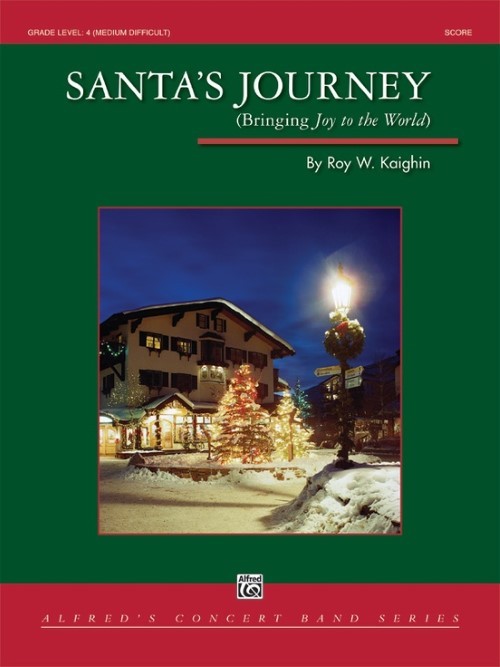
Santa's Journey (Bringing Joy to the World) (Concert Band - Score and Parts) - Kaighin, Roy
As Santa starts his journey, bringing 'Joy to the World' by delivering presents to children - and adults too, he sets off on his majestic sleigh driven by his reindeer. A few elves have snuck into the sleigh to help. With a whoosh, he flies across the sky and over the snowy mountains. The music is in continuous motion, just like Santa's Sleigh, as he has many presents to deliver before morning.The quiet moments in the music depict Santa's arrival in small villages, away from the hustle and bustle of the big cities, touching the hearts of people everywhere. During his journey, Santa discovers the elves who have apparently lost some of the presents. Santa offers a gentle reprimand before the presents are ventually found by Elfie, the youngest Elf. After all the presents have been delivered, Santa heads back home as he calls out, "I'll be back next Christmas!"Duration: 4.15
Estimated dispatch 7-14 working days
-
 £115.00
Duet from Don Carlo (Trombone or Euphonium Duet with Concert Band - Score and Parts) - Verdi, Giuseppe - De Meij, Johan
Don Carlo was originally written (title Don Carlos) as a French five-actor for the 1867 world exhibition in Paris. Later, Verdi transformed this improant grand opera into a four-acter in Italian. With its many leitmotifs, Don Carlo was 'too Wagnerian' according to French critics, although Verdi hardly knew the music by his German colleage. For the record, the composer was not happy either with the 'lifeless and cold' performance in Paris, and the drama, concerning Charles V, Philip II and crown price Don Carlo, found its way to La Scala only twenty years later. This duet, arranged by Johan de Meij, originates from the second act. While monks pray for the soul of Emperor Charles V, his grandson Don Carlo takes the stage, tormented by the fact that the woman he loves is now married to his father. Carlo's friend Rodrigo, the Margquis of Posa, has just returned from Flanders. He asks crown prince Carlo to help him ease the oppression and suffering of the Flemish people. Carlo reveals his secret: he is in love with his stepmother. Rodrigo advises him to leave Spain and to go to Flanders. The two men vow to be friends forever in the duet Dio, che nell' alma infondere (God, who wishes to instil love and hope in our souls). Duration: 4.00
Estimated dispatch 7-14 working days
-
£71.28
A Kind And Gentle Soul
This prolific composer has penned many beautiful pieces. On this occasion, he has created yet another powerful and expressive composition that is highly reflective in nature. Composed in honor of a young boy who passed away far too soon, this emotional work is scored to evoke the kind traits that he displayed to the many people whose lives he touched. Truly inspiring!
Estimated dispatch 7-14 working days
-
 £102.80
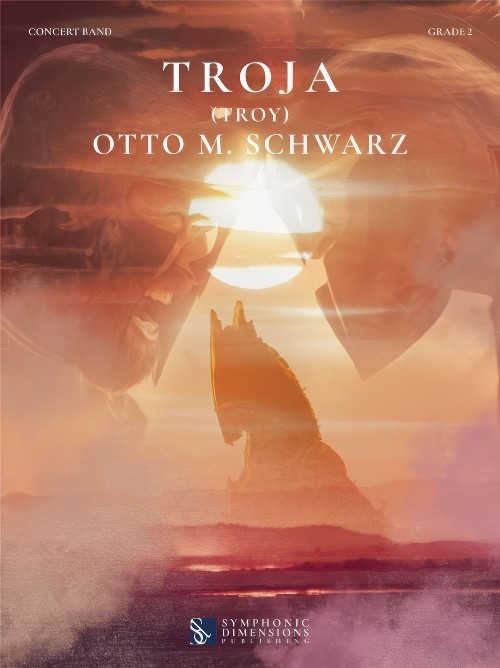
Troja (Troy) (Concert Band - Score and Parts) - Schwarz, Otto M.
The Greek poet Homer wrote about Troy and the Trojan War, which probably took place in what is now Asia Minor, in his Iliad in the 8th century B.C. Nowadays, the term Trojan generally refers to a malware program that is used to gain unauthorised access to computers. This use comes from the legendary Trojan Horse, which saw the turning point in the battle between Greeks and Trojans through the cunning of Odysseus. Let us return to the beginning of the story: Paris, son of the king of Troy, is tasked by Zeus with judging the beauty of the three goddesses Aphrodite, Pallas Athena, and Hera. Aphrodite, the goddess of love, flatters Paris by promising him the most beautiful woman in the world. Soon afterwards, on a journey to Greece, Paris meets the beautiful Helen, who immediately falls in love with him. Since however she is the wife of Spartan king Menelaus, she eventually lets herself be kidnapped by Paris voluntarily. The Greeks then form a large army and go to war against Troy to retrieve Helen, leading to a ten-year siege of the city. The city is eventually conquered not through combat, however, but through Odysseus' cunning ploy. He has the idea of building an enormous wooden horse with warriors hidden inside. The horse is placed at the gates of the city. Thus, the Trojans are tricked into giving up the siege when, despite various warnings, they bring the horse into the city to dedicate it to the goddess Athena. At night, the soldiers climb out of the horse and open the gate for the Greek army. The troops storm the city and burn it to the ground. The royal family and all the Trojan warriors are killed, only Aeneas, the son of Aphrodite, escapes. Later, following many years' wanderings he and his acolytes will become known as the founders of the Roman people. There are various accounts of the fate of the beautiful Helen. She is said to have returned to Sparta with Menelaus and to have ruled there until the end of her life. Or maybe not...Duration: 6.00
Estimated dispatch 7-14 working days
-
 £205.70
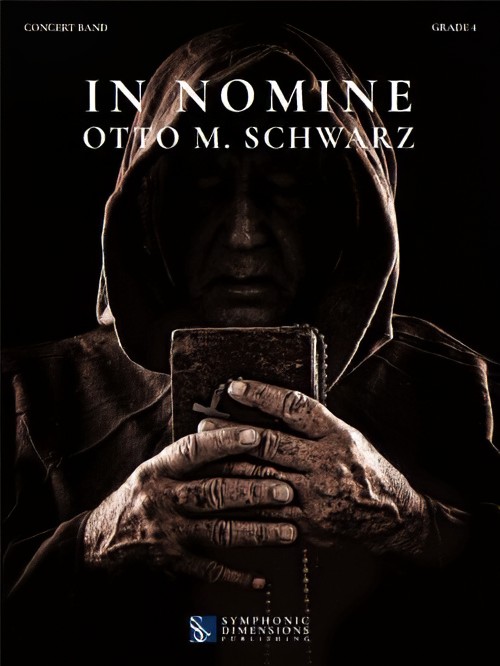
In Nomine (Concert Band - Score and Parts) - Schwarz, Otto M.
How often has something been justified by, declared to be, or blessed as 'in the name of' some cause or other? How can it be that opposing armies and the use of weapons are ever 'in the name of...'? This is a common thread in the history of different faiths. Good was created but evil was committed and all 'in the name of...' This thread is also found in the history of the Premonstratensian Abbey at Wadgassen. The abbey was built in the 12th century on unfertile, desolate moorland, which later evolved into the most powerful religious community in the Saarland. The history of the abbey records quite astounding achievements under the motto desertum florebit quasi lilium ('the desert will bloom like a lily'); but also the harsh treatment of delinquents. The order had its own school, in which children were taught the seven liberal arts (which included music as well as geography and astronomy), but the poor were left to starve outside the abbey walls and were only allowed to eat from the members' leftovers on feast days. The medieval witch trials demanded their pound of flesh, and one group that fell victim were ecstatic dancers who moved wildly to music, which was interpreted as the devil's work. The result: a show trial that sentenced the dancers to death by fire. All in the name of... The year is 1789: Abbot Bordier is in the tenth year of his command. He does not yet know that he is to be the last abbot of an almost 700-year tradition. Not far from the abbey is the French border, which has long been making itself felt with the sound of gunfire, and the brothers continue to keep a nervous eye on it. The first portents of the French Revolution loom, but no one wants to believe it, that is, until the French pound the door down, storm the abbey and come right into the brothers' chambers. In a blind fury, all the pipes of the abbey organ are torn out, icons beheaded with swords and brothers beaten death while numerous buildings are set on fire. The abbey church is in flames. A frantic and desperate escape begins. Abbot Bordier and a handful of brothers make their getaway via the River Saar, adjacent to the abbey, to the neighbouring village of Bous. They survive, but their life, the Premonstratensian abbey, is destroyed. While they flee towards Prague and the sanctuary of the Strahov Monastery, the abbey at Wadgassen is razed to the ground and becomes a stone quarry. The desert blooms once more, however. A few short decades later, a glasswork arises from the foundations of the abbey. As peace returns to the region, it brings jobs and a new vision for its people.Duration: 11.15
Estimated dispatch 7-14 working days
-
 £118.99
Elisabeth (Concert Band - Score and Parts) - Levay & Kunze - De Meij, Johan
The world premiere of the musical Elisabeth took place in Vienna on September 3, 1992. From the great acclaim with which the musical was received, it became clear that the life of the Empress of Austria still appeals to the imagination. Although Elisabeth's life (1837-1898) as an Empress has a fairy-tale-like beginning, it takes a gloomy turn. In this production, Luigi Lucheni, the man who finally takes her life, tells her story. Death plays a major role throughout Elisabeth's life. In the musical, an equally mysterious and attractive man portrays the phenomenon of death, seducing her to the realm of death time after time. Elisabeth's life resembles a fairy tale when she marries the Emperor Franz Joseph at the age of sixteen. Her mother-in-law, Archduchess Sophie, does not make it easy on Elisabeth. But it is life itself that puts the Empress to the test. First, her youngest daughter dies. Then, not long after her son Rudolf is born, her happiness is clouded when her mother-in-law decides she must take pity on him. After her husband's unfaithfulness and Sophie's death, Elisabeth is so disillusioned that she chooses a travelling existence without realizing her husband and her son, Rudolf, miss her. Rudolf's loneliness is one of the reasons he commits suicide. The accumulation of disappointments in Elisabeth's life almost drives her into the arms of Death. In the end, however, it is Lucheni who kills her.Duration: 8.30
Estimated dispatch 7-14 working days
-
 £191.30
Nepotism (Movement II from Symphony No.1, The Borgias) (Concert Band - Score and Parts) - Schwarz, Otto M.
A sinister legend hangs over the Borgia family, a legend of corruption, abuse of power, orgies, sex and murder. These rumours proliferated especially during the papacy of Alexander VI, a descendant of the family, who was even called the Antichrist. On his death, contemporary witnesses reported that the devil himself prowled around the death chamber and a black dog run along the corridors of the Vatican as his emissary. One might say that this Borgia pope, who ruled together with his family with the greatest brutality, became demonised. Unscrupulousness, poison-toting, incest and other malice are to this day the hallmarks of this pontiffNepotism: Rodrigo Borgia was elected Pope on 11 August 1492. From the very start, the new pope was prepared to use any means to eliminate his opponents, either through the infamous Borgia poison or by excommunication and execution. His son Cesare, who wanted little to do with the church, was appointed cardinal against his will. Alessandro Farnese, broth of Giulia Farnese, the Pope's mistress, also became a cardinal. Numerous Spaniards were brought into the country and were appointed to ecclesiastical posts. This infuriated the opponents of Alexander VI. The Dominican Girolamo Savonarola from Florence demanded the removal of the Pope. He was tortured and banned. Giuliano della Rovere wanted to convene councils to depose the Pope, which Alexander managed to prevent through artful political manoeuvrings. Through great brutality, brilliant political skill and power games, this pope was able to achieve his goal of leaving for his children a great legacy. Alexander VI constantly changed his allies and always acted unscrupulously to improve his financial situation and expand his sphere of influence. At the centre of the second movement of this work is the medieval hymn Dies Irae (Day of Wrath), which acts as a warning in the background condemning the Pope's actions.Duration: 9.15
Estimated dispatch 7-14 working days
-
 £244.99
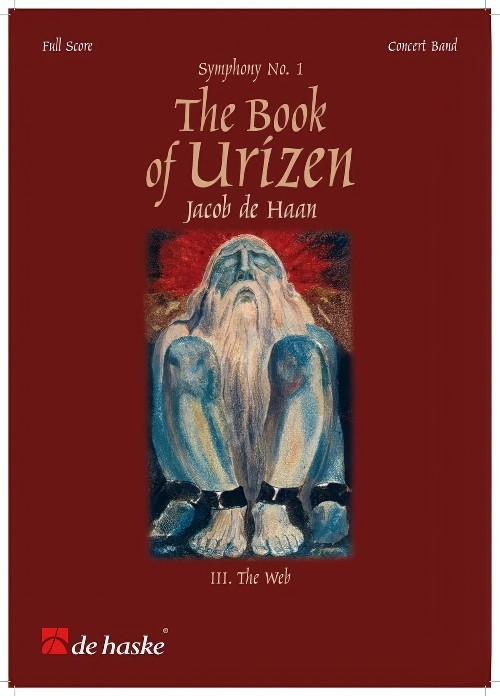
The Book of Urizen (Movement III: The Web) (Soprano, Narrator and Concert Band - Score and Parts) - De Haan, Jacob
The Book of Urizen is a work for concert band, solo soprano, and a male narrator in which sound collages of religious expressions are used. The piece is inspired by the compelling visionary poem of the same name (which the poet illustrated himself) by the Englishman William Blake (1757-1827), who occupies a unique position in western literature and the visual arts. He was not just a poet and a writer, but he was also a graphic artist, a painter, an illustrator, a spiritualist, a religious visionary, and a mystic philosopher. For the performance of this work, a professional sound system, including two microphones and a CD player, is needed. The three sound collages are three separate tracks on the enclosed CD and can be played easily at the right moment.The Book of Urizen bears resemblance to Genesis and Exodus, of which the contents form the basis of the Christian, Jewish, and Islamic faith. Blake adhered to the principle that all religions are in fact one, and that deities reside in human beings. In The Book of Urizen this is represented in "The Net of Religion," which is spanned over the earth by Urizen. The sound collages, compiled by Jacob de Haan in the studio, find their origin in Jerusalem, the Holy City, where the afore-mentioned faiths come together.The first two movements, The Vision and The Creation, are available in a separate set.
Estimated dispatch 7-14 working days
-
 £144.99
Pierius Magnus (Concert Band - Score and Parts) - De Haan, Jan
Pierius Magnus is a historical figure from the Friesland area of Holland. He was a farmer who became a resistance fighter against Dutch oppressors in around 1500. Whether Magnus was a hero or barbarian is still debatable, but composer Jan de Haan was fascinated by the exciting story and let it fuel his imagination. The protagonist is introduced with a capricious theme which is followed by "De Arumer Swarte Heap," the troops who took to the battlefields against the Dutch. An eerie calm takes over moments before Pier and his troops let their battle cries sound. The work ends as the disillusioned Pier retreats. A concert work overflowing with excitement!Duration: 9:00
Estimated dispatch 7-14 working days
 View Music