
Results
-
 £137.99
The Seventh Night of July - Itaru Sakai
In Japan, July the 7th is a holiday known as Tanabata, for which large celebrations are held throughout the country. The holiday is based on a legend about a young man and a young woman who are separated by the Milky Way and can only see each other once a year on this night. The Seventh Night of July is Itaru Sakai's musical interpretation of this romantic legend. The alto saxophone and euphonium solos during the middle movement represent the two main themes from the legend.
Estimated dispatch 7-14 working days
-
£184.99
Rubicon - Bert Appermont
The Rubicon is a river in Northern Italy which Julius Caesar crossed with his army in 49 BC in defiance of the leaders of Rome, who feared his power. A civil war against rival Pompey ensued, which culminated in Caesar seizing power as the absoluteruler of Rome. The phrase "crossing the Rubicon" therefore refers to any person committing himself irrevocably to a risky, decisive and irrevocable of course of action.The work consists of three parts that deal with this important moment in history.Part 1 (Meditation) symbolises Caesars request to the Gods to assist him in his difficult choice. In a slow introduction we hear the melancholy and beseeching sounds of the duduk (alternatively, this part can be played by a soprano saxophone)and of the soprano solo singer over the bourdon accompaniment. The soprano solo singer then sings "dona tibi pacem" (give him rest) in a melodious and probing theme.In Part 2 (Battle of Pharsalus) trumpets and trombones resound alternately ina stately Roman fanfare, producing a stereophonic effect. This develops into a martial theme in which Caesars impressive army goes to battle against the army of rival Pompey. While the theme of Caesars army fades away, Pompeys theme emerges as anaive dance in six-eight time. His army is definitely in the majority and it believes it can easily defeat the enemy. Suddenly trumpets and trombones clash on two sides of the orchestra: Caesars army advances and attacks. A fierce battle ensues inwhich the two themes are played alternately as well as simultaneously. Thanks to his shrewd battle tactics, Caesar manages to win this legendary battle after all: his theme resounds ever louder in trumpets and horns until everything dies out andchanges into a kind of reconciliation between the soldiers of the two armies. The melancholy "dona tibi pacem" from part 1 now serves as a reconciliation theme.Caesar is now the sole ruler of the New Roman Empire, which would be destined to leave itsmark on our Western civilisation to this day. The third part is a sparkling succession of dance music (Dance) with many Greek and Roman elements in which Caesars victory is praised and celebrated. It is common knowledge that the culture(arts, gods, etc.) of the Romans drew heavily on Greek culture. I have therefore used an authentic Greek theme (the Seikolos song) several times in this part (bar 17 in the euphonium, bar 60 in the base section, bar 68 in the sopranosaxophone) to suggest the music of that era and to evoke the right atmosphere. After a gradual increase in tempo in the entire orchestra, the opening melody gloriously resounds once more, surrounded by virtuoso dance music. The work ends withbombastic brass fanfares in which Caesars theme triumphs once more.NOTE FOR THE CONDUCTOR:The Armenian duduk and the monochord that are used in the introduction give a special tone to the music, but could be substituted (soprano saxophone instead ofthe duduk) or left out (monochord). The soprano solo is also doubled within the orchestra and could therefore also be left out if necessary, although it does provide the work with an extra dimension. The male voices in the introduction and the finalecould possibly be replaced with a synthesizer with choral setting.As a visual and acoustic element in part 2, the trumpets, the e-flat cornet, the small drum and trombones can be stood up and placed at two sides of the orchestra (bar 80).Seen fromthe point of view of the conductor, put the trumpets, the e-flat cornet and the small drum in the left section and the trombones in the right section of the orchestra. This also helps to create a visual contrast between the two themes of the secondpart. The players can be seated again at bar 97 or bar 121. The soprano soloist can be placed in or in front of the orchestra, depending on what gives the best result. For the conclusion of the work the soprano solo can be sung from afar (from thewings) to create additional atmosphere.This work was composed especially for the "St Joseph" brass band from Pey/Echt (Belgium) with conductor Mark Prils.
Estimated dispatch 7-14 working days
-
 £91.99
Exultation - Philip Sparke
Exultation is a short and energetic concert opener that is similar to a palindrome. A fanfare opens the work, juxtaposing 3/4 and 6/8, reminiscent of Latin-American music.The main theme is first heard on the euphonium, horns and saxophones which is very bluesy. The contrasting second theme is short and spikey and played by the bass instruments of the band. A lyric melody emerges as the rest of the orchestra joins in.The second theme reappears which leads back to the 'blues' melody, which leads back to the opening fanfare. Palindromic!
Estimated dispatch 7-14 working days
-
 £52.10
Call Of Heroes - Michael Geisler
Call of Heroes is an opening piece not only suited for concerts but for all festive occasions. The first part begins with a fanfare in the brass supported by woodwind motifs. In the second section the theme is first introduced by the euphonium and horn which transitions into the full orchestra taking it over. The piece ends majestically with a repeat of the opening fanfare.
Estimated dispatch 7-14 working days
-
 £72.99
Symphony No. 1 - Movement 2 - Richard L. Saucedo
Creative instrument combinations characterize this unique and appealing movement. Short solos for piano, string bass, alto sax, clarinet, flute, oboe, euphonium, trombone, trumpet and horn are featured along with fresh harmonies and pulsating ostinatos. Dur: 4:00 (Includes full performance CD)
Estimated dispatch 7-14 working days
-
 £64.99
Benediction - John Stevens
Originally scored for brass choir, composer John Stevens brings us this marvelous version for full band featuring flowing melodies and counterlines in a rich chorale-like setting.The solo part at the beginning and end is scored for euphonium, but is cued for clarinet, trumpet or trombone. Great for teaching a lyric style of playing, and also as an effective performance piece. Dur: 3:30
Estimated dispatch 7-14 working days
-
 £79.99
O Waly Waly (A Rhapsody for Band) - Jay Bocook
Dating from the 1600s, the folk song O Waly, Waly (commonly known as The Water is Wide) forms the basis for this well-crafted rhapsody for band. The lyrical opening section features solos on flute and euphonium, as a four-notemotif common to this song and also Carolina (South Caroline's official song) is developed. This motif unifies the entire work. A Celtic flavored Allegro takes over using this fragment, which leads ultimately to a grand Maestososection for the entire ensemble. A creative and dynamic work for contest or festival! Dur: 5:00
Estimated dispatch 7-14 working days
-
 £72.99
A Winter's Night (based on Silent Night)
Though Silent Night has been arranged for band many times before, this unique setting by Rick Kirby deserves special attention. An oboe solo (cued for alto sax) accompanied by piano sets the stage for an impressive rhapsodicapproach that includes lush full ensemble passages with harmonic twists, solos for recorder (flute), bassoon (tenor sax) and euphonium. Rick's beautiful rendering ends with the band singing Silent Night in unison. Sure to become aholiday highlight.
Estimated dispatch 7-14 working days
-
 £64.99
Jubilee (Variations on Saints Bound for Heaven) - James Curnow
Based on the shaped note melody Saints Bound for Heaven, Jubilee by James Curnow captures a feeling of joyful celebration through a series of unique and skillfully adapted variations. The opening strains are actually fragments ofthe first variation and occur before the main tune is introduced by low brass and woodwinds. The second variation features a euphonium solo and builds to a glorious climax with the full ensemble. The final variation is joyful andfilled with energy, using flourishes in the woodwinds and fanfares in the brass for a grand conclusion to this marvelous work. (Grade 3.5) Dur: 5:30
Estimated dispatch 7-14 working days
-
 £309.99
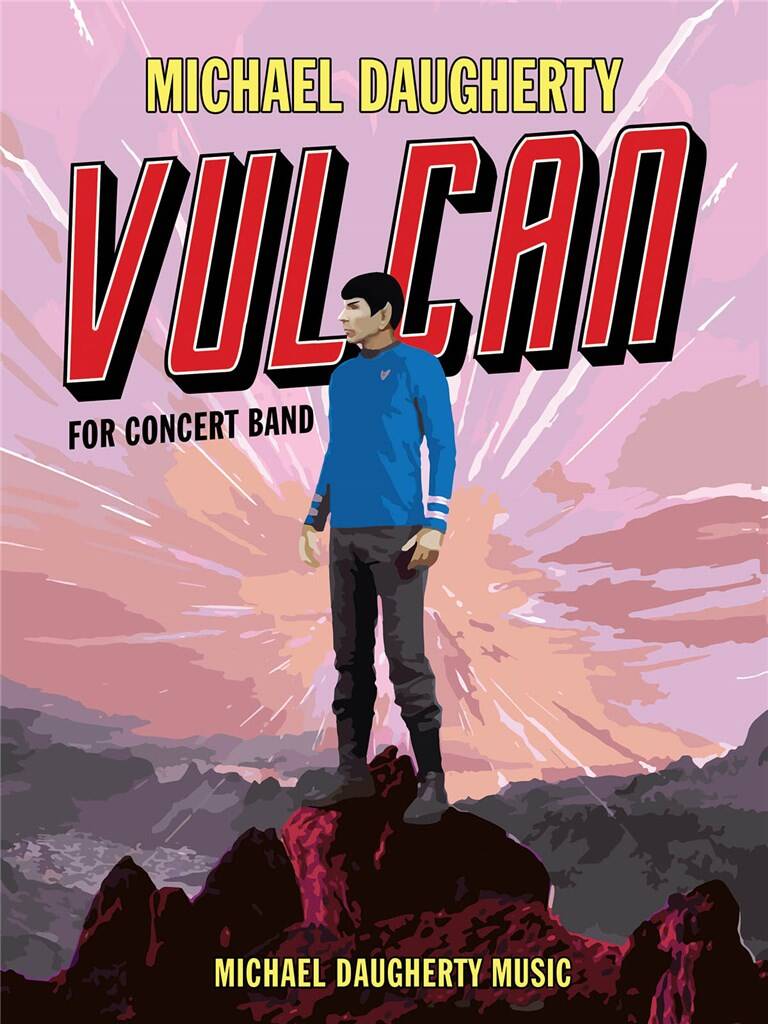
Vulcan - Michael Daugherty
(2014) Vulcan for Concert Band is Grammy award winning composer Michael Daugherty's first work for the high school and intermediate level college band. The work is a colorful homage to Gene Roddenberry's interstellar universe as depicted in the classic American television series Star Trek (1966-69). The title refers to the fiery planet Vulcan, home world of half-human, half-Vulcan Mr. Spock. As the rational-minded science officer aboard the starship Enterprise (commanded by the hot-blooded Captain James T. Kirk), Mr. Spock grapples with the fascinating predicament of making decisions predicated on human emotion versus Vulcan logic. Daugherty has composed stirring, yet highly structured music that alludes to the Vulcan Pon Farr ritual, Vulcan telepathic mind-melds, and the volcanic planet itself. At the the Ann Arbor, Michigan world premiere (utilizing the combined forces of the Pioneer, Huron and Skyline High School bands), Vulcan was an immediate hit and will surely become one of Daugherty's most performed works. Instrumentation The number of players doubling each part is at the conductor's discretion, but should be in keeping with a balanced sound. Piccolo 2 Flutes 2 Oboes English Horn (optional but recommended) 3 Bb Clarinets (minimum 2 players per part) 2 Bb Bass Clarinets Eb Contralto Clarinet or Bb Contrabass Clarinet and Bb Bass Saxophone (optional but recommended) 2 Bassoons 2 Eb Alto Saxophones Bb Tenor Saxophone Eb Baritone Saxophone 3 Bb Trumpets (straight metal mutes, harmon mutes-stem out) 2 F Horns 2 Trombones (straight metal mutes) Euphonium 2 Tubas Contrabass or Electric Bass (optional but recommended) Timpani (4 drums recommended) Percussion (instruments are not shared): 1. Glockenspiel, Xylophone 2. Vibraphone, Small Anvil (metal beater) 3. Shakaray, Marimba, Chimes, Suspended Cymbal (yarn mallets) 4. Two Tam-Tams (small, medium), Tambourine, Mark Tree, Finger Cymbals, Vibraslap, Piccolo Snare Drum 5. Tenor Drum, Maracas, Snare Drum 6. Large Bass Drum Movement I (YouTube) Movement II (YouTube) Movement III (YouTube)
Estimated dispatch 7-14 working days
 View Music