
Results
-
 £286.40
Poeme du Feu - Ida Gotkovsky
Major Albert Fasce, head of the musical department of the French Army, wrote about Pome du Feu:The Pome du Feu by Madame Ida Gotkovski is probably one of the original compostitions for symphonic band which has been most successful in recent years. I have had to conduct this work at concerts with different orchestras, and in particular at Budapest, and each performance was greeted by enthusiastic ovations. Moreover, it is quite rare in contemporary music to achieve, at the same time, the satisfaction of the musicians and success with the public. This is significant. This magnificent work is written remakably for wind instruments. There is no major technical difficulty, but the character of this work calls for meticulous placing and a certain orchestral glow. There is a "key" to be found in the first movement, which is in some way the rhythmic genesis of the work. The metronome marking of the first movement should be absolutely respected, and proper interpretation of the accents and the articulations are imperative. The fortissimi and rallentandi should not be exaggerated. As far as the little "trick" is concerned, this lies in the execution of the double crochets which should be considered in two ways: the first, a rhythmical one for those which arise from the rhythmic genesis, and the second more melodic for those arising in passages.Finally, to unseal the rhythmic origin of the double crochets, it is necessary to proceed by recurrence, starting from the four double crochets of the finale.These four double crochets must be executed very rhythmically in the different times. For the first, they arise:1: from the second bar of the first movement2: from the bar three bars before A for the second3: from the bar from G to the fourth time for the third.These double crochets must be played rhythmcally, while diminishing, however, those three bars before A.All this is of great importance, otherwise the whole execution will be in contradition with the spirit and the rhythmic inspiration of the work. Moreover, this beautiful work could very well support a ballet.As Head of Broadcast Music I must express all our gratitude to Madame Gotkovski for her contribution to constituting a real repertoire for wind ensemble. This articular and sometimes unappreceated band possesses unsuspected riches. This magnificent work is now in the repertoire of Musique de l'Air de France.
Estimated dispatch 7-14 working days
-
 £159.60
Rock Symphonie - Manfred Schneider
Manfred Schneider (1953), musician with the German Army Band Heeresmusikkorps 300 in Koblenz, has already proved his merits with his overture 'Uspide Down', the 'Song of Freedom' and the rhythmical etude 'Rock and Go', all published with Molenaar edition. This 'Rock Symphony' consists of contemporary rhythms alternating with more lyrical passages. Precisely these contrasts and the diversity of the composition make it extremely fascinating.
Estimated dispatch 7-14 working days
-
 £186.20
Evita - Andrew Lloyd Webber
The musical comedy 'Evita' dates from 1976 and was the third whom composer Andrew Lloyd Webber wrote in collaboration with lyricist Tim Rice. It ran for eight consecutive years in the London West-End and was already acclaimed on Broadway in 1979. 'Evita' tells the lifestory of the passionate second wife of the Argentinian dictator Juan Peron. Eva Duarte was born in Los Todos in 1919. Her life was similar to that of Cinderella. Though from modest origins, she became the most powerful woman in her country as spouse of Juan Domingo Peron who was president of Argentina from 1946 to 1955. She died of cancer on 26 July 1952, only aged thirty-three and was buried as a national heroin. Even after her dead, she was the object of a lay cult with the poorer Argentinian population. Only the army and the aristocracy had always opposed her position next to the president.The story is told by a cynical young man called 'Che'. He envies Evita's success while he cannot sell his invention, a new kind of insecticide. The splendid selection was made and arranged by Marcel Peeters. You hear succesively'Overture', 'On this Night of a Thousand Stars', 'Eva beware of the City', 'Buenos-Aires', 'Goodnight and thank You', 'I'd be surprisingly Good for You', 'Another Suitcase in another Hall', 'Waltz for Eva and Che', and the evergreen 'Don't cry for me Argentina'.
Estimated dispatch 7-14 working days
-
 £90.30
Village People on the Move
The once extremely popular American group 'The Village People' released its first album 'San Francisco' in 1977. The next year two more albums came, 'Macho Man' and 'YMCA', followed in 1979 by 'Go West'. That same year, the group was to be seen and heard in the film 'Can't stop the music'. Then there was their big hit In the Navy that caused some trouble when the American Army wanted to use it in one of their recruiting advertisements. You'll find that famous tune, and some more of their hits, in a fine arrangement by Peter Kleine Schaars.
Estimated dispatch 7-14 working days
-
 £87.99
York'scher Marsch - Ludwig van Beethoven
Beethoven's York'scher Marsch is one of a collection of three tattoos (WoO 18-20) and has had a chequered history, to say the least. There are several autograph copies for different instrumentations, dedicated to different archdukes who were commanders of various regiments of the army including the Prussian regiment called Marsch des Yorkschen Corps, which is how its current title arose. Philip Sparke's arrangement enables a march by this major classical composer to be enjoyed by concert bands.
Estimated dispatch 7-14 working days
-
 £99.99
A Monmouth Overture - Philip Sparke
A Monmouth Overture was composed in 2007 for the Haberdashers' Symphonic Winds, as part of Philip Sparke's year as composer-in-residence at the Monmouth school. The work is based around the 15th century Agincourt Song, written inhonor of Henry V's victory over the larger but outdated French army. Henry V was born in Monmouth in 1387, giving this wonderful overture its historical title. Bring a piece of history with a modern twist to your concert program.Dur: 4:30
Estimated dispatch 7-14 working days
-
 £68.99
Handel in the Strand - Percy Aldridge Grainger
Handel in the Strand is one of Grainger's early light orchestral pieces, written in 1911, before he enlisted in the US Army during World War I. Grainger had no trouble allowing other musicians to arrange his music to suit their needs, so Handel in the Strand has existed in several different versions. Grainger himself said of this piece, "...the music seemed to reflect both Handel and English musical comedy... as if jovial old Handel were careening down the Strand (London's Broadway) to the strains of modern English popular music." What can one add to that? Try it and find out!
Estimated dispatch 7-14 working days
-
 £118.99
Condacum - Jan Van der Roost
Condacum' was composed on the occasion of the 25th anniversary of the Arts Council in the Belgian district of Kontich, the home town of the composer Jan Van der Roost. It is an interesting composition in which the history of this Belgian community is depicted in sound. The opening reminds one of the advance of the Roman army, whilst the dynamic development is full of vitaliy!
Estimated dispatch 7-14 working days
-
 £152.99
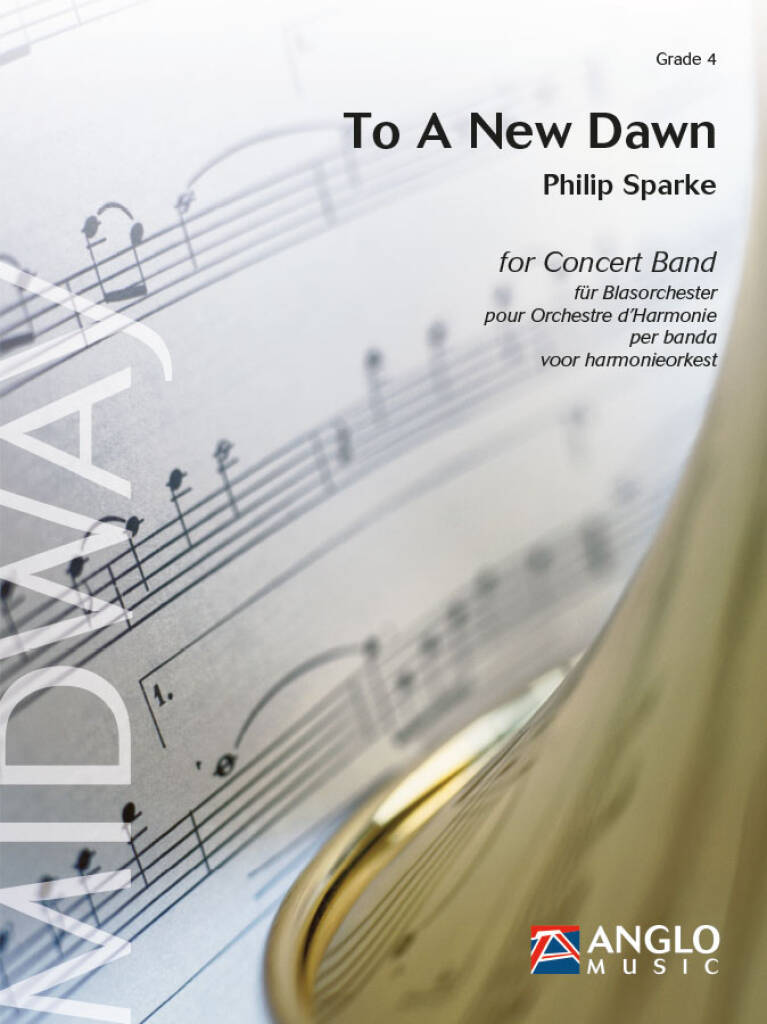
To A New Dawn - Philip Sparke
To A New Dawn was commissioned by the United States Continental Army Band - Captain Timothy J. Holtan, Commander and Conductor.The brief was for a piece to celebrate the 3rd Millennium and it was the composer's aim to provide a work which, as well as looking forward to the challenges of the new century, also contained moments of reflection about the last one.After a bright introduction featuring the trumpets a perky theme, passing quickly through several keys, appears on the woodwinds. A solo trumpet takes up a new theme over bubbling quavers (eighth notes) and this leads to a rhythmic figure on low clarinets, followed by the upper woodwinds. A brass interlude follows and, after ashort bridge passage, an oboe takes up a contrasting legato tune that builds to a climax.An andante section follows with solos for horn and flugel horn (or trumpet) and a florid flute cadenza. A passionate climax leads back to the faster music and, eventually, to a full recapitulation, revisiting the earlier material before a lively coda close the work as it began.
Estimated dispatch 7-14 working days
-
 £237.99
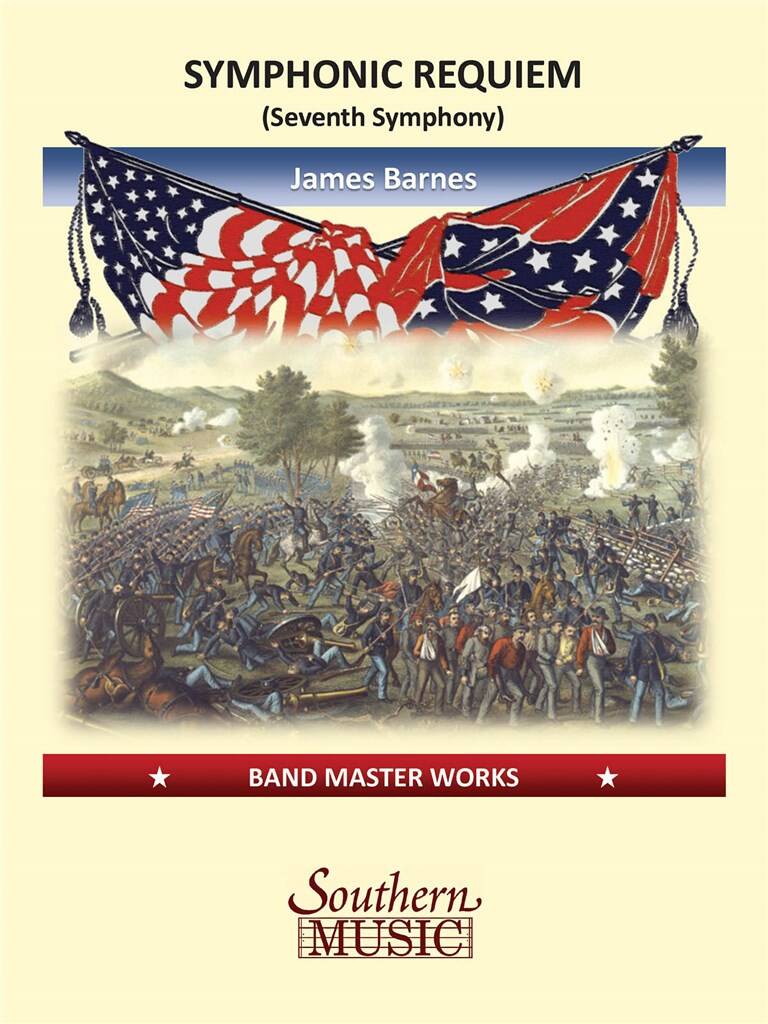
Symphonic Requiem - James Barnes
Commissioned for the United States Army Band to commemmorate the 150th anniversary of the America Civil War, the work combines two massive structures into one: a requiem and a symphony. It portrays the heartbreak of three of the most dramatic battles of the war, concluded by an apotheosis, a hymn of respect and praise for the 668,000 soldiers, Confederate and Federal alike, who gave their lives during this monumental conflict. Dur: 28:00
Estimated dispatch 7-14 working days
 View Music