Searching for Brass Band Music? Visit the Brass Band Music Shop
We've found 160 matches for your search

Results

  • £71.50

    In Regal Wonder - Gary P. Gilroy

    The Christmas season is an exciting time filled with wonder and marvel and is certainly the most musical time of the year - everywhere we turn we are treated to the festive "sounds of the season." Two of the most royal and regal carols, Hark! The Herald Angels Sing and Good King Wenceslas are gracefully combined into this energetic presentation for young players. It gives young bands the opportunity to explore new challenges while giving them some wonderful material for their winter concert.

    Estimated dispatch 7-14 working days
  • £87.99

    The Haunting Call - Travis J. Weller

    Travis Weller has created a down-right creepy new work for Halloween concerts! Featuring the sounds of ghosts (paper bags) and other optional sound effects, The Haunting Call will have you at the edge of your seat! A Spooktacular time!

    Estimated dispatch 7-14 working days
  • £71.50

    Always - Joshua Hobbs

    This new ballad by Joshua Hobbs is a perfect piece to stretch your musicianship. Written as a dedication to the composer's wife, this work will speak to audiences and musicians alike. As with most of Joshua's works - Always sounds much more mature and challenging than it is, which makes it a perfect showcase work for your musicians.

    Estimated dispatch 7-14 working days
  • £76.99

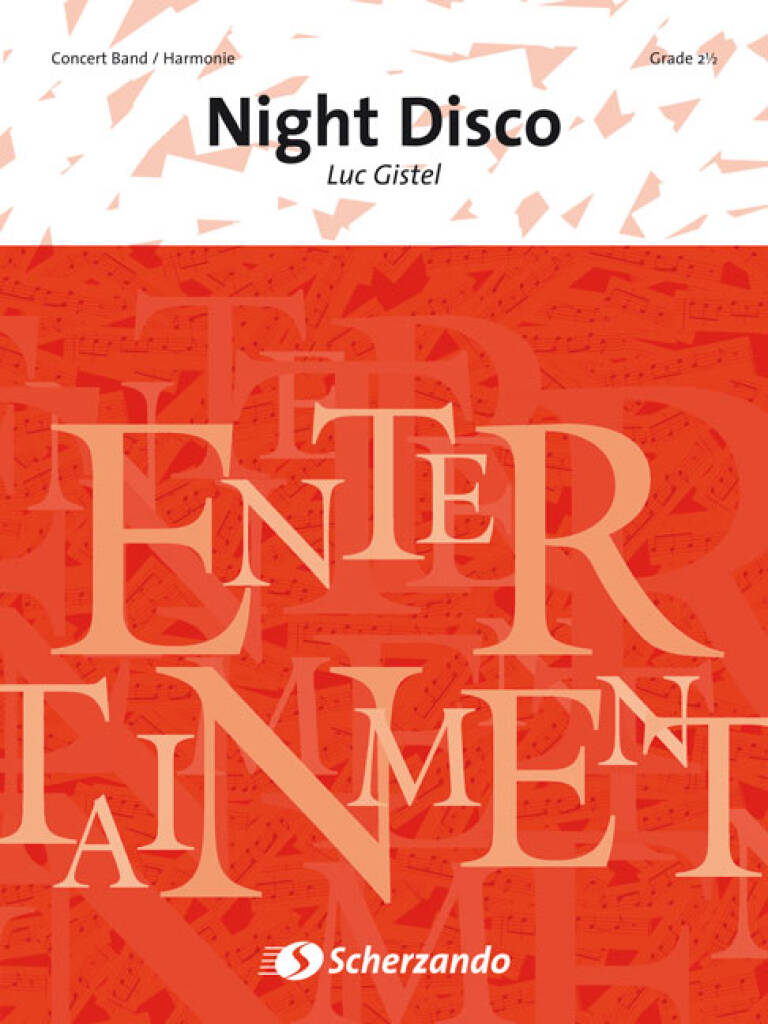
    Night Disco - Luc Gistel

    What could be better than a night out on the town? Luc Gistel obviously thought nothing! This entertaining composition has plenty of sounds that will remind young and old of many a night spent in the disco. After a tune that even John Travolta himself would have danced to, the mood quiets down for the obligatory slow song, during which new couples and old lovers can dance a little closer. Then things heat up again until the wee hours of the morning...

    Estimated dispatch 7-14 working days

     PDF View Music

  • £50.50

    Slip and Slide - Ralph Ford

    This delightful original melody is interrupted by comical trombone glissandos throughout . . . each carefully marked with slide positions for ease of teaching. A pleasant and unique opportunity to feature your beginning trombonists. "Listen to the sounds I can make with my new trombone!" This is a great selection to recruit more beginning trombonists. (1:30)

    Estimated dispatch 7-14 working days

     PDF View Music

  • £528.99

    Planet Earth (Complete Edition) - Johan de Meij

    Johan de Meijs third symphony, Planet Earth, unmistakeably marksa new peak in his large musical output. The symphonic version waspremiered in 2006 and has now been arranged for wind orchestra by the composer.Planet Earth is an impressive ode to Mother Earth. De Meij has pulled out all stops to sing the earth's praises in a heartrending manner. Splendid melodies, intense intermezzi, surprising sound patterns and noises/sounds from another world create a breathtaking musical experience with an amazing climax.A thrilling and rousing symphony!

    Estimated dispatch 7-14 working days

     PDF View Music

  • £129.50

    Goddess of Fire - Steven Reineke

    A magnificent programmatic work for symphonic band that is an offering to Pele, the Goddess of Hawaii's volcanoes. The work opens with primordial, mysterious sounds representing the foreboding volcanoes of Hawaii. We are then introduced to Pele as a tall, beautiful young woman. This is one of the forms she can take and it represents her powers of creation and beauty. This gives way to the active and destructive Pele, often taking the form of an old woman, wrinkled and bent with age. The following lyrical section of the piece is the full statement of Pele's theme of creation and beauty. As this theme settles, we begin to hear the ground pop and crack letting us know that new lava is beginning to bubble and flow. Suddenly and violently, one of her volcanoes erupts, creating massive chaos and destruction. After the eruption subsides, Pele's theme of creation and beauty returns again. A wonderful addition to any concert or festival performance by mature bands. Exceptional in every respect!

    Estimated dispatch 7-14 working days

     PDF View Music

  • £184.99

    Rubicon - Bert Appermont

    The Rubicon is a river in Northern Italy which Julius Caesar crossed with his army in 49 BC in defiance of the leaders of Rome, who feared his power. A civil war against rival Pompey ensued, which culminated in Caesar seizing power as the absoluteruler of Rome. The phrase "crossing the Rubicon" therefore refers to any person committing himself irrevocably to a risky, decisive and irrevocable of course of action.The work consists of three parts that deal with this important moment in history.Part 1 (Meditation) symbolises Caesars request to the Gods to assist him in his difficult choice. In a slow introduction we hear the melancholy and beseeching sounds of the duduk (alternatively, this part can be played by a soprano saxophone)and of the soprano solo singer over the bourdon accompaniment. The soprano solo singer then sings "dona tibi pacem" (give him rest) in a melodious and probing theme.In Part 2 (Battle of Pharsalus) trumpets and trombones resound alternately ina stately Roman fanfare, producing a stereophonic effect. This develops into a martial theme in which Caesars impressive army goes to battle against the army of rival Pompey. While the theme of Caesars army fades away, Pompeys theme emerges as anaive dance in six-eight time. His army is definitely in the majority and it believes it can easily defeat the enemy. Suddenly trumpets and trombones clash on two sides of the orchestra: Caesars army advances and attacks. A fierce battle ensues inwhich the two themes are played alternately as well as simultaneously. Thanks to his shrewd battle tactics, Caesar manages to win this legendary battle after all: his theme resounds ever louder in trumpets and horns until everything dies out andchanges into a kind of reconciliation between the soldiers of the two armies. The melancholy "dona tibi pacem" from part 1 now serves as a reconciliation theme.Caesar is now the sole ruler of the New Roman Empire, which would be destined to leave itsmark on our Western civilisation to this day. The third part is a sparkling succession of dance music (Dance) with many Greek and Roman elements in which Caesars victory is praised and celebrated. It is common knowledge that the culture(arts, gods, etc.) of the Romans drew heavily on Greek culture. I have therefore used an authentic Greek theme (the Seikolos song) several times in this part (bar 17 in the euphonium, bar 60 in the base section, bar 68 in the sopranosaxophone) to suggest the music of that era and to evoke the right atmosphere. After a gradual increase in tempo in the entire orchestra, the opening melody gloriously resounds once more, surrounded by virtuoso dance music. The work ends withbombastic brass fanfares in which Caesars theme triumphs once more.NOTE FOR THE CONDUCTOR:The Armenian duduk and the monochord that are used in the introduction give a special tone to the music, but could be substituted (soprano saxophone instead ofthe duduk) or left out (monochord). The soprano solo is also doubled within the orchestra and could therefore also be left out if necessary, although it does provide the work with an extra dimension. The male voices in the introduction and the finalecould possibly be replaced with a synthesizer with choral setting.As a visual and acoustic element in part 2, the trumpets, the e-flat cornet, the small drum and trombones can be stood up and placed at two sides of the orchestra (bar 80).Seen fromthe point of view of the conductor, put the trumpets, the e-flat cornet and the small drum in the left section and the trombones in the right section of the orchestra. This also helps to create a visual contrast between the two themes of the secondpart. The players can be seated again at bar 97 or bar 121. The soprano soloist can be placed in or in front of the orchestra, depending on what gives the best result. For the conclusion of the work the soprano solo can be sung from afar (from thewings) to create additional atmosphere.This work was composed especially for the "St Joseph" brass band from Pey/Echt (Belgium) with conductor Mark Prils.

    Estimated dispatch 7-14 working days

     PDF View Music

  • £109.99

    Dublimania - Menno Bosgra

    This new work is based on Irish folk music.In the first part, the main theme is presented as a ballad, starting with the piccolo (as replacement for the flute which is widely used in Ireland), moving on the wood section to end with the entire orchestra.It then changes to a kind of rock style theme: powerful, rhythmic accompaniment with effects in dampers, a pedal point and the use of the spoons which is typical of Irish music (Irish pub), high-range bongo drum (replacement for the Bodhran), etc.In this second part I introduced a second theme as a counterbalance, played by several groups, which has clearly a more legato character and therefore sounds more melodious.The climaxof the work starts in the low-range brass section with its marcato theme that is developed with a great deal of rhythmicity in the accompaniment, clusters, etc. into a percussion solo interspersed by the orchestra in five-eight time with frequent parallel movement in chords (folk music style).Towards the end, theme 2 recurs twice: first as heard earlier with an extra counter melody and accompaniment pattern, then in a canonical form, in which the theme is played by three groups. The conclusion is a repeat of the middle section in five-eight time.I have tried to use many of the colours of a wind orchestra by having the wood sections and brass section play alone and making extensive use of dampers. Percussion also has a prominent role throughout the work.

    Estimated dispatch 7-14 working days

     PDF View Music

  • £264.99

    Diferencias on an Old Spanish Song - Yasuhide Ito

    I am immensely happy that my Gloriosa, symphonic poem for band (1990), has been performed by so many bands in the last thirty years.During this period, the growth of the internet has made it much easier to access information.When I composed Gloriosa, I only had limited information about the period when Christianity and Western music was first introduced to Japan, and had to rely a lot on my imagination.However, nowadays, it is easy to obtain various source materials and to read interesting studies on the music of the past.In recent years, the music of Luis de Narvez (born ca.1500 - died between 1555-1560), Spanish composer and vihuela player, has become increasingly known, and several CDs of his music are now available.Narvez composed the earliest-known set of diferencias, a forerunner of the variation form. One of his works is Seys diferencias sobre el himno "O gloriosa domina" [Six diferencias on the hymn "O gloriosa domina"] (1538), based on the Spanish Marian hymn, and it was this melody I used in the first movement of my Gloriosa.Western music has been my musical roots since childhood, and throughout my career as a composer, it has continued to fascinate me. One could say that this has provided the inspiration for Diferencias on an Old Spanish Song, my own take on the diferencias form.Actually, such music from the early sixteenth century could sound fresh to our modern ears. So I decided to quote the melody from Narvez's Sey diferencias at the beginning and end of the piece, in order that people can get the feel for the period.The main section (bars 42-390) is formed of 13 diferencias, similar to the first movement of the Gloriosa.In the middle section, which begins after the eighth diferencia(from bar 187), one should be totally absorbed in the tranquility and the beauty of the music. Although it's in the style of a sarabande, it should be taken slower and played as pianissimo as possible.This is followed by folk-style dance music. (As only standard percussion instruments are used, try to be creative with tonal colours and sense of rhythm).The structure of the work is simple, but be aware of the connection between the sections when constructing the whole.Also, think about the tonality. Overall, the work is in F minor. The main section is basically in D minor, but from bar 102, it modulates to A flat minor and G minor, and then in the middle section it suddenly switches to A flat major (which is the furthest key from D minor, and the relative major of F minor). From bar 219, it modulates to F minor and then to C minor, then back to F minor by way of A minor.N.B. The Oboe II part can be substituted by the English Horn (as indicated in the parts). One can choose according to the player's skills or preference.Recent new compositions for wind band are often full of rhythm, dynamism, and tonal colour, and compositional techniques and orchestration have also evolved greatly. Yet on the other hand, they tend to feature fewer melodic or expressive elements. Since this work is the test piece for WMC Kerkrade 2022, I had to think about what "tests" or "challenges" to set, and I decided to compose something that doesn't involve a lot of technical display, but requires beautiful sounds and harmonies, and above all, musical expressivity. I didn't put many expression markings in the score, because I wanted the performers to think about how best to express this music. If it is played merely as notated, it's not going to sound very interesting.Christianity was introduced to Japan in the mid-16th century, but it was subsequently banned and Japan entered a period of national isolation, which meant that there was hardly any international exchange for two hundred years. As a result, the Christian hymns that were introduced prior to the isolation became almost unrecognizable over the centuries. This was the theme I explored in my Gloriosa thirty years ago.Now, in 2021, the whole world has been forced to "isolate" due to the Covid-19 pandemic. In such times, it seems pertinent that I've written a work using this melody again. I sincerely hope that people will be able to gather in Kerkrade in 2022.(English Translation:Nahoko Gotoh)

    Estimated dispatch 7-14 working days

     PDF View Music