
Results
-
 £50.50
Slip and Slide (Concert Band - Score and Parts) - Ford, Ralph
This delightful original melody is interrupted by comical trombone glissandos throughout . . . each carefully marked with slide positions for ease of teaching. A pleasant and unique opportunity to feature your beginning trombonists. "Listen to the sounds I can make with my new trombone!" This is a great selection to recruit more beginning trombonists. Duration: 1.30
Estimated dispatch 7-14 working days
-
 £53.95
The Sound and the Fury (Concert Band - Score and Parts) - Smith, Robert W.
The Sound and the Fury was inspired by the literary work of the same name by William Faulkner, known for his epic portrayal of the conflicts between the old and new South. Opening with a vibrant drama of punctuating thrusts in strings, winds, and percussion, the mood only shifts when we move to a lyrical and ambient section of contrasting sounds. Powerful strokes return, moving to a dramatic conclusion. A superior choice for concert or contest with guaranteed stunning audience appeal. Duration: 2.00
Estimated dispatch 7-14 working days
-
 £69.99
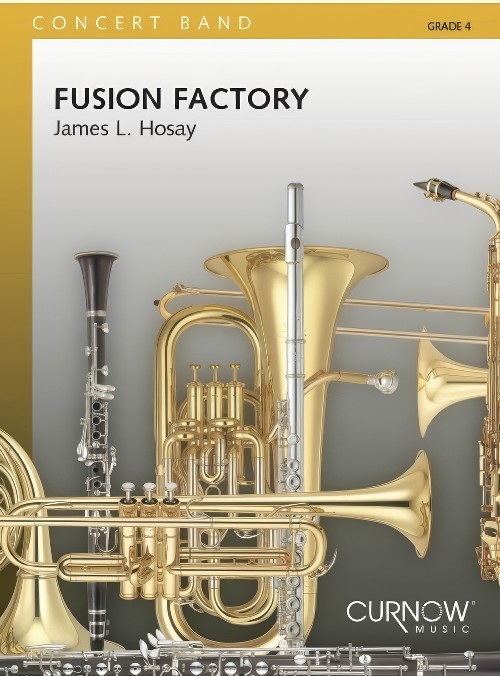
Fusion Factory (Concert Band - Score and Parts) - Hosay, James L.
At the end of the Sixties and the beginning of the Seventies, slowly but surely, a new exciting music style arose in pop music. Pop groups enlarged the musical spectrum by combining jazz harmonies with rock 'n' roll rhythms. These experiments are now known as fusion. Fusion Factory combines elements of early fusion with modern fusion sounds. Listen to the excellent result!Duration: 5.45
Estimated dispatch 7-14 working days
-
 £67.32
Antecedium
Antecedium was Ed Huckeby's first published composition for band and this brand new edition makes it better than ever. An exceptional piece for mid-level bands that sounds much more difficult than it plays..
Estimated dispatch 7-14 working days
-
£332.99
Cantica de Sancto Benedicto Wind Band Set (Score & Parts)
Cantica de Sancto Benedicto is a three-movement work for mixed choir, soprano solo, concert band and organ ad libitum - on Latin lyrics that relate to the life of Saint Benedict. It was commissioned by the city of Norcia in Italy, where Benedict was born. The holy Benedict (480-547) is considered the founder of monastic life within the Roman Catholic Church. His enormous influence is especially owing to his monastic rule, the Regula Benedicti.Jacob de Haan has named the movements of Cantica de Sancto Benedicto after the Holy Trinity: the Father (Gloria Patri), the Son (Gloria Filio) and the Holy Spirit (Gloria Spiritui Sancto). The lyrics of thehymn Gemma Caelestis, (which, like the other texts, were originally used in Gregorian chant) are voiced by the choir. To this purpose, Jacob de Haan composed new, choral-like, homophone music. The sequence Laeta Quies is rendered by the soprano; the verses (divided over the three movements) are alternated with those of Gemma Caelestis. The work closes with an impressive grand finale, in which texts are used from the proprium of the mass in honor of the saint's day of the holy Benedict (11 July). Notes to the conductor: For this cantata, there are various possibilities for the performance. The first involves a performance in which the choir and soprano parts are only accompanied by organ. Such a performance has several advantages: since the band never sounds together with the choir and the soprano, no balance problems occur, and even a performance with a large concert band and a small cantata choir is conceivable. A special layout is also possible - with which you can set up a three-dimensional performance in a church. For example, the choir can sing in the chancel, accompanied by the choir organ; the soprano can stand on the gallery, accompanied by the main organ; and the band can be seated in another part of the church. The choir could also sing from a gallery. With layouts like this, working with two conductors is advisable. Choral parts available separately. 0:28:30
Estimated dispatch 7-14 working days
-
£59.40
Emblem of Unity - Swearingen, James
This highly regarded work has long been a favorite from the repertoire of outstanding concert marches found in band libraries throughout the world. This new edited version with full score will allow directors the opportunity to once again experience the exhilarating sounds of one of the all-time great marches. EXCELLENT!
Estimated dispatch 7-14 working days
-
£89.10
Goddess of Fire
A magnificent programmatic work for symphonic band that is an offering to Pele, the Goddess of Hawaii's volcanoes. The work opens with primordial, mysterious sounds representing the foreboding volcanoes of Hawaii. We are then introduced to Pele as a tall, beautiful young woman. This is one of the forms she can take and it represents her powers of creation and beauty. This gives way to the active and destructive Pele, often taking the form of an old woman, wrinkled and bent with age. The following lyrical section of the piece is the full statement of Pele's theme of creation and beauty. As this theme settles, we begin to hear the ground pop and crack letting us know that new lava is beginning to bubble and flow. Suddenly and violently, one of her volcanoes erupts, creating massive chaos and destruction. After the eruption subsides, Pele's theme of creation and beauty returns again. A wonderful addition to any concert or festival performance by mature bands. Exceptional in every respect!
Estimated dispatch 7-14 working days
-
£49.50
Gospel John
Jeff Steinberg's "Gospel John" was a great hit for Maynard Ferguson in the 1970's and still sounds totally hip. This new Andy Clark arrangement makes it playable with mid-level concert bands where it is sure to be a favorite with students and audiences alike! Ranges are reasonable and all the sections of your band get a chance to shine. A timeless classic that really rocks!
Estimated dispatch 7-14 working days
-
£76.99
Night Disco (Concert Band - Score and Parts)
What could be better than a night out on the town? Luc Gistel obviously thought nothing! This entertaining composition has plenty of sounds that will remind young and old of many a night spent in the disco. After a tune that even John Travolta himself would have danced to, the mood quiets down for the obligatory slow song, during which new couples and old lovers can dance a little closer. Then things heat up again until the wee hours of the morning... 05:25
Estimated dispatch 7-14 working days
-
£174.99
The Legend of Flathead Lake Wind Band Set (Score & Parts)
In Scotland, the monster of Loch Ness is a hot issue, but the American state of Montana enjoys a comparable phenomenon going by the name of Montana Nessie. In the western part of this remote state lies Flathead Lake: a lake of 45 kilometres /38 miles in lenght and 24 kilometres /15 miles breath. At several places, its depth exeeds 100 metres.Nessies discovery takes us back to the year 1889, when captain James Kerr aboard the passengership U.S.Grant was startled by a ship unknown to him suddenly approaching his vessel across Flathead Lake. However, it turned out not to be a ship but an undefinable animal of immense size.From that moment onwards, life would never be the same again in and around Flathead Lake.The composer was inspired by the story, and summarized the events into a symphonic poem, but from a surprising angle:that of the monster. The exiting opening allows us to follow the monster in its natural surroundings.The fast follow-up movement depicts Montana Nessie trotting and frolicking about the Montana woods and prairies.From its abode, it thorougly enjoys everything around it. This period abruptly ends in a short climax (Chimes). The solo for cor anglais marks a new period in the monsters life.The presence of people has a paralizing effect and the apprehensive atmosphere of the slow movement may be felt profoundly.The monster observes and mildly teases the ship. Abhor sounds force the ship to a withdrawal.The moving musical continuation depicts the triumphant monster dancing an ironic waltz. The monsters fear and anger at the intrusion of his freedom run through the piece like continuous threads, and develop into the works final theme. 12:00
Estimated dispatch 7-14 working days
 View Music