
Results
-
 £127.30
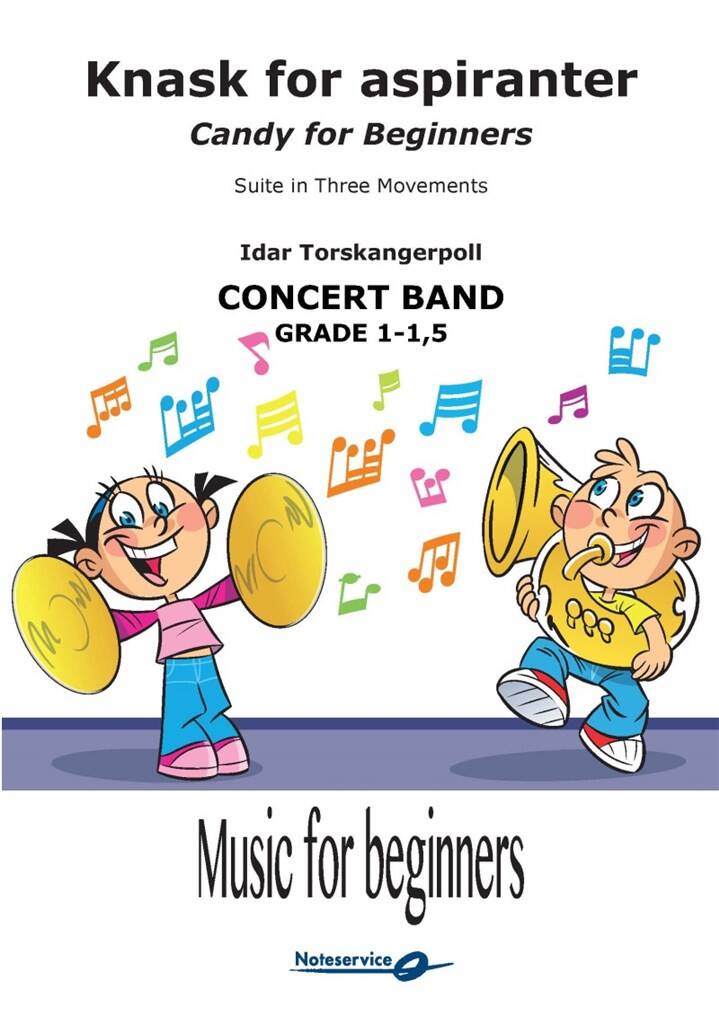
Knask for aspiranter - Suite in Three Movements - Idar Torskangerpoll
Candy for Beginners is a suite of three songs used by the composer with the youngest beginners throughout several years. The method is to sing the melodies before learning it on the instruments. Lyrics about candy has proven to be very popular among the youngsters.... In English it can goes like this: "Candy floss, candy floss, candy floss, candy floss, oh yeah". And: "Soda for me, give me soda for free". And: "Lefse, it is good, lefse, now you should, Lefse, give me one, lefse, sure is fun." The composer urges the band to find their own lyrics to the melodies, making it their own with a local twist. This is a good rhythmic exercise for the young players.
Estimated dispatch 7-14 working days
-
 £149.40
Bekken (Fra Lyriske stykker opus 62) - Edvard Grieg
Brooklet is one of the movements from Grieg's Lyric Pieces for Solo Piano opus 62. Information for the conductor: Brooklet is an technically advanced work for solo piano. In this arrangement, technical passages are simplified by overlapping and doubling some of the parts. To master the technical challenges and make it sound effortless, it is important to pay close attention to balance and precision. Some of the parts also have alternative parts added which can lower the technical challenges a bit. The normal instrumentation are Clarinet 1-2-3, but there is also an "optional" part for Solo Clarinet. This is included on the same sheet as Clarinet 1. Both parts can stand alone or be played together. (i.e. The Solo Clarinet part can be played in addition to Clarinet 1, in whole or in part if desired, or it can replace Clarinet 1 entirely, using only Solo Clarinet and Clarinet 2 and 3.). From bar 5 to bar 13, there is a suggested solo for Solo Clarinet. If played by Solo Clarinet, please omit Clarinet 1, 2 & 3 for these bars.
Estimated dispatch 7-14 working days
-
 £154.99
Greek Folk Song Suite - Franco Cesarini
Greek folk music is characterised by the sound of the 'buzuki' which is often used in combination with the clarinet, the mandolin, the violin and various types of tambourines. In Greek Folk Song Suite, Franco Cesarini has elaborated on three songs belonging to this most ancient tradition. The first, O Haralambis, is in 7/8 time, a characteristic of a popular folk dance called kalamatianos. Originally, the song O Haralambis was sung to 'tease' during weddings with the text of the song refering to a young man who refuses to marry. The second movement, Stu Psiloriti, refers to an ancient song from the island of Crete. The third movement of the suite is based on the songVasilikos tha gino and is characterised by the sirtaki, probably the most popular Greek dance outside of Greece. This is Greek passion portrayed by a concert band!
Estimated dispatch 7-14 working days
-
£202.99
Spirited Away - Joe Hisaishi
This is an arrangement of Ghibli's Anime film, "Spirited Away". It consists of six themes including No-Face, One Summer Day, The Bottomless Pit, Yubaba's Panic, Always with Me, and Reprise. I also added an alternate introduction using The Dragon Boy. The No-Face opener is somewhat avant-garde with technical difficulties so select the opening that is best suited to your ensemble. The arrangement concept was created by Mr. Tomoki Ubata of Ina Gakuen Sr. High School. His wonderfully crafted ideas always impress me. Especially, in the arrangement, mallet percussion and piano are effectively used to sound like a music box and the lyrical melody of Reprise is superimposed. This scene is the best part of the entire arrangement and is very emotional. All these fine melodies from the film transport both audience and performers to the fantastic world of anime. (Kazuhiro Morita)
Estimated dispatch 7-14 working days
-
 £189.99
Masked - Alex Shapiro
Masked by Alex Shapiro is composed in the exact shape of a Classical Minuet and Trio waltz, though the music--a whimsical if somewhat demented masked ball (or, balls, in this case)--bears little connection to that of Mozart or Haydn. Historically, third movement Minuets gave way to the joke-like Scherzo, and the Trio section tips its hat to some welcome levity. This is one of four movements in Suspended, a piece is composed in the tradition of an 18th century Classical symphony: four contrasting movements which serve specific functions and reveal a story. The work begins in absolute rage and chaos, then alternates between moments of grief and bleakness. Grim reality shifts to a macabre, circus-like insanity, and by the end, flickers of genuine hope contrast a pervasive sense of dread, and finally arrive at more optimistic possibilities. To perform the piece, you'll need an audio system capable of playing the prerecorded audio tracks from a laptop computer via a small digital audio interface connected to an audio mixer. Download information is provided in the printed piece.
Estimated dispatch 7-14 working days
-
 £184.00
Chasing Light - Harrie Janssen
Chasing Light is a one-part composition in 3 movements. The work opens with a slow introduction, dark in atmosphere, in which the main thematic ingredients are exhibited. This is followed by a fast movement, Chasing Light, in which previously heard thematic material is incorporated. Characteristic of this middle movement is the driving motoric movement that galvanises the aforementioned hunt. An extended Euphonium solo bridges the gap to the final movement. Here ethereal sounds dominate. Harp and Mallets dominate the soundscape, symbolising the light that has finally been achieved.The title Chasing Light can be seen as a metaphor for striving to solve major problems facing the world today, such as the Corona pandemic and the climate problem, among others.Chasing Light was composed on behalf of Stadsfanfaren Izegem, conducted by Hans Demeurisse for the World Music Contest 2022 in Kerkrade.
Estimated dispatch 7-14 working days
-
 £141.99
Pulcinella - Philip Sparke
Pulcinella was commissioned by the Taiwanese euphonium player Tzu-Hsiang Lin. Lin is a renowned soloist and teacher and a Besson Euphonium Artist. He teaches euphonium at Taipei National University of the Arts, National Taiwan University of Arts, Shih Chien University and National Kaohsiung Normal University. Lin gave the premiere of Pulcinella in both its concert band and brass band versions in January 2021. Pulcinella continues Sparke's series of euphonium solos named after characters of the Italian commedia dell'arte and opens with a long and expressive minor melody for the soloist over a brooding accompaniment. This is taken up briefly by the full band and is extended by the soloist after a change of key. A cadenza, accompanied by fragments of the main melody leads to a complete change of mood, tempo and tonality, introducing a Vivo section starting with a perky syncopated tune for the soloist. The band then uses elements of this new tune to introduce a change of key, where the soloist introduces a more lyrical second subject over a pulsing accompaniment. The band then takes this up and changes key to reintroduce the original Vivo melody, which leads to a short and acrobatic coda to bring the work to a spectacular close.
Estimated dispatch 7-14 working days
-
 £104.99
A Northern Jubilee Fanfare - Thomas Doss
A city celebrating a jubilee is always a very special occasion - this is certainly the case for the fiftieth anniversary of the German city of Norderstedt. In light of this milestone, composer Thomas Doss has written a festive work which conveys pride, joyfulness, ideals and the thirst for action. The joy in the music is so palpable that sparks will fly - everyone is guaranteed to have a good time.
Estimated dispatch 7-14 working days
-
 £149.99
Crystal Magic - Bert Appermont
The source of inspiration for this work is the magical world of gemstones. The special powers of four of these stones appealed to composer Bert Appermonts' imagination. In this work, different distinguishing atmospheres are evoked. The work is composed as a suite containing four movements: Carnelian: The Stone of Perseverance, Opal: The Stone of Misfortune, Amethyst: The Stone of Wisdom and Amazonite: The Stone of Playfulness. This is a challenging and striking piece of music to inspire your audience in a concert or a jury during a contest.
Estimated dispatch 7-14 working days
-
 £79.99
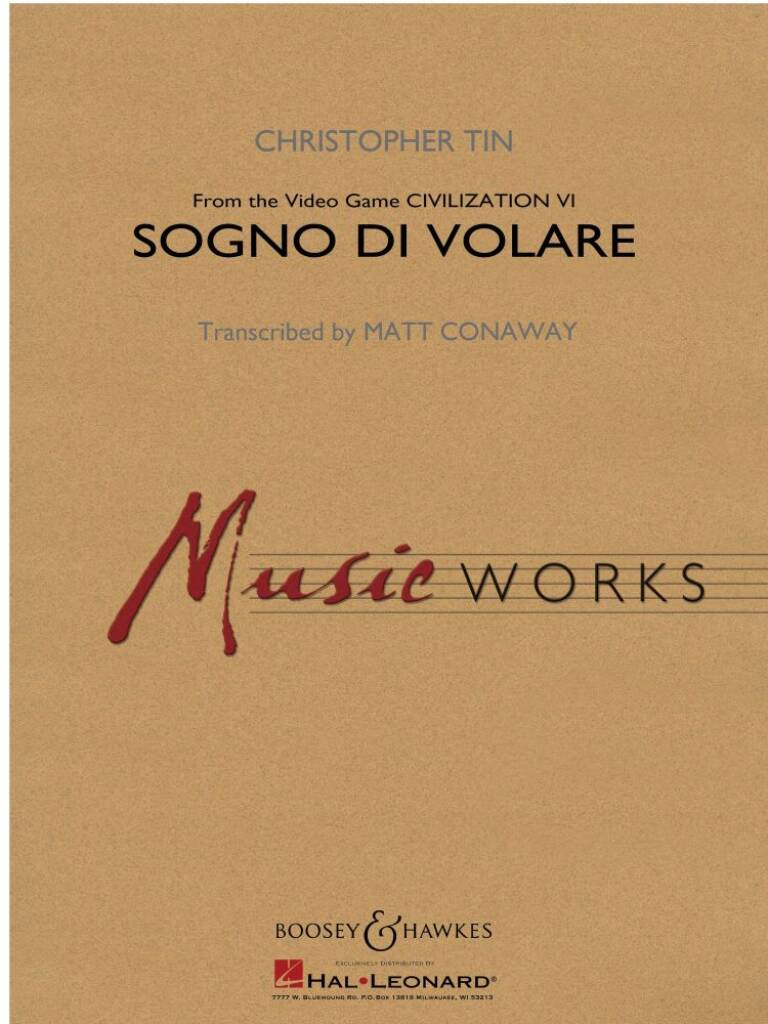
Sogno di Volare - Christopher Tin
From the popular and long-standing Civilization video game franchise, Sogne di Volare is the stirring and popular theme from Civilization VI. This powerful adaptation is taken directly from the original version and is compatiblewith the composer's own arrangement for choir. Whether performed with band alone or with the addition of voices, this is a stunningly beautiful concert work portraying a sense of conquest and wonder. Dur: 4:00
Estimated dispatch 7-14 working days
 View Music