
Results
-
 £57.50
A Precixe Prelude And an Excellent March - Thomas Duffy
Playing one wrong note can ruin the performance of a piece, right? Well, composer Thomas Duffy actually wants the performers to make mistakes in this clever composition! The precise imprecision comes to life as students are asked to intentionally play wrong notes in various parts of the march. After performing this work, you and your students will never look at perfection the same way again! Free interdisciplinary curriculum for the piece is available for download at www.BandQuest.org. BandQuest, an exciting series of new music and accompanying curricula for band, is a program published by the American Composers Forum. The series was started as a response to feedback from music educators that there is a pressing need for new, fresh band music. The heart of this program is new works written by a diverse group of leading American composers who have created challenging pieces that are a true departure from standard middle school repertoire. Every BandQuest project includes a residency component in which the composer works collaboratively with a middle school as they create their new piece. Many BandQuest pieces are accompanied by an interdisciplinary curriculum designed to assist students as they learn the music and to integrate each piece with non-music studies. Visit www.bandquest.org to learn more about this innovative series, and email [email protected] to request a free downloadable audio catalog.
Estimated dispatch 7-14 working days
-
 £57.50
Grandmother Song
Grandmother Song is an introduction to the Mohican tradition of sung syllables, or what Native Americans call vocables. Combining them with traditional wood flute songs, composer Brent Michael Davids offers a fresh look at the sound of Native American songs. Band instruments are performed less as musical instruments and more as talking sticks, singing reeds, rustling winds and shooting thunder. Through this beautiful ballad, students are given the materials to understand how Native Americans celebrate the world around them through the blending of words and song. (Includes score and parts.) BandQuest, an exciting series of new music and accompanying curricula for band, is a program published by the American Composers Forum. The series was started as a response to feedback from music educators that there is a pressing need for new, fresh band music. The heart of this program is new works written by a diverse group of leading American composers who have created challenging pieces that are a true departure from standard middle school repertoire. Every BandQuest project includes a residency component in which the composer works collaboratively with a middle school as they create their new piece. Many BandQuest pieces are accompanied by an interdisciplinary curriculum designed to assist students as they learn the music and to integrate each piece with non-music studies. Learn more on YouTube. Visit www.bandquest.org to learn more about this innovative series, and email [email protected] to request a free downloadable audio catalog.
Estimated dispatch 7-14 working days
-
 £57.50
Smash the Windows - Robert Xavier RodrÝguez
Smash the Windows is a vigorous piece full of energy and motion. The work is based on a traditional Irish jig with the same name. Robert Xavier Rodrguez calls the piece a toccata moto perpetuo, the music gradually builds from its quiet beginning to a brilliant flourish that, with sound effects, truly befits the title. Learn more on YouTube! BandQuest, an exciting series of new music and accompanying curricula for band, is a program published by the American Composers Forum. The series was started as a response to feedback from music educators that there is a pressing need for new, fresh band music. The heart of this program is new works written by a diverse group of leading American composers who have created challenging pieces that are a true departure from standard middle school repertoire. Every BandQuest project includes a residency component in which the composer works collaboratively with a middle school as they create their new piece.Many BandQuest pieces are accompanied by an interdisciplinary curriculum designed to assist students as they learn the music and to integrate each piece with non-music studies. Visit www.bandquest.org to learn more about this innovative series, and email [email protected] to request a free downloadable audio catalog.
Estimated dispatch 7-14 working days
-
 £60.99
Out Of The Shadows - Michael Sweeney
Commissioned for the Wisconsin Lutheran High School's centennial year, this expansive work incorporates the Welsh folk song The Ash Grove in a lush and varied treatment. The main melody, played first by horns and baritone, returns near the end in a glorious, fully orchestrated chorale. In between is a beautiful secondary theme played by oboe and flute soloists followed by a dramatic fugal section. A musically rewarding and effective piece. (6:00)
Estimated dispatch 7-14 working days
-
 £57.50
Mosaic - Stephen Paulus
Mosaic is an aural representation of the varied qualities each of us possess and contribute to the whole of our American society. As a kaleidoscope of various musical elements coming together, this work evokes a visual of mosaics - tiny tiles individually glued together to create a broader image. Composer Stephen Paulus integrates layers of sound with varying meters that feature every instrument in the band. Learn more on YouTube! BandQuest, an exciting series of new music and accompanying curricula for band, is a program published by the American Composers Forum. The series was started as a response to feedback from music educators that there is a pressing need for new, fresh band music. The heart of this program is new works written by a diverse group of leading American composers who have created challenging pieces that are a true departure from standard middle school repertoire. Every BandQuest project includes a residency component in which the composer works collaboratively with a middle school as they create their new piece. Many BandQuest pieces are accompanied by an interdisciplinary curriculum designed to assist students as they learn the music and to integrate each piece with non-music studies. Visit www.bandquest.org to learn more about this innovative series, and email [email protected] to request a free downloadable audio catalog.
Estimated dispatch 7-14 working days
-
 £57.50
Nonantum Bulgar - Hankus Netsky
Adding to the minuscule number of Klezmer pieces for concert band, Nonantum Bulgar is the 20th piece published in the BandQuest series. The title, Nonantum Bulgar, refers to Nonantum, a district in Newton which is home to the city's oldest synagogue (on the National Register of Historic Places), and bulgar (pronounced 'bull-ghar'), a type of Klezmer dance. When writing the piece, the composer imagined the dedication of the Adams St. Shul, which took place over one hundred years ago and featured a prominent Boston cantor and choir and a klezmer orchestra leading a Grand March down Adams St. This upbeat work is fun to play, features a trumpet solo, and gives every instrument the opportunity to play the melody. Learn more on YouTube! BandQuest, an exciting series of new music and accompanying curricula for band, is a program published by the American Composers Forum. The series was started as a response to feedback from music educators that there is a pressing need for new, fresh band music. The heart of this program is new works written by a diverse group of leading American composers who have created challenging pieces that are a true departure from standard middle school repertoire. Every BandQuest project includes a residency component in which the composer works collaboratively with a middle school as they create their new piece. Many BandQuest pieces are accompanied by an interdisciplinary curriculum designed to assist students as they learn the music and to integrate each piece with non-music studies. Visit www.bandquest.org to learn more about this innovative series, and email [email protected] to request a free downloadable audio catalog.
Estimated dispatch 7-14 working days
-
 £79.99
Purple Whispers - Richard L. Saucedo
This remarkable and descriptive work opens and closes with members of the ensemble whispering to one another, creating a soft yet chaotic effect. The simple poem is by the composer: Whispers move in colored flight, seeking signs of next twilight, purple as the violets grow, warm but rich for all to know. As the piece progresses, introduced by a solo piano, the listener is taken through a dynamic range of emotional tension and release before the quiet mood returns to close out this uniquely effective composition. Dur: 5:15 Recorded by the Marshall University Wind Symphony - Steve Barnett, conductor
Estimated dispatch 7-14 working days
-
 £118.99
First Essay - Samuel Barber
Samuel Barber's First Essay, arranged by Joseph Levey for Concert Band. Score/parts. Previously only available on rental, this new publication of Barber's FirstEssay (ca. 1930) is a welcome addition to the literature. This edition includes newly discovered historical information on Barber's personal edits and revisions - including adding original music - to thearrangement prior to his approval for publication. Set in the original orchestral key, this arrangement by Joseph Levey has been performed by several of the most prestigious concert bands. This deserves a seriouslook for mature groups.
Estimated dispatch 7-14 working days
-
 £141.99
Concerto for Wind Ensemble - Karel Husa
Commissioned by the Michigan State University Alumni Band, this three movement work by Karel Husa was the winner of the first Louis Sudler International Wind Band Composition Competition in 1983. A note from thecomposer: 'Divided into three movements, this work is a display of virtuoso passages given to solo instruments as well as to the groups of the ensemble. In the Fanfare of the first movement, the Brass section concertises in groupsof four Brass quintets (2 Trumpets, Horn, Trombone and Tuba or Baritone), spread from left to right in back. The Saxophones (SATB) are placed in front of the Brass quintets, and the Woodwinds occupy the front of the stage, withPercussion on the left and right side. These groups, like the Brass quintets, play in the concertante style, particularly in the first and last movements. 'At the same time, each movement contains individual solo passages(for example, Timpani and Flute in Movement I - Drum Ceremony and English Horn and other low Woodwinds in Movement II - Elegy). The composition of this piece was prompted by the excellence of Wind and Percussion players today, andby the incredible growth of Wind ensembles, orchestras, and bands in the last 25 years. It is intended for their enjoyment.'
Estimated dispatch 7-14 working days
-
 £92.00
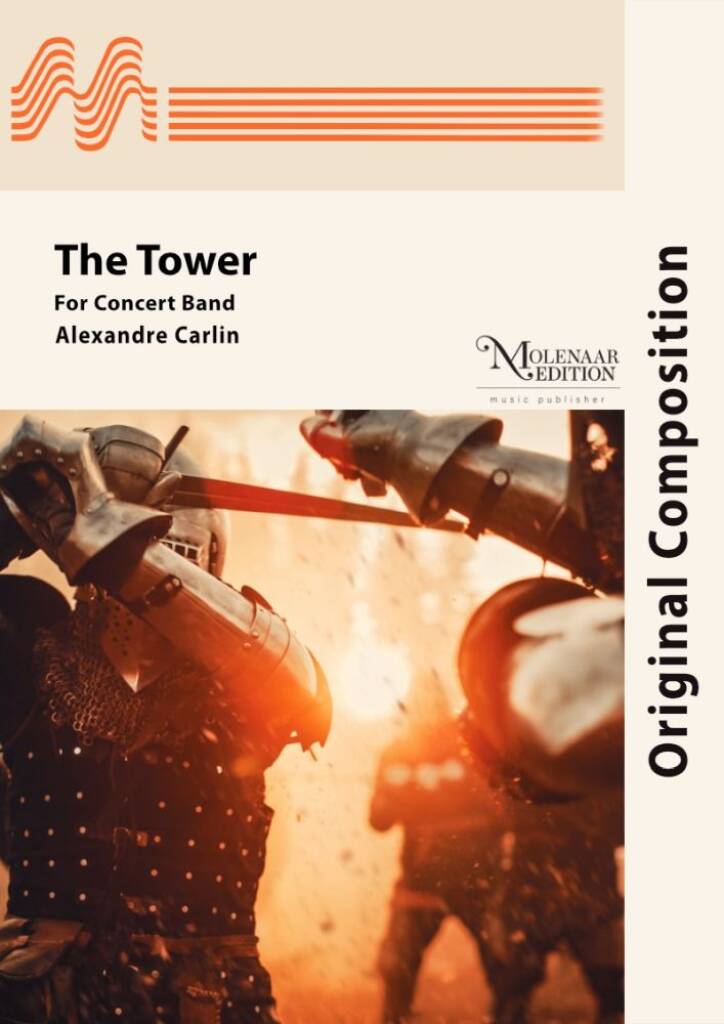
The Tower - Alexandre Carlin
The Tower was commisioned by the concert band of Auneau (France), for their 190th anniversary. The composer was inspired by a medieval tower standing in the city and decided to transcribe in music the life in the middle ages, the gregorian chant of the monks, a village festival, the building of the tower, step by step, and then the evocation of the battle of Auneau, one of the famous religious battles of the middle ages in France. The work ends with the regained calm, and the monks singing their gregorian chant at the end of the day.
Estimated dispatch 7-14 working days
 View Music