
Results
-
 £141.50
Searching For Lost Dreams - Dana Wilson
The composer states:"As I began this piece, it was as though I were entering a dream. The music was atmospheric, undefined, and somewhat disorienting. Gradually the material became more focused, but just in time to switch to a very different--though related--sound world, which became the second movement. The overall poignancy, varied sound worlds and dramatic shape of the music suggested the title."
Estimated dispatch 7-14 working days
-
 £76.80
Chestnut Memoires - A. Romanov
Originally this music was composed as a song on Ukrainian text and dedicated to Kiev - capital of the Ukraine. Kiev is one of the oldest in the former USSR city, it has its own originality and has a lot of parks and public gardens. Chestnuts trees among others are very beautiful and considered as a typical sign for this city. The content of this 'instrumental song', as it always happens in music with its universal language, is to express warm, 'sweet' and cheerful feelings.
Estimated dispatch 7-14 working days
-
 £104.50
Honey Boys On Parade - Edward Victor Cupero
This is the best known of the many works written by E.V. "Honey Boy" Cupero during his successful career as a cornetist, band leader, music director, arranger, and composer. First published in 1914, it is a classic example of marches from this era, and it was very popular with American minstrels and circuses.
Estimated dispatch 7-14 working days
-
 £104.50
Entebbe Variations - Keith Michael Davis
This set of symphonic variations on the Israeli song, Hine ma Tov, was commissioned for the Bryan High School Band, Omaha, Nebraska. Hine ma Tov was first heard by the composer in the movie, "Raid on Entebbe." The main theme is presented in a very traditional setting by the tubas and low reeds, after which it goes through a series of fascinating transformations, leading to a brilliant, exciting finale.
Estimated dispatch 7-14 working days
-
 £62.95
The Best of Leroy Anderson - Leroy Anderson
From the dean of American light music, this through-played medley is scored to be accessible for young and developing bands. It includes Plink! Plank! Plunk!, The Syncopated Clock, Forgotten Dreams, Blue Tango, A Trumpeter's Lullaby, and Fiddle-Faddle. With ample shifting of melodic responsibility that permits adequate rests for all, Leroy Anderson's unique style remains as young and fresh as the very day on which it was composed. (4:45)
Estimated dispatch 7-14 working days
-
 £140.80
Above and Beyond - John Tatgenhorst
The American composer John Tatgenhorst (East Liverpool, Ohio, 1938) started composing works for school bands. Among his numerous band compositions the overture 'Tanglewood' was very successsful. The work 'Above and Beyond' is a spectacular composition for symphonic band, whose ambition matches its title. There is an extended percussion part requiring six players and there are also parts for piano, harp and violoncello. It was commissioned by the United States Air Force Band, Washington and its conductor Alan Bonner.
Estimated dispatch 7-14 working days
-
 £193.20
CASTRVM - Lionel Beltrán-Cecilia
CASTRVM is a symphonic episode inspired by four of the main civilizations that have coexisted over time in Ulldecona's Castle. With its melodies and sound effects, the composer tries to transport the listener through a trip to four uninterrupted movements, from the beginnings of this small settlement, creating a natural atmosphere recreated by the voice and the singing of birds to take us into the history with the first inhabitants, the Iberians, giving strength to the introduction of the composition, to move on to the time of the Andalusians, which with a melody in the form of a dance marked by percussion will transport us to take a walk in the surroundings of its circular tower. Next, and with strength, we arrive at the medieval and Christian period, marked in the score by the brass instruments, in this fragment we find moments that take us into the church of "Santa Mara de los ngeles", with melodies that evoke resonance and pomposity, continuing until we find the immense square tower, symbol of the fortress and homage, finally used as a prison and arsenal of those times. Then, there is a small slow march that will move us to some measures of strong stridency to finish with the whole section of low brass having its great moment of prominence, down to we reach the last part, Qna, a name that is recited during the musical piece and one of the names given in the past to the area that could be seen from the castle, where the change of location of the new town is recreated leaving the castle site, but always looking at it with respect and admiration as at the beginning of what is now the current Ulldecona, in this part, the composer plays a bit with a very well-known and significant melody for the inhabitants of Ulldecona, the "Jota Vieja", first making a reflex effect of all its melody and then only with the first six notes of this one, which builds a bridge until reaching the march and, later, the grand finale of this symphonic episode. The work was commissioned by Ulldecona Town Council and the Ulldecona Music Band, led by its conductor Joan Nadal i Girona, to commemorate the 800th anniversary of the donation of the Town Charter of Ulldecona "the old" (1222-2022), as part of the PATRIMONIUM 20.22 programme, "La Banda (Sonora) del Castell" (The soundtrack of the Castle).CASTRVM consists of: I.Iberians: stone and ironII.AndalusiansIII.The square tower: fortress and homageIV.Qna
Estimated dispatch 7-14 working days
-
 £124.99
Shamadan Dance - Thomas Doss
This work has been written within the framework of the Obertne project by the Bezirksblasmusikverband Linz-Land (Austria). It was dedicated to Anton Forstner as a thank you for his years of support to wind music in the Linz-Land District. The Shamadan is an old oriental folk dance full of symbolism in which a female dancer - often on the occasion of a wedding - balances a candelabra on her head as a token of spiritual light. In this work, the euphonium takes up the role of the dancer. At the very beginning, the soloist already has the opportunity to shine in an unaccompanied recitative. Next, the soloist and band alternate, and in the course of the work the band also plays an important part with various technical highlights. More variation is created with a solo passage accompanied by percussion and hand claps, culminating beautifully in a grand tutti towards the end of the piece. Challenging music with much to enjoy!
Estimated dispatch 7-14 working days
-
 £149.40
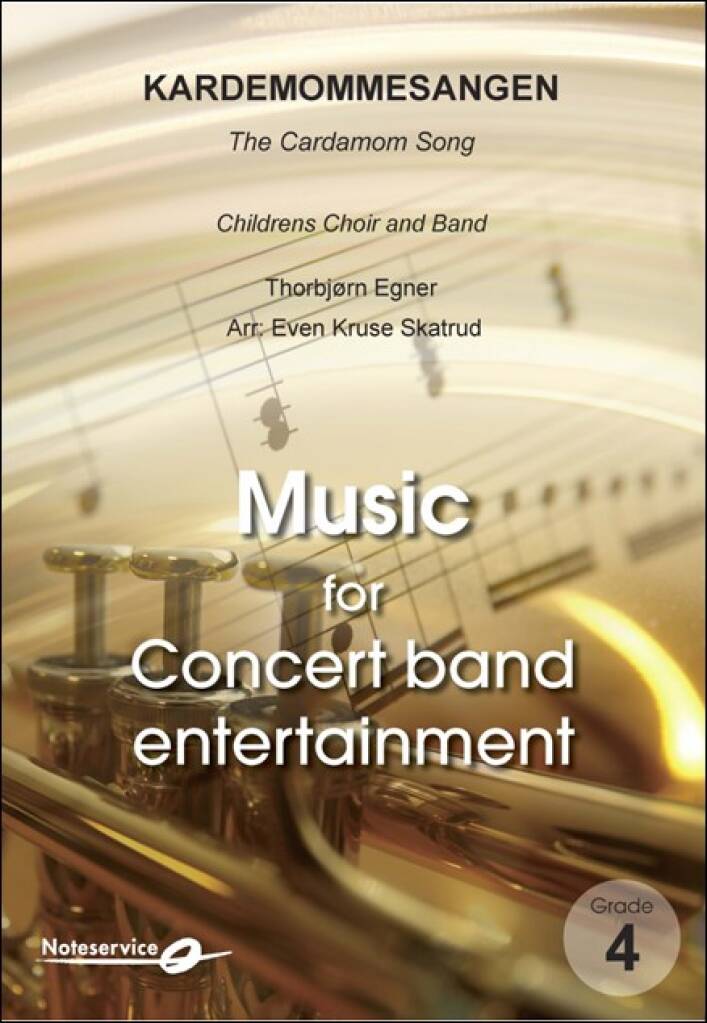
The Cardamom Song - Thorbjørn Egner
"The Cardamom song" is a very popular children's song in the Nordic countries. It's taken from the music and book "Folk og rvere i Kardemomme by" written by Thorbjrn Egner.This arrangement written in a latin style features a childrens choirwith concert band.The arrangement was written for the recording "Muntre musikanter Karius og Baktus mter dyrene I Afrika" by Forsvarets Musikkorps Nord-Norge.
Estimated dispatch 7-14 working days
-
 £209.99
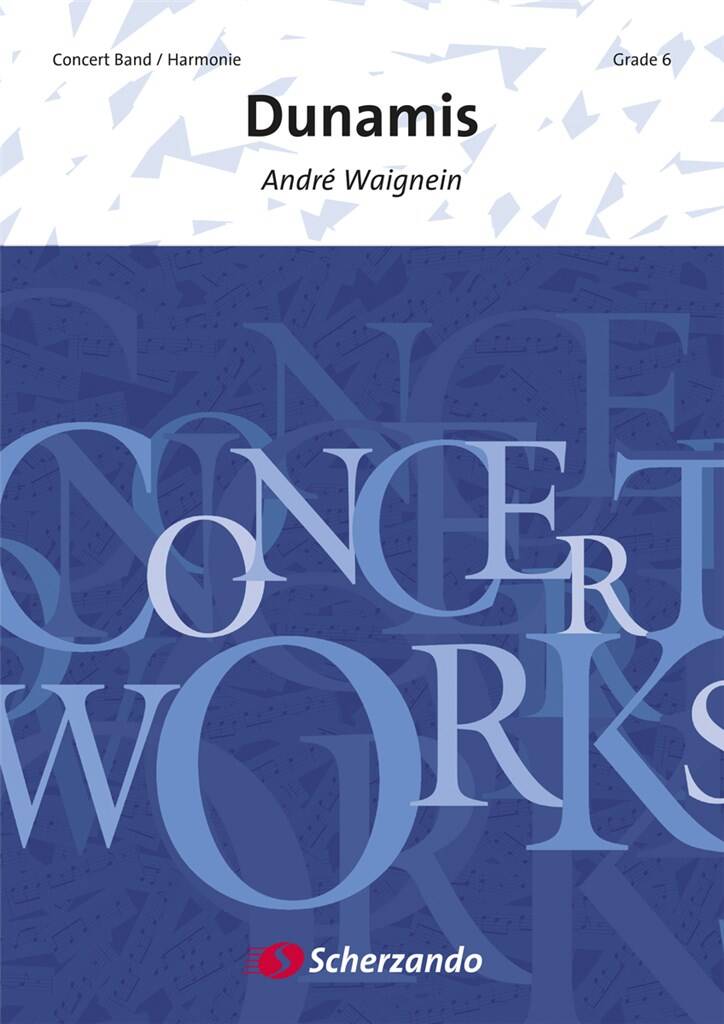
Dunamis - André Waignein
Major Yvon Ducene wanted a new lush and colourful composition for his Guides military band, with Andr Waignein as its composer. Early in 1979 the composer began his assignement and in October of the same year, the finished full score was on the music stands of this prestigious military band of the Belgian Army.The introduction (Grave) mirrors an atmosphere full of serenity in which the theme, played by the oboes and the English horn is predominant and immediately holds the listener spell-bound. It is taken up again as central element of the slow movement.The Allegro breaks away from the quiet passion of the introduction. Here, the band can really show its capabilities to thefull. Based on a very precise rythm, an idiom of sudden desperation and adversity develops which, fused with a crushing agression, culminates in a kind of eruption, soom calmed down by a Lento : peace and quiet has returned thanks to a melody by the horns and soon taken over by the clarinets. In the meantime, the saxophone - an instrument full of human emotion - express the main spatial dimension in contemporary psyche. Following a harmonic transition the brass-players take up the theme again in forte whilst the basses and the woodwinds interwine in technical arabesques.The movings of the mind and the heart get an audible and almost touchable shape in the ensuing Allegro, a movement characterized by a rhythmic dialogue in which the whole orchestra participates and where the exposition contains a wealth of sound and technical contrasts. The Lento finally uses the central theme of the slow movement again, with some occasional references to the two allegros. The last page is of unprecedented grandeur. All the instruments display their most beautiful sound which were named by Jacques Ferschotte, when speaking about Honneger, "harmonies d'intensits" harmonies of the unmeasurable.
Estimated dispatch 7-14 working days
 View Music