
Results
-
 £159.60
Indiana Jones Selection - John Williams
This selection made a choice from the thrilling and expressive sound tracks John Williams wrote for thethree movie pictures dealing with the adventures of the archeologist Doctor Jones (Harrison Ford). It startswith the popular 'Raiders' March' which runs as a thread throughout the whole selection. The listener isimmediately brought to the subterranean vaults from the film 'The Temple of Doom'. In 'Slave Children'sCrusade' we hear the children toiling in the mines of Pangkot-Palace. The 'Short Round's Theme' (ShortRound is the name of the boywho saves Indiana Jones several times) is followed by the quieter 'Love Theme'from the first film 'Raiders of the Lost Ark'.The choral and the cor anglais (alto saxophone) solo at the endwere borrowed fromthe third film 'Indiana Jones and the last Crusade'.
Estimated dispatch 7-14 working days
-
 £90.30
Turkey Talk - Bernhard Bogisch
This musical whimsy is based on the well known folk tune Turkey in the Straw. After the introduction we meet our friend as we all know him from the folk tune.At Moderato we catch the turkey in a melancholy mood, as he thinks back to the good old days, spent as a youngster at Old McDonald's Farm, which is next door to the Daisy Hill Puppy Farm. But that's another story. Sadness overcomes him at Adagio. The mood passes and next we see him happily dancing a jig. Fate makes an appearance in the shape of the human hand; there is a short chase, and our turkey cries for the last time.After a brief period of mourning, we find that our friend has gone the way of many other turkeys, and has ended up on the Christmas table. A short Coda concludes the piece. Linguistic footnote: The Turkish word for turkey translates as 'Indian bird'.
Estimated dispatch 7-14 working days
-
 £83.80
Derrick - Les Humphries
The German police television series in which actor Horst Tappart plays the role of 'Inspector Derrick' is still extremely popular in numerous European countries, even after 23 years. There have 280 episodes and the last one was broadcast by the German Television Channel ZDF on 16 October 1998. Manfred Schneider skilfully arranged the main musical theme of this series, composed by Les Humphries, by alternating rhythmical rock passages with more lyrical waltz passages.
Estimated dispatch 7-14 working days
-
 £159.60
Cartoon
The Flemish composer and arranger Marcel Peeters has certainly influenced the wind band repertoire of the last decade. With his usual talent he arranged some fine cartoon melodies into a relaxing medley. You don't even have to know or recognise the cartoons but you still know you are listening to cartoon soundtracks. The orchestration is really suggesting and varied. This music turns you into a youngster again.
Estimated dispatch 7-14 working days
-
 £140.80
Decennium - Eric Swiggers
'Decennium' was composed in 2003 as a commission by the municipality of Berheze for its tenth anniversary. The composition describes the history of this town in the Province of Brabant, consisting of 6 different villages: Heesch, Heeswijk, Dinther, Nistelrode, Loosbroek and Vorstenbosch. The composition starts with a slow introduction, Adagio Misterioso, suggesting the atmosphere in long-ago days when the area consisted mainly of swamps, meres and low woods. (The word 'Bern' is a synonym of 'Born' meaning source or water, whereas 'Hese' is derived from 'Haisjo' meaning brushwood ). Above the dark sounds we hear far away trumpet signals announcing the Middle Ages. After a piercing crescendo, we hear the full sound of festive trumpets. A medieval dance, as was to be heard in the Heeswijk castle, follows. This dance gets a more and more stirring character and finally turns into a merry popular dance ending with a burst of laughter reproduced by descending scales with the muted trombones and trumpets. A slow transition with a quotation from a Gregorian plainsong (Domine Deus) and church bell ringing, referring to the Abbey of Berne, brings us to a romantic Larghetto. This part describes the quiet rural life in a beautiful natural surrounding. The last dying note contrasts with the threatening ostinato, referring to the rise of the industrialization, which provoked quite some resistance with the local people. Once more we hear the 'Domine Deus' but much more powerful this time. When the resistance calms down, the work concludes with an Alla Marcia. The first notes of the main theme could be heard all through the composition and now we hear the complete main theme again. The new town is born. A festive conclusion refers both to the tenth anniversary and the optimism and confidence as to the future.
Estimated dispatch 7-14 working days
-
 £286.40
Piano Concerto Opus 16 A Minor - Edvard Grieg
Composed in 1868. One year later Franz Liszt received this beautiful composition to play through, and suggested some changes which Grieg initially wrote in, and then partly removed because people found it too warlike. Nowdays it's one of the most well loved piano concertos. The last part is the most interesting. Harsh accordian and characteristic Norwegian rhythms.
Estimated dispatch 7-14 working days
-
 £90.30
Demasiado Corazon - Willy DeVille
This is the first great hit (and the last as well) of Mink De Ville. This group was lead by singer and lyricist Willy De Ville. He started a solo career about 1990 with the guitar player of the group Dire Straits. Demasiado Corazon is a Spanish Fandango published in 1983. A large part of this arrangement is reserved for various soloists. You will find several proposals to bring these solos at the back page of this score.
Estimated dispatch 7-14 working days
-
 £175.30
Tetis - Luís Cardoso
Tethys was the sister (and wife!) of the Oceanus, and the last of the Titaness, the goddess of the waters according to Greek mythology. This goddess was the inspiration for this work for symphonic band, which is derived from a three note melodic fragment, heard in the opening 2 bars.
Estimated dispatch 7-14 working days
-
 £94.80
A Short Story in Blue - Ennio Salvere
A Short Story in Blue opens with an easy 'medium swing' which is followed by a more melancholy blues. The last part of the work is in a happy 5/4 beat and then closes with a reprise of the introduction. In addition to the regular orchestra, piano, bass and drums have been added.There are also so called 'Side Skills' included in the score and parts, which can be used as Warm Ups for learning the composition.
Estimated dispatch 7-14 working days
-
 £156.30
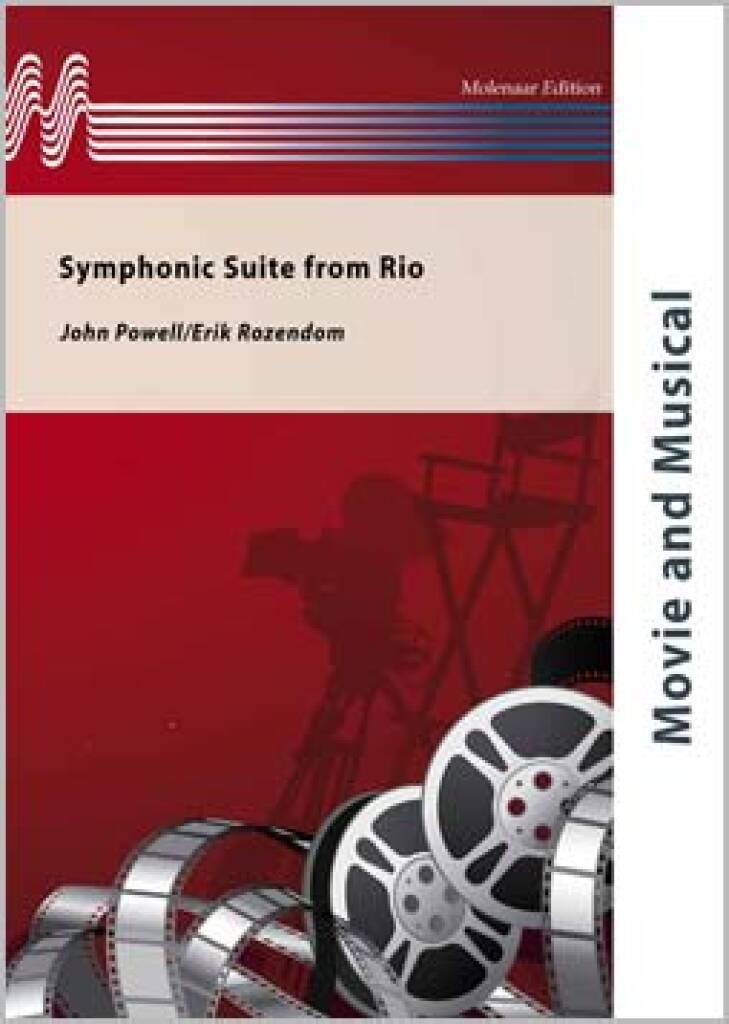
Symphonic Suite from Rio - John Powell
Blu is a tame Macaw parrot who never learned to fly. He enjoys a comfortable life and thinks he is the last of his kind, but in exotic Rio, lives Jewel, who is a female of his kind. Together with his owner Linda, he travels to the other side of the world in order to meet Jewel. In Rio, Blu goes on the adventure of a lifetime. The wonderful soundtrack from John Powell, who is also known for Ice Age, and How to Train Your Dragon, is a wonderful mix of not only latin, rumba and samba styles, but also big classic film music.
Estimated dispatch 7-14 working days
 View Music