
Results
-
 £205.70
In Nomine (Concert Band - Score and Parts) - Schwarz, Otto M.
How often has something been justified by, declared to be, or blessed as 'in the name of' some cause or other? How can it be that opposing armies and the use of weapons are ever 'in the name of...'? This is a common thread in the history of different faiths. Good was created but evil was committed and all 'in the name of...' This thread is also found in the history of the Premonstratensian Abbey at Wadgassen. The abbey was built in the 12th century on unfertile, desolate moorland, which later evolved into the most powerful religious community in the Saarland. The history of the abbey records quite astounding achievements under the motto desertum florebit quasi lilium ('the desert will bloom like a lily'); but also the harsh treatment of delinquents. The order had its own school, in which children were taught the seven liberal arts (which included music as well as geography and astronomy), but the poor were left to starve outside the abbey walls and were only allowed to eat from the members' leftovers on feast days. The medieval witch trials demanded their pound of flesh, and one group that fell victim were ecstatic dancers who moved wildly to music, which was interpreted as the devil's work. The result: a show trial that sentenced the dancers to death by fire. All in the name of... The year is 1789: Abbot Bordier is in the tenth year of his command. He does not yet know that he is to be the last abbot of an almost 700-year tradition. Not far from the abbey is the French border, which has long been making itself felt with the sound of gunfire, and the brothers continue to keep a nervous eye on it. The first portents of the French Revolution loom, but no one wants to believe it, that is, until the French pound the door down, storm the abbey and come right into the brothers' chambers. In a blind fury, all the pipes of the abbey organ are torn out, icons beheaded with swords and brothers beaten death while numerous buildings are set on fire. The abbey church is in flames. A frantic and desperate escape begins. Abbot Bordier and a handful of brothers make their getaway via the River Saar, adjacent to the abbey, to the neighbouring village of Bous. They survive, but their life, the Premonstratensian abbey, is destroyed. While they flee towards Prague and the sanctuary of the Strahov Monastery, the abbey at Wadgassen is razed to the ground and becomes a stone quarry. The desert blooms once more, however. A few short decades later, a glasswork arises from the foundations of the abbey. As peace returns to the region, it brings jobs and a new vision for its people.Duration: 11.15
Estimated dispatch 7-14 working days
-
 £100.80
Leonardo (Concert Band - Score and Parts) - Schwarz, Otto M.
Leonardo da Vinci (1452-1519) was a painter, sculptor, inventor, philosopher and researcher. He is renowned as the original 'Renaissance Man'. 'I will preserve the memory of myself in the minds of others' was one of his maxims. Among his most famous works of art are the Mona Lisa, The Last Supper and the Vitruvian Man. He left an extensive collection of handwritten documents in his notebooks. These books, known as codices, survive in various volumes such as the Codex Atlanticus, Codex Madrid, Codex Trivulzianus etc.). They include sketches of ground-breaking inventions as well as studies and commentaries which span the gamut of human study. The left-handed da Vinci wrote the texts in mirror writing. Through wars and other upheavals, the documents were scattered throughout Europe and much of his work disappeared. Leonardo da Vinci wanted to leave a kind of encyclopaedia for posterity and, although it is estimated that up to 80% of his manuscripts were lost, some 6,000 individual documents survive to this day, the contents of which in many cases were only understood centuries later.Duration: 6.00
Estimated dispatch 7-14 working days
-
 £100.80
Nostradamus (Concert Band - Score and Parts) - Schwarz, Otto M.
Nostradamus was one of humankind's greatest prophets. Many of his coded prophecies proved true. He lived at the time of the inquisition, and his predictions and medical therapies as a physician made him face consequences from the church. After he had been forced to flee several times and had lost his family to the plague, he devoted himself to clairvoyance. He wrote down many events in history in coded predictions. Although there is probably more than one possible way of interpretation, in our world, Nostradamus is still considered to be a unique personality. Whether he is degraded to a charlatan or turned into a myth, he surely has moved humankind with his prophecies. Otto M. Schwarz, soundtrack composer since 2001, wrote a cinematographic work about this man, who is probably the best-known prophet of the last 1000 years.
Estimated dispatch 7-14 working days
-
 £85.00
Under Spanstind (Concert Band - Score and Parts) - Torskangerpoll, Idar
Suite in Three MovementsThis piece of music is a commissioned work for Lavangen School band and their band music convention in 2019. The piece was performed under the mountain Spanstind (located far north in Norway) by a band consisting of approx 400 amateur musicians. The mountain Spanstind is 1457 meters high and drops into the valley Spansdalen below, an especially scenic venue.The composition is inspired by the sami joik (folk song) Ru?gu?ohkka, the song to Spanstinden. It is also inspired by the nature of the surroundings. Mvt 1 "Ro" (calmless) describes the feeling of calmness in the midnight sun. Mvt. 2 "Uro" (unrest) describes a scene of wind, snow, avalance and the big forces of nature. Mvt 3 "Storhet" (greatness) describes the feeling of greatness the nature has, and how we experience it as majestic and exalted.The piece can be played with the movements alone, or one can add the signals played by soloist(s) off-stage or in the back of the hall. The signals are to be played before, in between, and after the 3 movements. All instruments can be soloists. The soloist performs the signals rhythmically aleatoric, where each soloist repeats the signal 4 times in his or her own tempo. Signal 1 is played before Mvt 1, signal 2 is played between Mvt 1 and 2, signal 3 is played between Mvt 2 and 3, and signal 4 is played while the band holds the last note (long, use stagger breathing). after a while, all the soloists end on the same note and the music fade out.Duration: 6.30
Estimated dispatch 7-14 working days
-
 £85.00
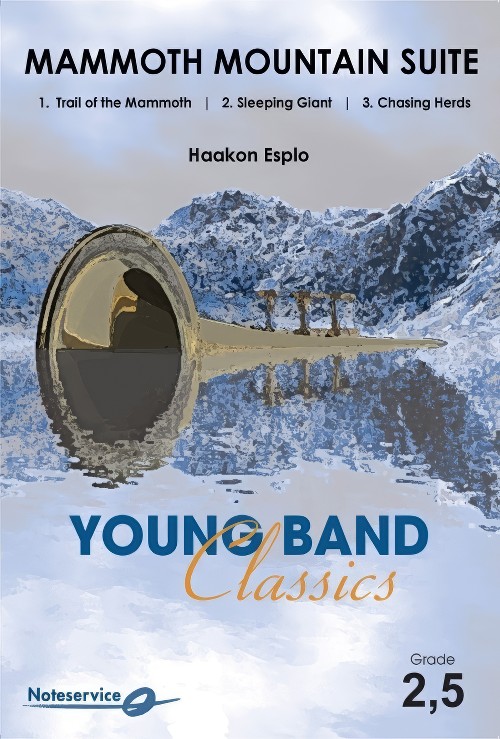
Mammoth Mountain Suite (Concert Band - Score and Parts) - Esplo, Haakon
Suite in Three Movements. Mammoths were a family of elephants that, with one exception, died out at the end of the last ice age. Their closest living relative is the Asian elephant. In many places in the world one can find mammoth remains. In Norway (especially in Gudbrandsdalen), 20 discoveries of teeth and skeletal remains have been made after mammoths that lived here between 40,000 and 50,000 years ago. On cave paintings and carvings you can see many pictures of mammoths with other animals. Pictures of killed mammoths have also been found with humans. Mammoth Moutain Suite describes a bunch of hunters looking for mammoths. Imagine the majestic animals, what it felt like to see the herd in the mountains and what it sounded like when the 6 ton heavy and 3.5 meter tall mammoths were on the run. Duration: 7.30
Estimated dispatch 7-14 working days
-
 £91.00
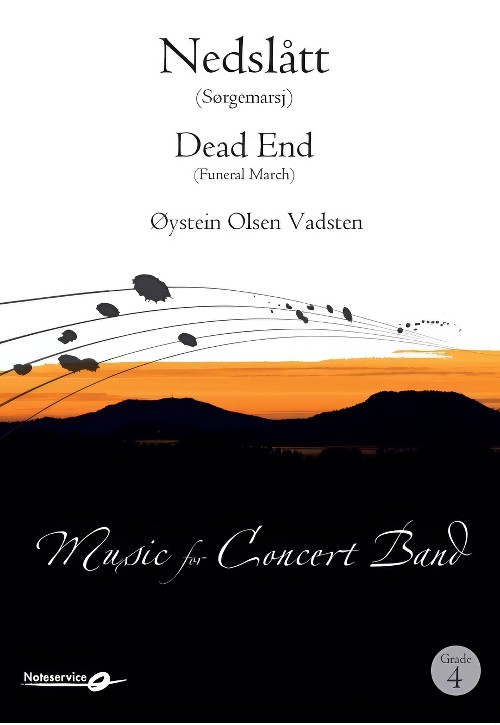
Nedslatt, Sorgemarsj (Dead End, Funeral March) (Concert Band - Score and Parts) - Olsen Vadsten, Oystein
An addition to the composer's series of folk music inspired pieces, has the slightly condescending title "Dead End". The piece is a funeral march and so also written for an occasion, where this style of music was a natural inspiration. It is built on a drum ostinato, which is followed by a melody in Norwegian folk music style. The repetitions in the melody line and rhythm, create a hypnotic effect, leaving us in a special state of mind, alternating between deep sorrow, bottomless despair and grateful gratitude. The piece has proven to be effective, both as a concert opener and as the last piece in a concert. Duration: 6.10
Estimated dispatch 7-14 working days
-
 £159.99
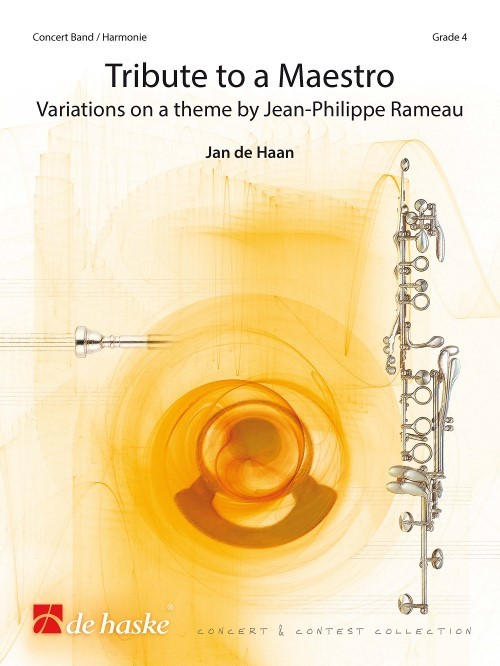
Tribute to a Maestro (Concert Band - Score and Parts) - De Haan, Jan
Tribute to a Maestro is an homage to Jean-Philippe Rameau (1683-1764), one of the most important French Baroque composers. Rameau was a hugely significant composer, organist, harpsichordist and music teacher: he also published several authoritative books on music theory. Jan de Haan based this tribute on a theme from Les Sauvages (The Savages), the fourth act of Rameau's ballet-opera, Les Indes Galantes (The Amorous Indies). The work begins with two variations, whereupon the striking theme can be heard. After a short intermezzo, four more variations follow, of which the last one is composed in Baroque style.Duration: 12.00
Estimated dispatch 7-14 working days
-
 £75.00
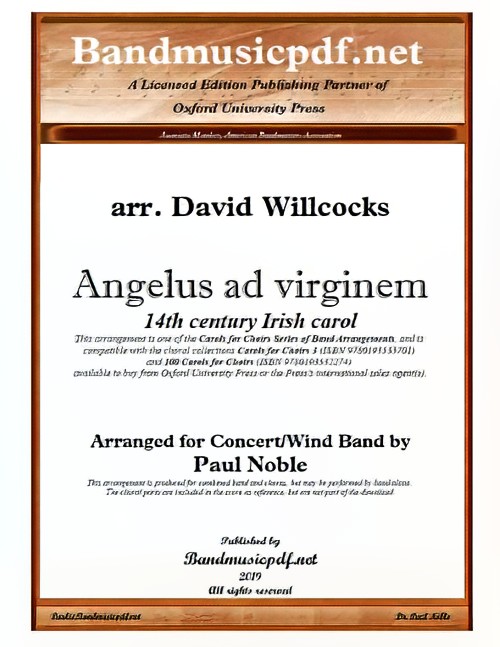
Angelus ad Virginem (Concert Band with Optional Choir - Score and Parts) - Noble & Willcocks
Angelus ad Virginem (or its English title, Gabriel, From Heven King Was To The Maide Sende) was a popular medieval carol,whose text is a poetic version of the Hail Mary and the Annunciation to the Virgin Mary. Probably Franciscan in origin, it was brought to Britain by French friars in the 13th century. It is said to have originally consisted of 27 stanzas, with each following stanza beginning with the consecutive letter of the alphabet. Surviving manuscripts may be found in a c. 1361 Dublin Troper (a music book for use at Mass) and a 13th or 14th century vellum Sequentiale that may have been connected with the Church of Addle, Yorkshire. Its lyrics also appear in the works of John Audelay (perhaps a priest, he definitely spent the last years of his life at Haughmond Abbey, where he wrote for the monks), in a group of four Marian poems.
Estimated dispatch 7-14 working days
-
 £109.99
Austrian Fantasy (Concert Band - Score and Parts) - Oswald, Gerald
Modern Austria has been shaped by various historic events over the last 100 years. In his piece Austrian Fantasy, composer Gerald Oswald works various motifs of the three different Austrian national anthems of this period into the music. The anthems serve as a testament to the political culture of Austria, which has left its mark on the nation. A piece of Austrian history is shaped into this work.Duration: 6:00
Estimated dispatch 7-14 working days
-
 £200.00
A Sousa Celebration (Concert Band - Score and Parts) - Sousa, John Philip - Noble, Paul
A Sousa Celebration is the arranger's collection of excerpts from several of Sousa's interesting marches, creating a patriotic presentation of greater length than the typical march. This selection includes a variety of content, offering a showpiece to several sections of the band: Hail to the Spirit of Liberty, composed for the Paris Exposition of 1900, for the unveiling of the Lafayette Monument on July 4; Yorktown Centennial (1881), written to commemorate the hundredth anniversary of the last important battle of the Revolutionary War: the surrender at Yorktown; Mother Hubbard March (1885), based on nursery rhymes; "Three Blind Mice," "Thus the Farmer Sows His Seed," "Old Mother Hubbard," "Hey Diddle Diddle," "Little Redbird in the Tree," "London Bridge is Falling Down," "Scotland the Brave," and "The Minstrel Boy." The celebration concludes with excerpts from Sousa's most celebrated march, The Stars and Stripes Forever.
Estimated dispatch 7-14 working days
 View Music