
Results
-
 £122.50
Golden Winds - Philip Sparke
This contrasting work builds up twice from quiet relaxation or meditative calm to a climax for the entire ensemble, before the main section, a rhythmic vivo, begins. Golden Winds ensures truly precious moments in your concert right up to the last note!
Estimated dispatch 7-14 working days
-
 £102.99
Surfin' FM - The Beach Boys
In 1961, the three Beach Boys brothers, Brian, Dennis and Carl, went straight to the top of the charts with their first single called "Surfin'". By 1966, the Beach Boys were even more popular that The Beatles thanks to the single "Good Vibrations". Juri Briat has made an excellent medley of the songs "Surfin USA", "I Get Around", "Barbara-Ann" and last but not least "Good Vibrations".
Estimated dispatch 7-14 working days
-
 £109.99
Showtime ! - Sven Van Calster
In this piece, which consists of four contrasting sections in which doubling of parts make it suitable for a wide range of bands. The first part is a kind of musical appetizer which has a heavy disco beat while the second part is a romantic ballad. The third part is inspired by an Irish dance and the last part is a variation of the first part with a spectacular ending. This work makes an ideal challenge for dynamic and young bands.
Estimated dispatch 7-14 working days
-
£102.99
Adios Havana - Willy Fransen
Cuba is one of the word's few remaining communist countries and has a turbulent history behind it, in no small part due to the charismatic Fidel Castro, who has steered a more Western course in the last few years. Willy Fransen wrote a musical travel piece about the real Havana with illustrations from the local scene, enjoying a daiquiri while a live band plays in the Buena Vista Social Club.
Estimated dispatch 7-14 working days
-
£141.99
Nausicaa Requiem - Joe Hisaishi
From Anime master Hayao Miyazaki's career take-off point,Nausica of the Valley of the Wind(1984) captures the last scene of Nausica coming back alive after being flown away by swarms of Ohmu. It's directly arranged from the film sound track but has been adapted for band as needed. The medium grade level allows many groups to enjoy this arrangement.
Estimated dispatch 7-14 working days
-
£264.99
Diferencias on an Old Spanish Song - Yasuhide Ito
I am immensely happy that my Gloriosa, symphonic poem for band (1990), has been performed by so many bands in the last thirty years.During this period, the growth of the internet has made it much easier to access information.When I composed Gloriosa, I only had limited information about the period when Christianity and Western music was first introduced to Japan, and had to rely a lot on my imagination.However, nowadays, it is easy to obtain various source materials and to read interesting studies on the music of the past.In recent years, the music of Luis de Narvez (born ca.1500 - died between 1555-1560), Spanish composer and vihuela player, has become increasingly known, and several CDs of his music are now available.Narvez composed the earliest-known set of diferencias, a forerunner of the variation form. One of his works is Seys diferencias sobre el himno "O gloriosa domina" [Six diferencias on the hymn "O gloriosa domina"] (1538), based on the Spanish Marian hymn, and it was this melody I used in the first movement of my Gloriosa.Western music has been my musical roots since childhood, and throughout my career as a composer, it has continued to fascinate me. One could say that this has provided the inspiration for Diferencias on an Old Spanish Song, my own take on the diferencias form.Actually, such music from the early sixteenth century could sound fresh to our modern ears. So I decided to quote the melody from Narvez's Sey diferencias at the beginning and end of the piece, in order that people can get the feel for the period.The main section (bars 42-390) is formed of 13 diferencias, similar to the first movement of the Gloriosa.In the middle section, which begins after the eighth diferencia(from bar 187), one should be totally absorbed in the tranquility and the beauty of the music. Although it's in the style of a sarabande, it should be taken slower and played as pianissimo as possible.This is followed by folk-style dance music. (As only standard percussion instruments are used, try to be creative with tonal colours and sense of rhythm).The structure of the work is simple, but be aware of the connection between the sections when constructing the whole.Also, think about the tonality. Overall, the work is in F minor. The main section is basically in D minor, but from bar 102, it modulates to A flat minor and G minor, and then in the middle section it suddenly switches to A flat major (which is the furthest key from D minor, and the relative major of F minor). From bar 219, it modulates to F minor and then to C minor, then back to F minor by way of A minor.N.B. The Oboe II part can be substituted by the English Horn (as indicated in the parts). One can choose according to the player's skills or preference.Recent new compositions for wind band are often full of rhythm, dynamism, and tonal colour, and compositional techniques and orchestration have also evolved greatly. Yet on the other hand, they tend to feature fewer melodic or expressive elements. Since this work is the test piece for WMC Kerkrade 2022, I had to think about what "tests" or "challenges" to set, and I decided to compose something that doesn't involve a lot of technical display, but requires beautiful sounds and harmonies, and above all, musical expressivity. I didn't put many expression markings in the score, because I wanted the performers to think about how best to express this music. If it is played merely as notated, it's not going to sound very interesting.Christianity was introduced to Japan in the mid-16th century, but it was subsequently banned and Japan entered a period of national isolation, which meant that there was hardly any international exchange for two hundred years. As a result, the Christian hymns that were introduced prior to the isolation became almost unrecognizable over the centuries. This was the theme I explored in my Gloriosa thirty years ago.Now, in 2021, the whole world has been forced to "isolate" due to the Covid-19 pandemic. In such times, it seems pertinent that I've written a work using this melody again. I sincerely hope that people will be able to gather in Kerkrade in 2022.(English Translation:Nahoko Gotoh)
Estimated dispatch 7-14 working days
-
 £209.99
Machu Picchu - Satoshi Yagisawa
Commissioned for the Ensemble Liberte Wind Orchestra, Kawaguchi City, 30th Anniversary ConcertExplaining the significance of Machu Picchu begins with remembering the Incan empire at its zenith, and its tragic encounter with the Spanish conquistadors. The great 16th century empire that unified most of Andean South America had as its capital the golden city of Cuzco. Irresistible to Francisco Pizarro, while stripping the city of massive quantities of gold, in 1533 he also destroyed Cuzco's Sun Temple, shrine of the founding deity of the Incan civilization.While that act symbolized the end of the great empire, 378 years later an archeologist from Yale University, Hiram Bingham, rediscovered "Machu Picchu", a glorious mountaintop Incan city that had escaped the attention of the invaders. At the central high point of the city stands its most important shrine, the Intihuatana, or "hitching post of the sun", a column of stone rising from a block of granite the size of a grand piano, where a priest would "tie the sun to the stone" at winter solstice to insure its seasonal return. Finding the last remaining Sun Temple of a great city inspired the belief that perhaps the royal lineage stole away to this holy place during Pizarro's conquest.After considering these remarkable ideas I wished to musically describe that magnificent citadel and trace some of the mysteries sealed in Machu Picchu's past. Three principal ideas dominate the piece: 1) the shimmering golden city of Cuzco set in the dramatic scenery of the Andes, 2) the destructiveness of violent invasion, and 3) the re-emergence of Incan glory as the City in the Sky again reached for the sun.(Satoshi Yagisawa)
Estimated dispatch 7-14 working days
-
£104.99
Nocturne - Pyotr Ilyich Tchaikovsky
Tchaikovsky is best known for his purely instrumental compositions. However, we must not underestimate him as a composer of operas. Many of his operas such as Pique Dame and Eugene Onegin are still performed regularly throughout the world. Eugene Onegin (also called Jevgeny Onegin), composed in 1877-1878, was not called an opera by Tchaikovsky himself, but "lyric scenes". The work is entirely dominated by lyricism. However, there are two moments that contrast sharply with this lyricism: two ball scenes, for which Tchaikovsky wrote a waltz and a polonaise.After opening with a less well-known allegro dansant, this arrangement features the aforementioned waltz, which can beconsidered a beautiful Russian equivalent of the Faust Waltz by Charles Gounod. In the opera, this waltz is actually played by a military band. The arrangement concludes with the pompous polonaise (also mentioned above) which opens the last act: the ideal music to characterize high aristocracy in the salon of a palace in St. Petersburg.
Estimated dispatch 7-14 working days
-
£139.99
Cobra - Jan Bosveld
Shortly after the Second World War, a combative movement of Danish, Belgian and Dutch artists chose the cobra snake - extremely dangerous yet considered sacred - as a symbol of their resistance to strict guideliness of form. The name "Cobra" also happens to contain the first letters of the cities Copenhagen, Brussels ans Amsterdam, from where most of the movement's members came. The Cobra movement, which existed from November 1948 until November 1951, can with some justicication be called the last major avant-garde movement of the 20th century.The source of inspiration for the composition Cobra comes from four paintings: "Obhobning" by the Dane Egill Jacobsen; "La jeune fille et lamort" by the Belgian Pierre Alechinsky; "Orgeldraaier" and "Le rythme joyeux de la ville" by the Dutch artists Karel Appel and Corneille. Obhobning means "pile-up", which is represented musically in the first part by a melodic and harmonic pilling up of perfect fourth's. The first part is also characterized by a rhythmic feeling, which the painting gives through its use of numerous black stripes. In the painting La jeune fille et la mort, Pierre Alechinsky places a young girl opposite Death. The second part features the constantly pulsating motion of live while a creeping, dark, melodic line develops. The tension between life and death is tangible as a battle reveals itself. In part three, one hears the Orgeldraaier by Karel Appel, as cheerful and playful as an organ grinder's music. The painting Le rythme joyeux de la ville by Corneille is busy and extremely dynamic, a perfect source of inspiration for a powerful, rhythmic ending to this composition.
Estimated dispatch 7-14 working days
-
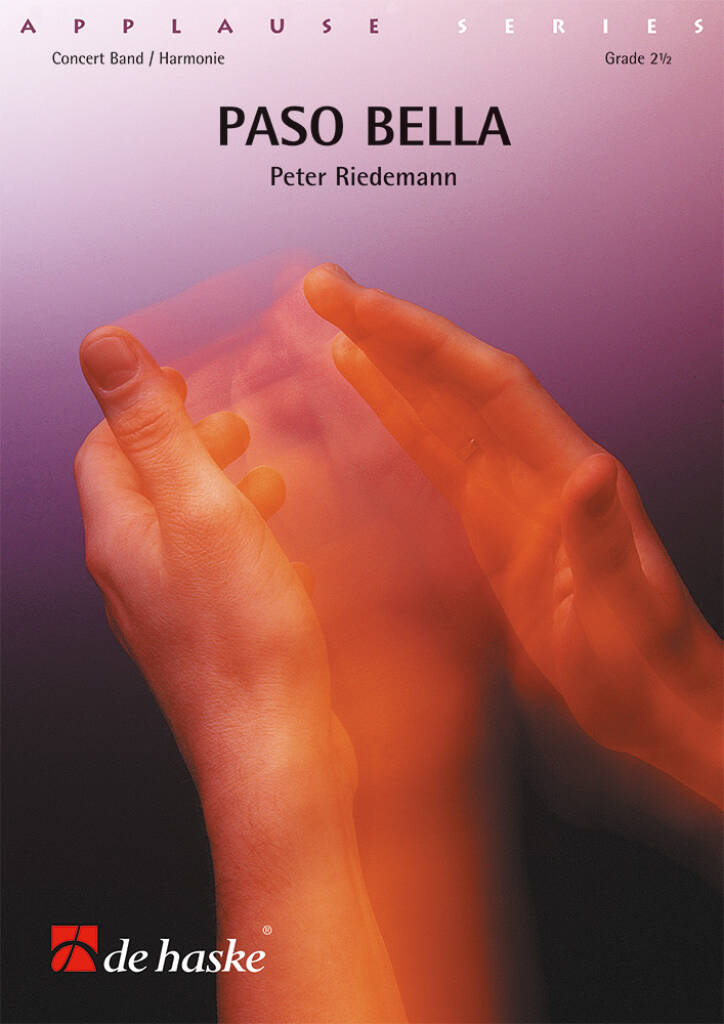 £84.99
Paso Bella - Peter Riedemann
Paso Bella is full of the typical fiery and melodic characteristics of the paso doble. The hot Spanish temperament can be heard from the opening themes in the minor key, as is usual in a paso doble, to the last bars of the trio. The trio is followed by an exuberant closing which will reverberate in the ears of both musicians and audience for a long time.
Estimated dispatch 7-14 working days
 View Music