
Results
-
 £74.00
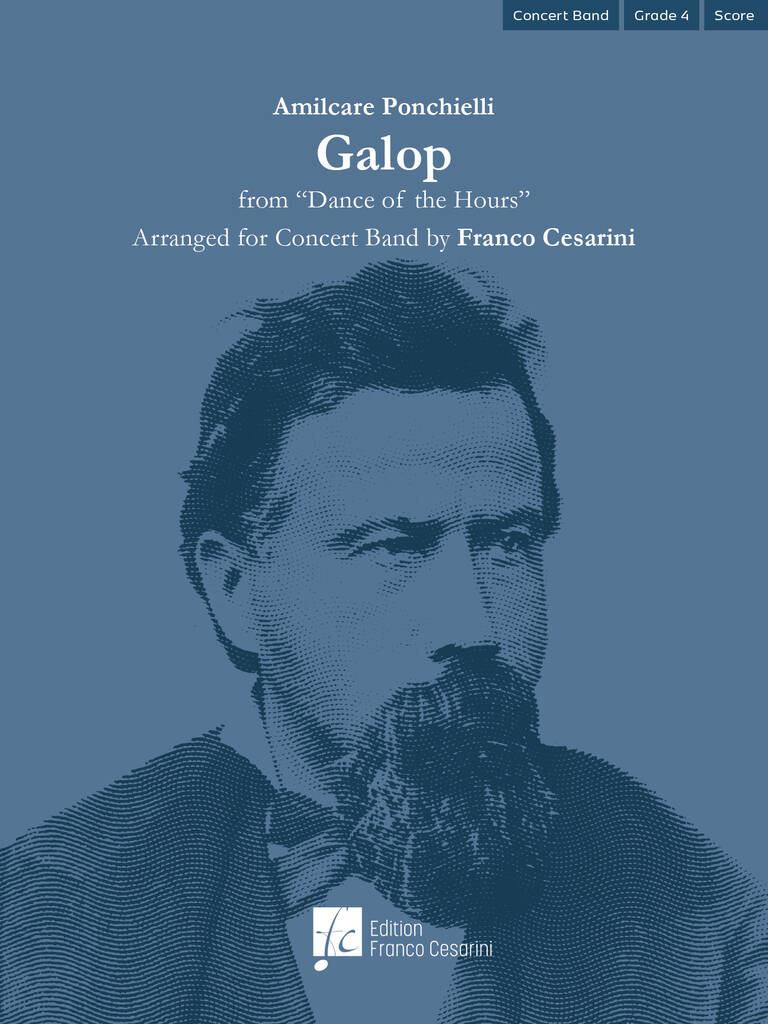
Galop - Amilcare Ponchielli
La Gioconda, with a libretto by Arrigo Boito, is the most successful theatrical work by Amilcare Ponchielli (1844-1886). In this work there are two dance pieces: the Furlana at the conclusion of the 1st act and the Danza delle ore in the 3rd act. The Dance of the Hours has a precise choreographic outline: it is a masked ball which includes the "hours" of dawn, day, evening and night successively, and ends with a wild finale of galop. The latter is a sort of fast polka, in binary rhythm and unbridled pace. A French variant of it is the can-can. The finale in galop time of the Dance of the Hours recalls certain playful dances by the composer Jacques Offenbach, such as the famous Can-can that concludes the overture of the operetta Orphe au enfers.
Estimated dispatch 7-14 working days
-
 £87.40
Radio Ga Ga - Rodger Taylor
Radio Ga Ga is a song by the British rock band Queen, released on the album The Works in 1984. Written by Roger Taylor and inspired by some words from the author's youngest son, it is a song about the golden age of radio and nostalgia for what once was considered a family member. The song peaked at number two in the English hit parade.
Estimated dispatch 7-14 working days
-
 £60.99
The Banks of Green Willow - George Butterworth
Written by British composer George Butterworth in 1913, this classic work is based on two folk songs - The Banks of Green Willow and Green Bushes (the latter also appearing in works by Grainger and Vaughan Williams). Butterworthdied in World War I at the age of 31, and this composition remains his most popular, regarded as an anthem for Unknown Soldiers. Here is a masterful setting for winds adapted by Robert Longfield. Dur: 3:50
Estimated dispatch 7-14 working days
-
 £94.99
Children's Oak - Thierry Deleruyelle
Children's Oak was commissioned by the wind band from Beauquesne, France. This solemn work pays homage to a city particularly affected by the two World Wars and is inspired by the knowledge that the city of Beauquesne needed to recover from these terrible episodes in its history. The title has its origin in the roots of the word "Beauquesne", the beautiful oak tree. It is a beautiful slow piece for your concert, or as a resource to work on phrasing and intonation, or alternatively as a warm up piece.
Estimated dispatch 7-14 working days
-
 £149.40
The Battle of the Hats - Øystein Sjøvaag Heimdal
The word svimesltt, which is the title of this piece in Norwegian, has two meanings. One meaning is "knocked out", whilst the other, "sltt", means a folk melody/dance.Svimesltt is one of several folk dances, all of them with humorous titles, originally written by ystein Olsen Vadsten. Norwegian culture is the basis for these dances, both rhythmically and melodically. The accompaniment has brought this funpiece into the 21st Century.When it comes to Svimesltt, it is the traditional dance "halling" that is the inspiration. Halling is a rather wild dance, where the man tries to win the heart of a lady by attempting to kick a hat off a stick,held up in the air. This iswhere "The Battle of the Hats" gets its distinctive name A truly Norwegian tradition.The composer wanted to write a "crazy" melody, which highlights how "knocked out" a man can be by love, as he tries to win the chosen ones heart.
Estimated dispatch 7-14 working days
-
 £76.99
Drums of the Saamis - Samuel R. Hazo
Drums of the Saamis was commissioned by the Medicine Hat Concert Band Society of Medicine Hat, Alberta, Canada. The piece chronicles the merger of the First Nation (first natives) and modern Albertan cultures.The opening tribal drums followed by the haunting melody simulating the traditional wooden flute comprise two themes that are the foundation for the entire piece. Both elements are developed, varied and enhanced throughout as the listener senses the increasing influence of modern day Alberta through the use of modern sounding chords and rhythms.By the end, the marriage of the old and the new is complete. This powerful work closesas it began; a restatement of themes representing the musical and historical foundation of the region. Dur: 5:00
Estimated dispatch 7-14 working days
-
£84.99
Euphoria - Wim Laseroms
Euphoria is a bracing composition which concentrates its energy on the baritones/euphoniums. The solo parts require at least two soloists. This piece opens with a syncopated introduction followed by a statement of the simple melodic theme interpreted by the baritones/euphoniums. The style of performance is particularly affected by the alternation of staccato and legato passages. The finale of this work develops through a progression of accelerandos and crescendos leading to an amazing conclusion.
Estimated dispatch 7-14 working days
-
 £109.99
Boreas - Jan Bosveld
In Greek mythology, Boreas is the God of the North Wind. When thinking of the north wind we particularly think of the bleak wind coming from the freezing cold north, but in Homers' work we see a more varied picture. As shown in the following two stories, Boreas often does play the role of a storm wind that blows forth heavy dark clouds while whipping up the dark waves of the tempestuous sea to mountainous heights. When the stake of the fallen Patroclos refuses to burn, Achilles begs for some wind. When Iris, the swift messenger of the Gods, asks the winds for assistance, they raise themselves up with tremendous roaring and rush to Troy. Upon theirarrival they blow the divine fire of Patroclos' stake far up into the sky. When Troy was destroyed, the Greeks returned home. After many wanderings, Odysseus, however, ends up with the beautiful nymph, Calypso, who keeps him as a prisoner. As ordered by Zeus, Calypso frees him and sends him off on a handmade wooden raft. At sea, Odysseus is threatened by the aggressive sea god, Poseidon, who stirs up the winds and thrashes the waves with his trident. The goddess, Athena, stems the violence of all the winds except for the north wind, and thus it is Boreas, who sends Odysseus to the land of the hospitable Phaiakes. Jan Bosveld composed Boreas for OLTO, a music association in Loenen, The Netherlands, for which he had served as conductor for many years. Turbulent movement in both tempo and dynamics characterize this composition. The result is a whirling piece that races by in a positive manner. Boreas is in de Griekse mythologie de god van de noordenwind. Bij noordenwind denken wij vooral aan de gure wind uit het ijskoude noorden, bij Homerus echter zien we een meer gevarierd beeld. Natuurlijk speelt Boreas, zoals uit de twee onderstaande verhalen blijkt, meestal de rol van de stormwind die de zware zwarte wolken voor zich uit blaast en de donkere golven van de onstuimige zee torenhoog opzwiept.
Estimated dispatch 7-14 working days
-
 £286.40
Fifth Symphony - Alfred Reed
This work was commissioned by the Senzoku Gakuen College of Music in Tokyo in celebration of its 70th anniversary in 1994. However, in view of the invitation by WASBE (World Association of Symphonic Bands and Ensembles) for its Wind Orchestra to perform at the 7th annual convention of this association, to be held in Hamamatsu, Japan, in the summer of 1995, it was decided to premiere the music at that time instead of the anniversary year itself. The symphony is in three movements, with an introduction marked 'Moderately and sustained' leading to the first movement proper, a driving 'Allegro assai' whose main thematic material is first heard in the timpani and mallet percussion. The second movement, from which the symphony drives its sub-title, is an extended treatment of one of the oldest and most beloved Japanese folk songs 'Sakura' ('Cherry Blossoms'), a long-breathed elegiac melody taken as the basis for a free variation development through all the individual sections of the orchestra. The third movement is a brilliant rondo form (Allegro Molto, con fuoco) in which some elements of the preceding two movements are incorporated to bring the entire work to a breath-taking conclusion in a final burst of virtuoso performance from every instrument in the ensemble. The 'Fifth Symphony (Sakura)' was first performed on July 26th 1995, by the Senzoku Gakuen Symphonic Wind Orchestra under the direction of the composer, at the 7th WASBE Conference in Hamamatsu, Japan.
Estimated dispatch 7-14 working days
-
 £116.40
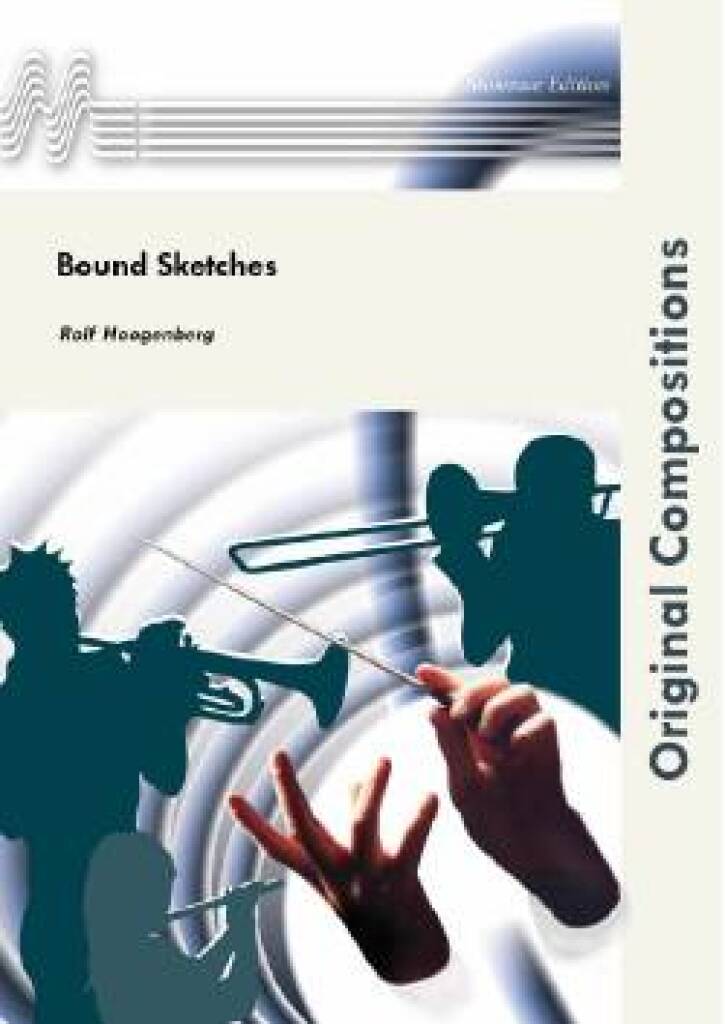
Bound Sketches - Rolf Hoogenberg
I Prelude (start)II Landscape ( measure 17)III Crowded and Urbanization (measure 68)In case of lack of time or potential technical problems, it is possible to skip the third part. One can make a straight jump from measure 65 to measure 109.In 'Bound Sketches' the composer links two musical sketches Waterland by means of the theme of the prelude.Rolf Hoogenberg was born at Middenmeer (Province of Northern Holland) in The Netherlands in 1984. At nine he started studying the trombone with Wim de Vreugd at the Waterland music school. Since September 2001 he has been studying trombone and wind band conducting at the Amsterdam Conservatory of Music.For the 1998/1999 Musical Olympics he composed a work for Fanfare band, called 'Townscape' about Purmerend, the small town where he lives. With this composition he did not only win those Musical Olympics, but was also warded the NIB (Dutch Wind Music Institute) Prize for the best wind band composition of that season. The composer Johan de Meij handed him the prize during the ABCO concert on 12 December 1999.'Bound Sketches' was commissioned by the Waterland Music Festival for its 50th anniversary. By means of this commission, the festival foundation hopes to stimulate wind band music in the Waterland area.
Estimated dispatch 7-14 working days
 View Music