
Results
-
 £82.50
Detonation - Gary D. Ziek
This intense and volatile piece lights the fuse with a one-bar introduction that leads to and ignites the impact of the full band. A unifying four-note motif makes several expanded appearances. A brief period of calm is underpinned by a series of pulsating ostinati which maintain a constant state of agitation. In the explosive conclusion, the percussion section provides the last word with one final detonation.
Estimated dispatch 7-14 working days
-
 £179.99
Austrian Overture - Thomas Doss
Austria is an industrious country. During the last century--which was characterized by extreme changes--the hard-working and ambitious people achieved a great deal, enduring two world wars and numerous political skirmishes. Despite all the problems involved in a change from a dual monarchy to a small state, Austria has found its independence. With his Austrian Overture, Thomas Doss looks toward the future. The first part of the composition provides an optimistic outlook; along with the happiness and energy, some musical humor is also present: while the horns powerfully express joy, small yodeling melodies sound throughout. As the rhythm continues insearch of new ways to go, catchy tunes compete to be heard. However, in addition to the energetic, diligent Austria, there's also the quiet landscape where one can enjoy repose and beauty. These aspects - as well as the freedom of spirit and cultural life -are conveyed in the second part of the work through the surprising linking of chords, romantic phrasing, and tender melodies. But life never stands still: creativity, ambition, and work are the driving forces of our existence. Embracing this thought, a reprise of the first part provides a compelling ending.
Estimated dispatch 7-14 working days
-
 £159.99
Solemnitas - Franco Cesarini
Each year on the last Monday in June, the German city of Burgdorf celebrates the holiday of youth, the so called 'Solennitat'. It is the most important event occurring in the city and consists of three processions walking through the centre of town to celebrate, at the city's expense, the good results achieved in school. This new work by Franco Cesarini takes it's inspiration from this event and leads us through contrasting variations of a Swiss folk tune.
Estimated dispatch 7-14 working days
-
 £89.99
Prima la Musica - Thomas Doss
This work describes the development of a local village band as it grows in both size and ability to become a symphonic wind band. It is dedicated to all orchestras that follow the same, sometimes hard, road. No matter what, the focus should always be the music, providing us with the energy and motivation we need along the way! With this in mind the march Prima la Musica reflects a spirit of change and optimism from the first to the last note.
Estimated dispatch 7-14 working days
-
 £144.99
Ante Lucem - Thomas Doss
This meditative work describes the final minutes before the night slips away and officially turns to day, the last few moments before a new dawn. The composition is based on the old Austrian folk tune Auf dem Berg bin i gern which has been used as the main theme in a wonderfully atmospheric way. Calm yet effective!
Estimated dispatch 7-14 working days
-
 £134.99
Dublin Pictures - Marc Jeanbourquin
Ireland is a multi-faceted country that has developed a popular and distinctive musical culture. The first movement of Dublin Pictures reflects Irish festivals where there is dancing and traditional beer flowing. More tranquil in its feel, the second movement illustrates the landscape that can be seen from the Ha'penny Bridge, a bridge that crosses the River Liffey in Dublin. This movement highlights the wide range of the orchestra's sound colours as the musicians' voices combine with the wind and percussion to accompany the soloist. The lively and joyful rhythms of the last movement take the listener to Temple Bar, the famous tourist quarter of the city, well knownfor its vibrant nightlife. The music's energy and virtuosic motifs are in contrast to the previous movement and provide a spirited and festive finale.Marc Jeanbourquin wrote this piece in three movements for Azimuts Brass in 2011. He then arranged it for Concert, Fanfare or Brass Band
Estimated dispatch 7-14 working days
-
 £195.00
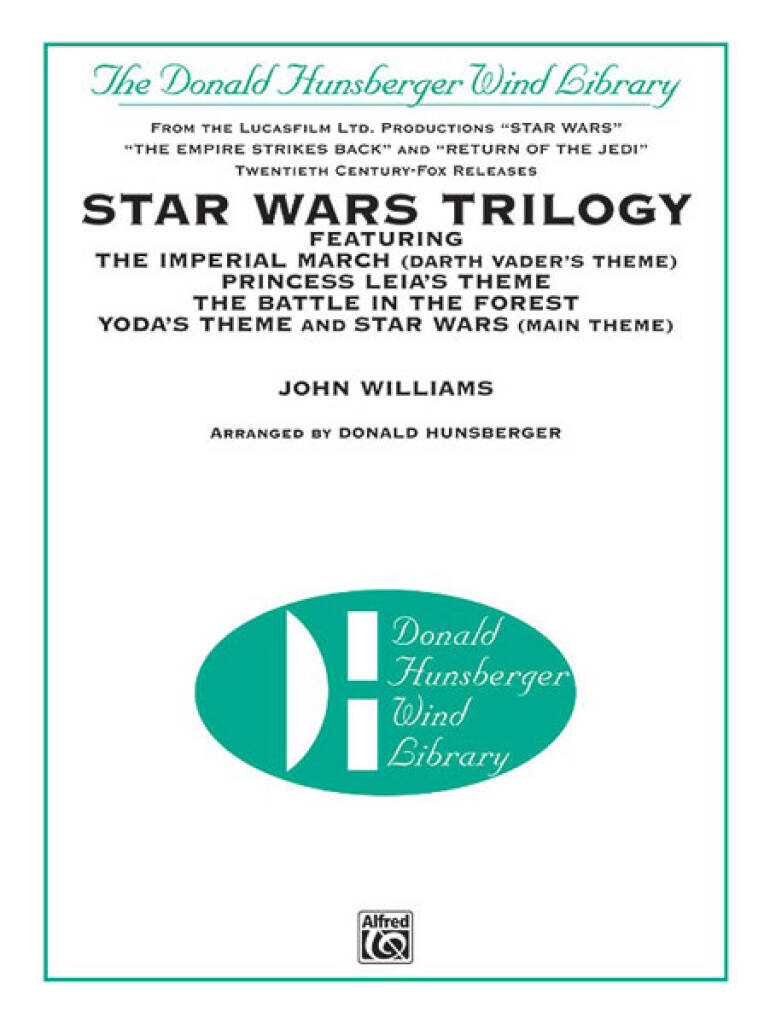
Star Wars Trilogy - John Williams
John Williams has rightfully earned a place in the hearts of all film lovers with his numerous brilliant scores to some of the best movies of the last half century. Capable of writing music ranging from tender, intimate moods to galactic battles,Williams carefully constructs each score as a separate, freestanding entity, not just background snippets. The selections in this exciting collection include "The Imperial March (Darth Vader Theme)," "Princess Leias Theme," "The Battle in theForest," "Yodas Theme," and "Star Wars (Main Theme)."
Estimated dispatch 7-14 working days
-
 £74.99
Ch'ella mi creda - Giacomo Puccini
Ch'ella mi creda libero e lontano is the last aria that tenor-role Dick Johnson (the bandit Ramerrez) sings before his death sentence is carried out. Puccini's opera La Fanciulla del West is set in America's Wild West. The impressionistic-inspired opera separates this opera from most of Puccini's other works. Johan de Meij's arrangement uses the solo trombone in the role of the bandit Ramerrez.
Estimated dispatch 7-14 working days
-
 £152.99
To A New Dawn - Philip Sparke
To A New Dawn was commissioned by the United States Continental Army Band - Captain Timothy J. Holtan, Commander and Conductor.The brief was for a piece to celebrate the 3rd Millennium and it was the composer's aim to provide a work which, as well as looking forward to the challenges of the new century, also contained moments of reflection about the last one.After a bright introduction featuring the trumpets a perky theme, passing quickly through several keys, appears on the woodwinds. A solo trumpet takes up a new theme over bubbling quavers (eighth notes) and this leads to a rhythmic figure on low clarinets, followed by the upper woodwinds. A brass interlude follows and, after ashort bridge passage, an oboe takes up a contrasting legato tune that builds to a climax.An andante section follows with solos for horn and flugel horn (or trumpet) and a florid flute cadenza. A passionate climax leads back to the faster music and, eventually, to a full recapitulation, revisiting the earlier material before a lively coda close the work as it began.
Estimated dispatch 7-14 working days
-
 £69.99
Infinity and Beyond... - Philip Sparke
The last decades of the 20th century saw man's first steps in space exploration. Since the first moon landing by Neil Armstrong in 1969, these adventures in outer space have captured the public's imagination and have given birth to scores of science fiction movies, books and TV series that have tackled the subject. Infinity and Beyond... takes as its inspiration the wonderful film scores of composers such as John Williams and Jerry Goldsmith, who have almost invented a style which could be called 'space music'.Opening with a rhythmic bass figure, Infinity and Beyond... begins with a robust introduction in 3/4, which leads to the main theme in 4/4, played by the full band. Ashort bridge passage, utilising the interval of a fourth, leads to a modal central section, featuring first the trumpets and then played by the whole band; this in turn leads back to a repeat of the introduction until the main theme returns to bring the piece to a close.
Estimated dispatch 7-14 working days
 View Music